Industry Day Events: How to Make the Most of Them
Learn how to prepare for government industry day events, ask the right questions, and convert attendance into contract wins. Covers FAR rules, ethics, and strategy.

Tiatun T.
Federal Sales Consultant · Mar 15, 2026
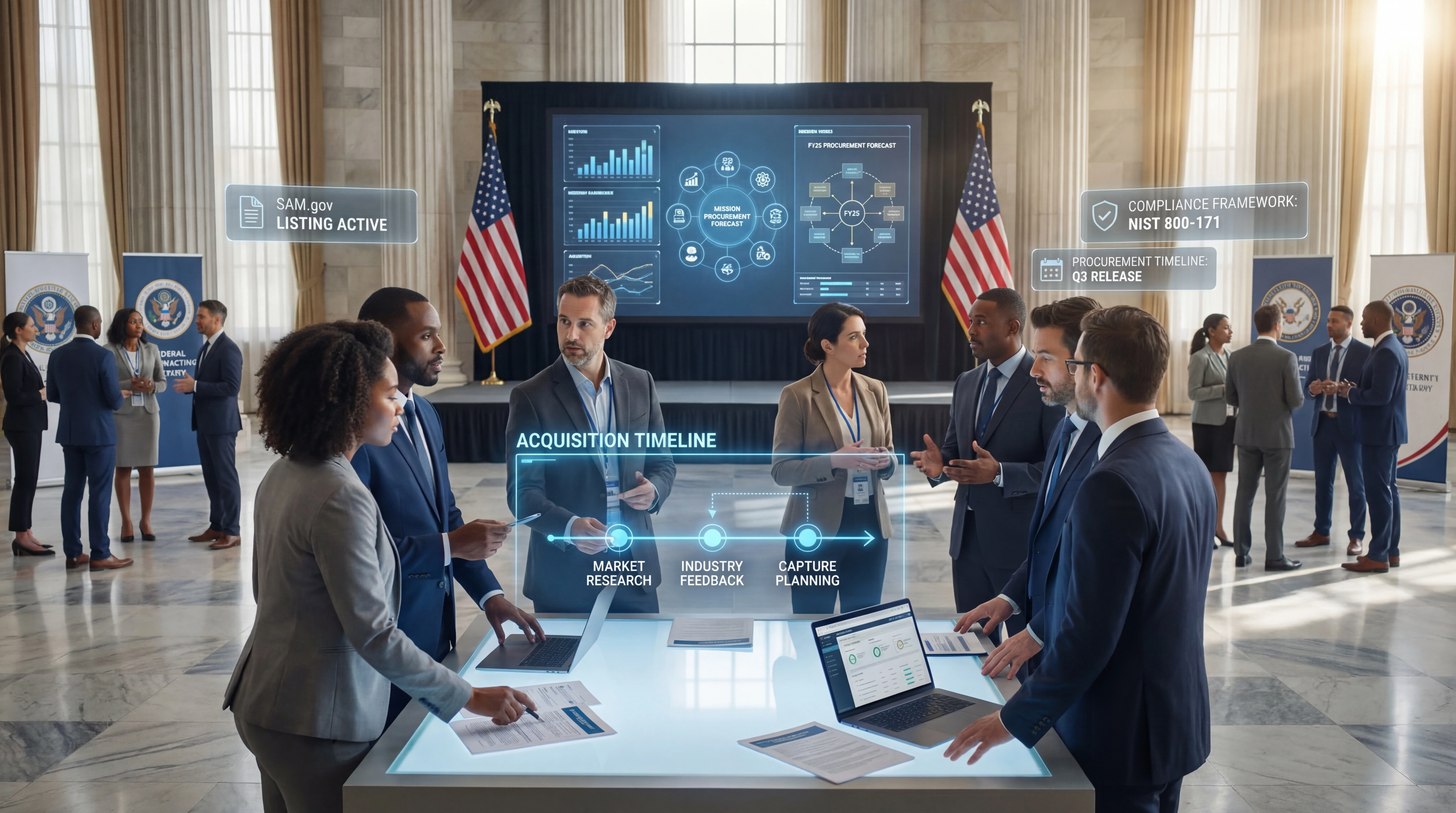
This article explains what a government industry day is, how the Federal Acquisition Regulation (FAR) authorizes these events, and — most importantly — how to turn attendance into a genuine competitive advantage. By the end, you will know how to prepare before the event, what to do and say in the room, where the ethical and legal guardrails are, and how to convert what you learn into a stronger capture plan. Whether you have never attended an industry day or you have been to dozens, the framework here will sharpen your approach and help you understand how to win government contracts by engaging earlier and smarter than your competitors.
What This Article Covers — and Why It Matters
By the end of this guide, you will understand:
- What a government industry day is and the FAR rules that authorize it
- Why agencies hold industry days — and why you should care
- How to prepare like a capture manager before the event
- What to do and what to avoid in the room — including Procurement Integrity Act and gift rules
- How to convert attendance into pipeline with follow-up, capture updates, and teaming
- Common mistakes — and how to avoid them
What Is a Government Industry Day?
An industry day is a formal, pre-solicitation event hosted by a federal agency to brief vendors on an upcoming procurement and to collect market feedback before proposals are due. Think of it as a two-way conversation: the agency describes the mission problem it needs solved, and vendors respond with questions, technical insights, and capability information that helps the agency refine its acquisition strategy. The FAR explicitly encourages these exchanges. FAR 15.201 (Exchanges with Industry) [1] lists industry conferences, pre-proposal conferences, Requests for Information (RFIs), and one-on-one meetings as permissible activities — provided the agency handles them fairly and does not give any single vendor a competitive edge.
You may also hear the terms pre-solicitation conference, pre-proposal conference, or reverse industry day. They differ in timing and format. A pre-solicitation conference happens before the formal Request for Proposal (RFP) is issued; a pre-proposal conference happens after the solicitation drops but before proposals are due. A reverse industry day flips the microphone — vendors present their capabilities to the agency, rather than the agency presenting requirements to vendors. All three are authorized under FAR 15.201 and serve the same core purpose: reducing risk for both sides before contract award.
Agencies typically announce industry days on SAM.gov (the System for Award Management, which serves as the Governmentwide Point of Entry, or GPE) as a “Special Notice” under FAR 5.205 [2]. That notice usually includes the date, location, draft documents such as a Statement of Objectives (SOO) or draft Performance Work Statement (PWS), and instructions for registering, submitting questions, or requesting one-on-one sessions. If you are not yet comfortable navigating SAM.gov’s opportunity search, our guide on how to search for contracts on SAM.gov walks through the process step by step.
Why Agencies Hold Industry Days — and Why You Should Care
Agencies do not hold industry days out of generosity. They hold them because the FAR requires market research before most acquisitions (FAR Part 10) [4], and talking to vendors is one of the most effective ways to do that research. Specifically, the agency is trying to answer questions like: Is this requirement achievable? What contract type makes sense? Are there enough qualified small businesses to justify a set-aside under the “Rule of Two” (FAR 19.502-2) [6] — meaning, are at least two responsible small businesses expected to submit offers at fair market prices? What risks has the agency not considered?
For you, the vendor, this is the moment when the agency is most open to influence — not in a corrupt sense, but in a legitimate, encouraged-by-regulation sense. The acquisition strategy is still being shaped. Evaluation factors are still being drafted. The agency genuinely wants to hear whether its draft PWS is realistic, whether the proposed period of performance is feasible, and whether the pricing structure aligns with how industry actually delivers the work. If you wait until the RFP drops to engage, you have already lost the chance to shape the competition in ways that highlight your strengths. Understanding this timing is fundamental to how to win government contracts consistently.
For acquisitions expected to exceed the synopsis threshold of $25,000 (FAR 5.201) [3], the agency must publicly announce the opportunity at the GPE, and industry days often accompany or precede that announcement. The table below summarizes key dollar thresholds that affect how the government buys and how visible opportunities are to the market:
| Threshold | Amount | What It Means for You |
|---|---|---|
| Micro-Purchase Threshold (MPT) | Generally $10,000 | Purchases below this are made with a government purchase card; no public posting required. Industry days are rare at this level. |
| Synopsis Threshold | Generally $25,000 | Above this, the agency must publicize at SAM.gov. Industry days typically accompany larger, more complex acquisitions well above this line. |
| Simplified Acquisition Threshold (SAT) | Generally $250,000 | Below the SAT, the agency uses simplified procedures. Above it, full FAR Part 15 (negotiated) or Part 14 (sealed bid) procedures apply. Industry days are most common for procurements above the SAT. |
| Subcontracting Plan Threshold | $750,000 ($1.5M for construction) | Other-than-small prime awardees must submit subcontracting plans above these amounts (FAR 19.702) [7]. Relevant for teaming discussions at industry days. |
All threshold amounts are per FAR 2.101 [5] and current as of the date of this article.
Before the Event: Prepare Like a Capture Manager
The single biggest mistake vendors make is treating an industry day like a networking happy hour. It is not. It is a capture management activity — an opportunity to collect intelligence that directly feeds your bid/no-bid decision and your proposal strategy. Here is how to prepare.
Map the opportunity to your business. Confirm the North American Industry Classification System (NAICS) code and Product Service Codes (PSCs) listed in the SAM.gov notice. If you are unsure which NAICS codes apply to your company, GovBidLab’s free NAICS Code Lookup tool can help you identify the right codes and their associated small-business size standards in seconds.
Research the predecessor contract. Almost every federal requirement has a history. Before the event, look up predecessor awards in the Federal Procurement Data System (FPDS) via SAM.gov’s data bank or USAspending.gov to understand the current contract value, period of performance, incumbent contractor, and contract type. This research lets you calibrate price realism and identify whether the incumbent has an advantage you will need to overcome. Our article on free government contract pricing research shows exactly how to pull this data, and our deep-dive on FPDS research covers advanced techniques using APIs and bulk data.
Draft three to five mission-relevant questions. These are not generic prompts like “Can you tell us more about the requirement?” They are specific, thoughtful questions that demonstrate you understand the agency’s mission and help you — and the agency — reduce risk. For example: “The draft SOO references cloud migration. Has the agency completed an Application Rationalization assessment, and will those results be available to offerors?” or “Is the funding profile expected to be stable across all option years, or should offerors plan for ramp-up/ramp-down?” Questions like these signal competence and give the agency useful data points for refining the solicitation.
Prepare a one-page capability statement. This is your leave-behind. It should include your company name, Unique Entity Identifier (UEI) — verify yours is current with GovBidLab’s free UEI Lookup tool — NAICS codes, PSCs, socioeconomic status (e.g., 8(a), Service-Disabled Veteran-Owned Small Business, HUBZone), relevant contract vehicles (such as GSA Schedule or a Best-in-Class GWAC), and two to three past-performance examples scoped to the requirement at hand. If you need to build or update a capability statement quickly, GovBidLab’s Capability Statement Generator walks you through each section and produces a professional, print-ready document.
For Department of Defense (DoD) industry days specifically, pay attention to any cybersecurity requirements mentioned in the draft documents. If the notice references Cybersecurity Maturity Model Certification (CMMC), use GovBidLab’s CMMC Calculator to estimate your readiness and the level you will need before award.
In the Room: What to Do, What to Avoid
When you arrive, you are operating inside a set of legal and ethical guardrails that apply to every vendor-government interaction. Understanding these rules is not optional — it is part of how to win government contracts without putting your company at risk.
The Procurement Integrity Act (PIA), codified at 41 U.S.C. §§ 2101–2107 and implemented through FAR 3.104 [8][9], prohibits obtaining or disclosing source-selection information (such as evaluation scores or rankings) or contractor bid/proposal information (such as a competitor’s pricing or technical approach). This means you should never ask a government official to share what another vendor proposed, what the government’s independent cost estimate is, or how the evaluation panel plans to score a specific factor. If a conversation starts drifting in that direction, politely redirect. Violations of the PIA can result in criminal penalties, contract cancellation, and debarment.
Ethics and gifts. Federal employees are bound by strict gift rules under 5 C.F.R. Part 2635 [10]. The general exception allows gifts of no more than $20 per occasion and $50 per calendar year from a single source. That means a branded pen is fine; a steak dinner is not. The “widely attended gathering” (WAG) exception (5 C.F.R. 2635.204(g)) can permit attendance at certain events, but it requires prior approval from the employee’s agency ethics office — that is their responsibility, not yours, but you should be aware of it. Keep your interactions focused on mission needs and capabilities, not hospitality.
One-on-one sessions. Many industry days offer scheduled one-on-one meetings with the Contracting Officer (CO), the program manager, or the Office of Small and Disadvantaged Business Utilization (OSDBU). Treat these as structured customer discovery — confirm the problem statement, ask about constraints (funding profile, place of performance, security clearance requirements, incumbent transition), and clarify any planned evaluation discriminators. Be direct, be concise, and assume that your questions — and sanitized versions of the agency’s answers — may be shared with all potential offerors. Under FAR 15.201(f), if a one-on-one session produces nonpublic information that would give a competitive advantage, the agency must neutralize that advantage by sharing the information broadly [1]. This is not a loophole to exploit; it is a fairness mechanism to respect.
For a broader discussion of building productive government relationships that extend well beyond industry days, see our guide on how to build relationships with government contracting officers.
Listen more than you talk. Capture every stated “intent” — preferred contract type, likely evaluation factors, anticipated set-aside strategy, timeline — but flag it in your notes as intent, not commitment. Nothing is binding until a warranted CO issues a solicitation or makes an award. Agencies change direction. Budgets shift. Capture plans must accommodate that uncertainty.
After the Event: Converting Attendance Into Pipeline
The value of an industry day is determined almost entirely by what you do in the 48 hours afterward. Here is how to convert attendance into measurable progress toward a win.
Submit written questions by the deadline. If the SAM.gov notice specifies a deadline for post-event questions, hit it. Agencies often compile all questions — from the event and from written submissions — into a single Q&A document posted to SAM.gov. Your questions shape the final solicitation. Missing the deadline means missing your chance to influence the RFP.
Follow up with key contacts. Within 24 to 48 hours, send a brief, professional email to the CO, the Small Business Specialist, or the OSDBU point of contact you spoke with. Reference your specific conversation, attach your capability statement, and propose a concrete next step — a 15-minute capability briefing, a technical interchange meeting, or simply an offer to provide additional information on a topic the agency flagged as a concern. Keep it short. Government officials are busy and wary of vendors who treat every interaction as a sales pitch. Our complete guide to government contractor networking events covers follow-up techniques in depth.
Update your capture plan. Every industry day should produce actionable intelligence. Document what you learned about the likely NAICS and PSC, anticipated contract type (firm-fixed-price, cost-plus, time-and-materials), probable small-business strategy, key technical and management risks, teaming gaps, and price-to-win parameters based on predecessor contract values. If you attended a large-scale event with multiple agencies, our roundup of top govcon conferences can help you plan which events to prioritize next.
Identify teaming partners. Industry days are one of the best places to meet potential teammates. If the acquisition is expected to exceed $750,000 (or $1.5 million for construction) and will be awarded to an other-than-small prime, FAR 19.702 [7] requires a subcontracting plan with goals for small-business participation. That means large primes attending the same industry day are actively looking for qualified small-business subcontractors. If you are a small business, your presence and a well-prepared capability statement make you findable. If you are a large business, industry day is the place to identify the small-business partners who will strengthen your subcontracting plan and, increasingly, your technical approach.
Track post-event postings. Agencies frequently promise to post slides, attendee lists, and consolidated Q&A documents to SAM.gov after the event. Set a reminder to check. Those documents often contain information that was shared verbally but not captured in your notes — and they are available to every potential offeror, including those who did not attend. Monitoring SAM.gov consistently after industry days is as important as attending the event itself.
Common Mistakes — and How to Avoid Them
Even experienced practitioners stumble at industry days. The most common mistake is showing up unprepared — no research on the predecessor, no drafted questions, no capability statement. You look like every other vendor who wandered in hoping to learn something. The second most common mistake is asking for information you should not have. Asking the CO for the government cost estimate or for details about a competitor’s incumbent performance crosses the Procurement Integrity Act line and damages your credibility permanently. Third, many vendors fail to follow up. The agency met 40 vendors that day. If you do not send a follow-up within 48 hours, you are forgotten by the time the solicitation drops.
A subtler mistake is treating the industry day as your only engagement. Smart capture management means you have already been tracking this requirement through market research, and the industry day is one data point in a longer campaign. If the first time you hear about a billion-dollar recompete is at the industry day, you are likely too late to win — but not too late to position for the next iteration or to join a competitive team.
Understanding these dynamics is central to how to win government contracts over time. The firms that win consistently are the ones that treat every industry day as a deliberate, measurable step in a multi-month (or multi-year) capture process, not a standalone event.
What to Do Next
Search SAM.gov for Special Notices in your NAICS codes and set up email alerts so you never miss an upcoming industry day. Before the next one you attend, use GovBidLab’s free tools to verify your UEI, confirm your NAICS codes, and build a capability statement tailored to the opportunity. Then follow the preparation, attendance, and follow-up framework in this article — and measure your results by whether each industry day moves a specific opportunity from “awareness” to “active capture” in your pipeline.
Glossary of Terms
| Term / Acronym | Definition |
|---|---|
| CO (Contracting Officer) | The government official with a warrant (legal authority) to enter into, administer, and terminate contracts on behalf of the United States. Only a CO can bind the government. |
| CMMC | Cybersecurity Maturity Model Certification — a DoD framework that requires defense contractors to meet specific cybersecurity standards before they can handle controlled unclassified information. |
| FAR | Federal Acquisition Regulation — the primary set of rules governing how federal agencies buy goods and services. |
| FPDS | Federal Procurement Data System — the government database that records information on all federal contract actions above the micro-purchase threshold. |
| GPE | Governmentwide Point of Entry — the single government-wide website (currently SAM.gov) where agencies must post public notices of proposed contract actions. |
| GWAC | Government-Wide Acquisition Contract — a pre-competed, multiple-award contract vehicle that any federal agency can use to buy IT products and services. |
| Industry Day | A formal pre-solicitation event where an agency briefs vendors on upcoming requirements and collects market feedback to inform its acquisition strategy. |
| MPT | Micro-Purchase Threshold — the dollar limit (generally $10,000) below which the government can buy goods and services using a purchase card without competitive bidding. |
| NAICS | North American Industry Classification System — a standardized numbering system that classifies businesses by industry type. The government uses NAICS codes to determine applicable small-business size standards. |
| OSDBU | Office of Small and Disadvantaged Business Utilization — an office within each major federal agency responsible for promoting opportunities for small and disadvantaged businesses. |
| PIA | Procurement Integrity Act — a federal law (41 U.S.C. §§ 2101–2107) that prohibits the unauthorized obtaining or disclosing of source-selection information or contractor bid/proposal information. |
| PSC | Product Service Code — a four-character code the government uses to categorize the type of product or service being purchased. |
| PWS | Performance Work Statement — a document that describes the required results or outcomes the contractor must achieve, rather than prescribing how to do the work. |
| RFI | Request for Information — a non-binding notice agencies use to gather information from industry about capabilities, market conditions, or technical approaches before issuing a solicitation. |
| RFP | Request for Proposal — a formal solicitation document that describes the government’s requirements and asks vendors to submit detailed proposals, including technical approach and pricing. |
| Rule of Two | The FAR requirement (19.502-2) that an acquisition be set aside for small businesses if the CO expects at least two responsible small businesses to submit offers at fair market prices. |
| SAM.gov | System for Award Management — the U.S. government’s official website for entity registration, contract opportunity searches, and federal award data. |
| SAT | Simplified Acquisition Threshold — the dollar limit (generally $250,000) below which agencies can use streamlined purchasing procedures. |
| SOO | Statement of Objectives — a high-level document that describes the agency’s desired outcomes without specifying how the work should be performed. |
| UEI | Unique Entity Identifier — a 12-character alphanumeric code assigned to every entity registered in SAM.gov. It replaced the DUNS number as the standard business identifier for federal contracting. |
| WAG | Widely Attended Gathering — an exception to federal gift rules that allows a government employee to accept free attendance at certain events, provided the employee’s agency ethics office grants prior approval. |
References
- FAR 15.201 — Exchanges with Industry Before Receipt of Proposals — acquisition.gov
- FAR 5.205 — Special Notices — acquisition.gov
- FAR 5.201 — Synopses of Proposed Contract Actions — acquisition.gov
- FAR Part 10 — Market Research — acquisition.gov
- FAR 2.101 — Definitions (including MPT and SAT) — acquisition.gov
- FAR 19.502-2 — Total Small Business Set-Asides — acquisition.gov
- FAR 19.702 — Statutory Requirements for Subcontracting Plans — acquisition.gov
- FAR 3.104 — Procurement Integrity — acquisition.gov
- Procurement Integrity Act, 41 U.S.C. §§ 2101–2107 — uscode.house.gov
- 5 C.F.R. Part 2635 — Standards of Ethical Conduct for Employees of the Executive Branch — ecfr.gov
- SAM.gov — Contract Opportunities — sam.gov
- USAspending.gov — Federal Spending Data — usaspending.gov
- SBA.gov — Small Business Contracting — sba.gov