Government Contract Pricing Research: The Free Trick That Can Save Your Bid (and Your Sanity)
Stop guessing your bid price. Learn how to use SAM.gov and FPDS to find what the government is paying right now — for free — so you can price with confidence.

Tiatun T.
Federal Sales Consultant · Feb 21, 2026
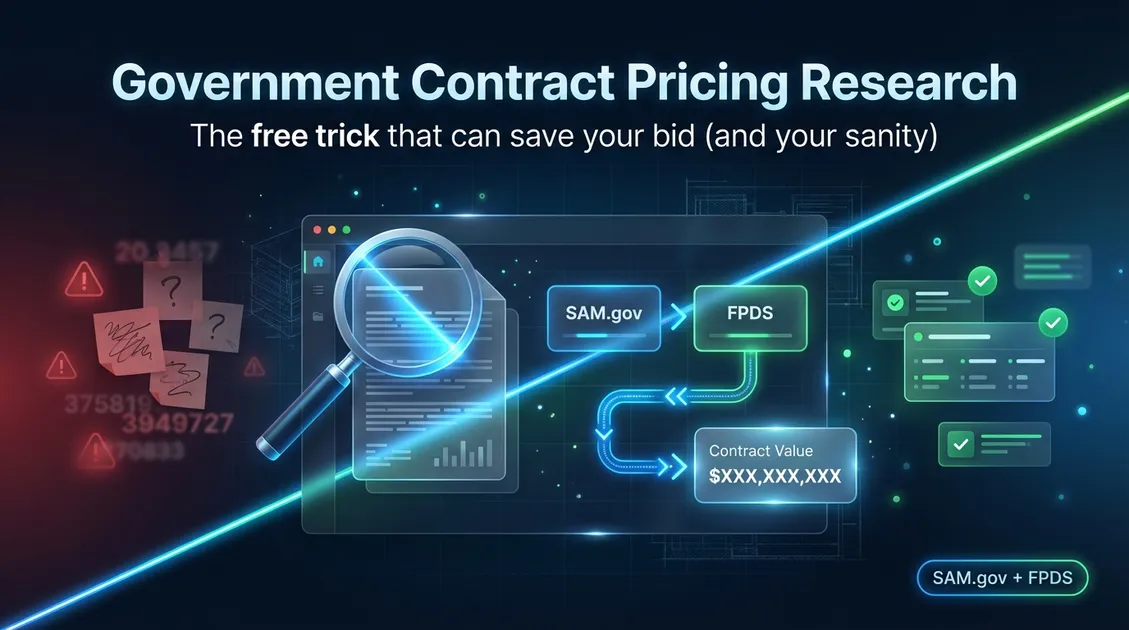
Government contract pricing research is the fastest way to stop guessing and start bidding like you actually want to win.
Ever stare at a solicitation and think…
"How am i supposed to price this without lighting money on fire?"
"What if i bid too high and lose?"
"What if i bid too low and spend the next year regretting my life choices?"
And the big one.
"Is this contract even worth what i think it's worth?"
That last question can wreck you.
Like, real wreck you.
Flights.
Proposal writers.
Weeks of work.
All for a contract that ends up being "a couple hundred thousand" when you had "millions" in your head.
That exact thing happened at a dinner i had with a business owner.
He was going all-in on a bid.
Traveling across the country.
Paying people to write.
Burning time like it was free.
And when he heard what the current contract was actually worth, his face did that slow collapse thing.
Like a cheap lawn chair.
So yeah.
Pricing isn't a detail.
Pricing is the bid.
And the good news is you can find what the government is paying right now. For free. With two public sites. No secret contacts. No "insider" stuff. Just a little detective work.
Why government contract pricing research matters so much
Pricing decides if you win.
And pricing decides if you survive after you win.
A "winning" bid that loses money is just a slow-motion problem. It looks fine on award day. Then it eats your cash for months.
Here's the part people miss.
You don't need to guess what the government might pay.
You can often see what they are paying right now.
And once you know the current number, you stop floating in space. You have a real anchor. You can still bid higher or lower. You just do it on purpose.
"Pricing is the most important part of your bid."
Hard to argue with that.
The simple truth: most work is already happening
Most government contracts get rebid every few years.
So the work you want is usually being done right now.
By someone.
Under a contract that's about to expire.
So the play is simple.
Find the new solicitation.
Then find the old contract that's doing the same work.
Then pull the dollar value.
That number won't solve everything. But it stops you from dreaming up fake revenue in your head.
And yes, people do that. All the time. It's like Zillow brain, but for contracts.
Step 1: Find a contract to bid on in SAM.gov
SAM.gov is where the government posts contract opportunities that are open for bid. So start there.
Now filters matter. Filters save you from scrolling until your eyes go dry.
Use the NAICS code filter (yes, it's worth it)
Go to the filter for Product or Service Information.
Find the box labeled NAICS code.
Example used here. Type 561320. That code is for administrative support services.
If you don't know your NAICS codes, use a NAICS lookup site and search by keyword.
Keep it simple.
One good code beats five random ones.
Use the set-aside filter so you don't get crushed
Use the filter called Set Aside. This lets you search contracts reserved for certain business types.
Example used here. Select Total Small Business Set Aside.
Translation.
Only small businesses can bid.
So you aren't trying to out-muscle huge companies with armies of proposal staff.
Now scan the results list on the right.
Pick one to inspect.
Example used here. USDA Forest Service Celery Lake Janitorial Services.
Click the title.
You'll land on the contract page.
You'll see a description.
And links to documents.
Download all documents provided.
Seriously.
Don't skip this and then act surprised later.
Find the Performance Work Statement (PWS)
The Performance Work Statement tells you what work gets done. And it often hints at contract length.
Example detail shown. It says the contract is for a base year and four option years. So it's a five-year setup.
That's a big clue. It usually means someone is doing this work right now. And the government is rebidding it as the current term ends.
Step 2: Find the current contract in FPDS
Now the fun part.
FPDS is a free government database of awarded contracts.
So once you have the solicitation name or keywords, you go hunting.
Example used here. Search for Celery Lake Janitorial Services.
You'll get a list of contracts.
Now sort for the most recent one.
On the right, find Sort Order.
Click Date Signed.
Then open the first contract listed.
Click View.
Now you'll see the details.
Example details shown in the walkthrough:
-
{[
"Contract start date: March 10, 2020",
"Contract completion date: September 30, 2024",
"Total contract value shown: $47,342"
].map((item, i) => (
- ✓ {item} ))}
You can scroll for more.
You can find the company name, address, and phone number.
You can see a description to confirm it matches the work.
You can even see how many bids they received.
That's a lot of useful stuff for a free site.
One caution. Numbers can be messy if you grab the wrong record. So always verify the description fits the job.
Step 3: Confirm the scope of work didn't change
This is the step people skip.
And then they wonder why their pricing feels "off."
The scope can change between rebids.
A lot.
Simple example given.
Maybe the current contract needs two people.
Then the new one needs ten.
That changes labor.
That changes supplies.
That changes supervision.
That changes everything.
So after you find the current contract value, go find the old solicitation that produced that price. Then read what they priced.
How to find the old solicitation in SAM.gov
Use the keyword search box.
Click Exact phrase.
Example keywords used. Search for "Celery Lake". And search for "janitor".
That gives results containing both terms.
Now change the status filter.
Scroll down the filter list to Status.
Switch from Active to Inactive.
You're looking for an old solicitation.
So active won't help you.
Example clue shown. A result where bids were due on February 13, 2020.
Open that listing.
Scroll down.
Download the solicitation document.
Now you can read the scope they bid when they priced it around that value.
And now you're not guessing.
You're comparing.
Old scope vs new scope.
Old price vs your target price.
That's how you build a price that makes sense. Not a price that "feels right."
What you can pull from FPDS besides price
Price is the headline. But FPDS gives extra nuggets that help you bid smarter.
Based on what shows up in the contract record, you may see:
-
{[
"The company currently doing the work",
"Their contact info (name, address, phone number shown in the example)",
"A description to confirm it's the right contract",
"The number of bids received"
].map((item, i) => (
- ✓ {item} ))}
And once you get used to FPDS, you can use it to spot patterns.
Who is buying.
What they buy.
How much they buy.
How often they buy.
That's the kind of info that gives you an edge without doing anything shady. It's public. You just have to look.
A quick workflow you can repeat every time
Here's the repeatable loop.
Print it.
Stick it on your wall.
Or tape it to your monitor like a gremlin.
-
{[
"Go to SAM.gov and find an opportunity.",
"Download the docs.",
"Read the PWS and note contract length clues (base + option years).",
"Go to FPDS and search the work keywords.",
"Sort by Date Signed to find the newest award.",
"Open the record and capture: value, dates, contractor info, description, bid count.",
"Go back to SAM.gov and search Inactive to find the old solicitation.",
"Compare old scope to new scope before you price."
].map((step, i) => (
- {i + 1} {step} ))}
If you can't find the predecessor contract, ask the government directly. Each solicitation includes an email address for questions. Use it. No ego.
FAQs
What is government contract pricing research?
It's the process of finding what the government is paying right now for the same work. You usually do it by finding a current solicitation in SAM.gov and the awarded contract in FPDS.
How do i find the current contract value for a solicitation?
Search the opportunity in SAM.gov, then use FPDS to search the same work keywords. Sort by "Date Signed," open the most recent record, and check the total contract value shown.
What if i can't find the predecessor contract in FPDS?
Use SAM.gov to search inactive opportunities with exact phrase keywords tied to the location or service. If you still can't find it, email the government contact listed in the solicitation and ask.
Government contract pricing research is how you stop guessing and start bidding with your eyes open.