Sole Source Contracts: When and How They Happen in Government
A complete guide to sole source contracts: the seven FAR 6.302 exceptions, the J&A approval tiers by dollar value, parallel pathways for GSA Schedule and IDIQ orders, small business program sole source authorities including 8(a), HUBZone, SDVOSB, and WOSB, brand-name justifications, and five strategies for positioning your company to win non-competitive awards.

Tiatun T.
Federal Sales Consultant · Apr 23, 2026
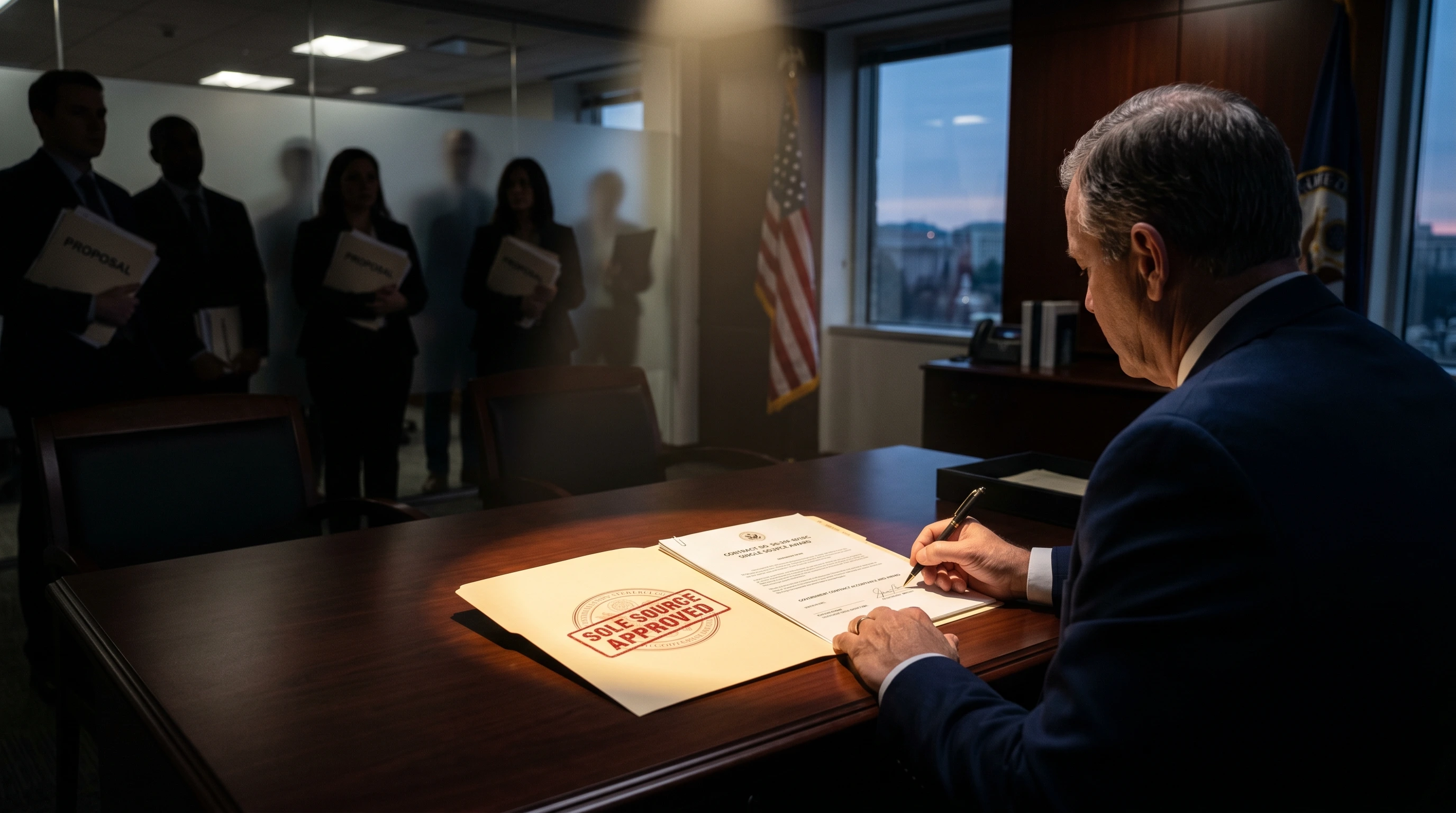
This article explains how the federal government awards contracts without full competition — what most people call sole source contracts. You will learn the legal foundations that allow these awards, the specific circumstances that trigger them, the documentation agencies must prepare, and what contractors can do to position themselves for sole source opportunities. By the end, you will understand the seven statutory exceptions under the Federal Acquisition Regulation (FAR), the J&A approval chain, the parallel pathways on GSA Schedules and IDIQ vehicles, small business program sole source authorities, brand-name rules, and five actionable strategies for earning non-competitive awards.
The Default Rule: Full and Open Competition
Every sole source award is, by definition, an exception to the default. Congress wanted these exceptions to be narrow, documented, and approved at the appropriate level.
Federal procurement starts from a simple principle established by the Competition in Contracting Act (CICA) of 1984: agencies must use full and open competition when acquiring supplies and services [8]. That means publishing requirements publicly, letting qualified vendors compete, and awarding based on the best value or lowest price.
The FAR implements CICA’s competition mandate and carves out the specific situations where an agency may legally bypass it. Understanding those situations is the first step toward knowing how to win government contracts that never appear on a public solicitation.
The Seven Statutory Exceptions Under FAR 6.302
FAR Part 6 contains seven exceptions to full and open competition, codified at FAR 6.302-1 through 6.302-7 [1]. Each maps to a different real-world circumstance.
| FAR Citation | Exception | Plain-Language Explanation |
|---|---|---|
| 6.302-1 | Only one responsible source | Only one vendor can meet the requirement — often because of proprietary technology, unique expertise, or exclusive data rights. |
| 6.302-2 | Unusual and compelling urgency | The government cannot wait for a full competition without risking serious harm — think disaster response, equipment failure threatening safety, or critical national security gaps. |
| 6.302-3 | Industrial mobilization or expert services | Maintaining the industrial base for national defense or acquiring expert services for litigation, engineering, or research. |
| 6.302-4 | International agreement | A treaty or executive agreement with a foreign government dictates the source. |
| 6.302-5 | Authorized or required by statute | A specific law directs the agency to use a particular source or program (e.g., certain SBA programs, Federal Prison Industries). |
| 6.302-6 | National security | Full disclosure of the requirement would compromise national security. |
| 6.302-7 | Public interest | The agency head determines competition is not in the public interest — rarely used, requires a written determination sent to Congress. |
In practice, the vast majority of sole source awards rely on FAR 6.302-1 (only one responsible source) and FAR 6.302-2 (urgency). If you are a contractor thinking about how to win government contracts on a sole source basis, your strategy will almost always revolve around demonstrating that you are the only source that can satisfy the requirement — through proprietary technology, data rights, integration knowledge, or incumbent expertise that no competitor can replicate within the timeframe the agency needs.
The Justification and Approval (J&A) Process
An agency cannot simply decide to skip competition and move on. It must prepare a formal document called a Justification and Approval (J&A), governed by FAR 6.303 and FAR 6.304 [1]. The J&A must include:
- A description of the supplies or services and the estimated dollar value
- The specific FAR 6.302 exception being invoked and the supporting facts
- A description of market research conducted under FAR Part 10 — the agency must show it looked for alternatives [1]
- An explanation of why the proposed source is the only one that can meet the need
- A statement that the price will be determined to be fair and reasonable
- A description of actions the agency will take to increase competition for future acquisitions
Strategic note
Even when an agency justifies a sole source award today, it is simultaneously telling its leadership and the public what it plans to do to avoid sole source next time. That creates both a window of opportunity and a ticking clock for incumbents.
Who Approves the J&A?
The approval authority escalates with dollar value. FAR 6.304(a) establishes tiers [1][5]:
| Dollar Value | Approval Authority |
|---|---|
| Up to approximately $750,000 | Contracting Officer (CO) |
| Above $750,000 to $15 million | Competition Advocate |
| Above $15 million to $100 million | Head of the Contracting Activity (HCA) |
| Above $100 million | Senior Procurement Executive (SPE) |
A $500,000 sole source J&A can be approved relatively quickly by the CO, while a $50 million award requires sign-off from an agency’s senior leadership — a process that can take weeks or months. Contractors should factor this timeline into their engagement strategy.
Posting Requirements
After award, the agency must publicly post the J&A (with permissible redactions) within 14 days — or within 30 days if the basis was unusual and compelling urgency [1]. These postings typically appear on SAM.gov [10]. A poorly written justification invites a protest, so agencies take the documentation seriously.
Sole Source Pathways Beyond FAR Part 6
Not every sole source award uses a FAR Part 6 J&A. Several acquisition vehicles have their own parallel justification mechanisms. Understanding which pathway applies depends on the contract vehicle the agency is using.
GSA Multiple Award Schedule (MAS) Orders: Limited Sources Justification
When an agency orders through the GSA Multiple Award Schedule, it follows FAR Subpart 8.4 instead of FAR Part 6. If the agency wants to restrict the order to a single source, it prepares a Limited Sources Justification (LSJ) under FAR 8.405-6 [2]. The permissible reasons mirror the Part 6 exceptions — only one source, urgency, logical follow-on, or items peculiar to one manufacturer (brand-name) — but the document format and approval chain are different.
If you are considering whether the GSA Schedule is the right vehicle for your business, GovBidLab’s free GSA Eligibility Calculator can help you assess your readiness in a few minutes.
Multiple-Award IDIQ Contracts: Fair Opportunity Exceptions
Under IDIQ contracts, the default rule is that every order must give all contract holders a fair opportunity to compete. However, FAR 16.505(b)(2) allows exceptions when only one contractor can perform, urgency exists, the order is a logical follow-on, or a minimum guarantee must be satisfied [3].
Practitioner tip
The logical follow-on exception allows an agency to direct an order to the incumbent when the work is a continuation of previously competed work and the original solicitation disclosed the government’s intent to award follow-on work. Savvy contractors ensure this language appears in the original competition — planting the seed for a future sole source order.
Simplified Acquisition Sole Source (FAR 13.5)
For commercial products and commercial services, FAR 13.5 offers streamlined procedures generally available up to $7.5 million — and higher in certain circumstances [4][5]. When the agency determines only one source is available, it prepares a Justification for Sole Source (JSS) under FAR 13.501 [4]. This document is less elaborate than a full J&A but still requires the CO to document market research, price reasonableness, and the basis for sole source.
Small Business Program Sole Source Awards
Some of the most accessible sole source pathways exist within the SBA programs. Congress created these authorities specifically to channel federal dollars to small, disadvantaged, and veteran-owned firms. If you are trying to figure out how to win government contracts as a small business, these programs deserve your closest attention.
Before you start
Before pursuing any small business sole source opportunity, confirm that your company qualifies as small under the correct NAICS code for the work being performed. GovBidLab’s free NAICS Code Lookup tool can help you identify the right codes and understand the associated size standards.
8(a) Business Development Program
Agencies can award sole source contracts to 8(a) participants through the SBA, typically for contracts up to $4.5 million for goods and $7 million for services. The contracting officer must determine the price is fair and reasonable and that the contractor is eligible and active in the program [6][7].
HUBZone Program
Under FAR 19.1306, sole source awards to certified HUBZone firms are permitted when the CO does not have a reasonable expectation that two or more HUBZone firms will submit offers at a fair and reasonable price [6][7].
SDVOSB Authority
The Service-Disabled Veteran-Owned Small Business sole source authority at FAR 19.1406 operates similarly to HUBZone — the CO must not expect two or more capable SDVOSB offers at fair and reasonable prices [6].
WOSB / EDWOSB Authority
Women-Owned Small Business and Economically Disadvantaged WOSB sole source authority under FAR 19.1506 applies in NAICS codes where WOSB firms are underrepresented or substantially underrepresented in federal contracting [6].
The Department of Veterans Affairs maintains a separate and particularly robust sole source authority for SDVOSBs and Veteran-Owned Small Businesses (VOSBs) under 38 U.S.C. 8127, implemented through the VA Acquisition Regulation (VAAR) at sections 819.7007 through 819.7009 [6]. The VA is one of the most active agencies for veteran-owned sole source awards.
In every small business sole source scenario, the contracting officer must verify three things: (1) the firm is certified and eligible in the relevant program, (2) the firm is small under the applicable NAICS code, and (3) the price is fair and reasonable. Contractors who make these verifications easy — by keeping certifications current, maintaining an accurate SAM.gov profile, and providing clear cost or pricing data — remove friction from the process and make the CO’s job easier.
Positioning Your Company for Sole Source Awards
Understanding the rules is necessary but not sufficient. The contractors who consistently receive sole source awards share a set of practical habits that complement the legal framework.
Invest in market research relationships
FAR Part 10 requires agencies to conduct market research before any acquisition [1]. Contractors who respond to Sources Sought notices, participate in industry days, and meet regularly with agency program managers give the government evidence that they are — or are not — the only capable source. This is not lobbying; it is helping the agency build the factual record required by law.
Create genuine differentiation
Proprietary technology, patented processes, exclusive data rights from prior contracts, security clearances held by key personnel, or integration with existing agency systems — these are the kinds of differentiators that make a sole source justification defensible. A contracting officer will not stake their career on a J&A that claims you are the only source if a competitor could credibly perform the work. Your uniqueness must be real, documented, and verifiable.
Make the agency’s paperwork easier
Experienced contractors draft capability statements that map directly to J&A requirements — describing their unique qualifications, alternatives considered and why they fall short, and the risks of switching sources. GovBidLab’s free Capability Statement Generator can help you build a polished statement that communicates these differentiators clearly to government decision-makers.
Anticipate protest risk
Every posted J&A is visible to competitors, and the Government Accountability Office (GAO) hears pre-award and post-award protests. Contractors who help agencies document alternatives considered, price reasonableness, and the timeline that precluded competition reduce the likelihood that a protest will succeed — and make the CO more comfortable signing the justification in the first place.
Address cybersecurity readiness early
For contractors pursuing sole source opportunities with the Department of Defense, cybersecurity readiness under the Cybersecurity Maturity Model Certification (CMMC) framework is increasingly relevant. Even sole source awardees must meet applicable cybersecurity requirements. GovBidLab’s free CMMC Calculator can help you estimate your current compliance level and identify gaps before they become barriers.
Brand-Name Justifications: A Special Case
Sometimes an agency needs a specific manufacturer’s product — not just any product that meets a general performance specification. When the requirement is written to a brand name without allowing equivalents, the agency must justify why only that brand will satisfy the need under FAR 11.104–11.105 [9]. Brand-name specifications effectively create a sole source situation for the named manufacturer (or its authorized distributors), and the justification requirements overlap with the J&A or LSJ process depending on the acquisition vehicle.
Contractors who manufacture proprietary products should ensure agencies understand the technical reasons their product is not interchangeable with alternatives. Contractors who resell or distribute products should confirm they are authorized to provide the brand-name item and can demonstrate pricing that is fair and reasonable relative to the manufacturer’s established catalog or market prices.
What to Do Next
Start by identifying which sole source pathway is most relevant to your business. If you hold an SBA certification — 8(a), HUBZone, SDVOSB, or WOSB — review the program-specific thresholds and begin tracking agencies that use those authorities most frequently. If your strength is proprietary technology or incumbent expertise, focus on building relationships with program offices and contributing to market research efforts. In either case, make sure your SAM.gov registration, NAICS codes, and capability statement are current and aligned with the requirements you want to pursue.
To check or locate your firm’s Unique Entity Identifier (UEI) — the number that identifies your business across all federal systems — use GovBidLab’s free UEI Lookup tool.
Glossary of Terms Used in This Article
| Term | Definition |
|---|---|
| 8(a) Business Development Program | An SBA program for small, disadvantaged businesses that provides access to sole source and competitive set-aside contracts, mentoring, and other support over a nine-year participation period. |
| Brand-Name Justification | A documented explanation of why an agency requires a specific manufacturer’s product by name, rather than allowing equivalent alternatives. |
| CICA | The 1984 federal law establishing that agencies must use full and open competition for procurement unless a specific statutory exception applies. |
| CMMC | A DoD framework that measures a contractor’s cybersecurity practices against defined maturity levels. Increasingly required for defense contracts. |
| CO (Contracting Officer) | The government official with legal authority to enter into, administer, and terminate federal contracts. |
| EDWOSB | A subcategory of WOSB for women-owned firms whose owners meet specific economic disadvantage criteria, providing access to additional set-aside and sole source opportunities. |
| FAR | The primary set of rules governing how the federal government purchases goods and services. Organized in numbered parts and subparts. |
| Fair and Reasonable Price | A price determination the CO must make confirming that the government is paying an appropriate amount based on market data, historical pricing, or cost analysis. |
| Fair Opportunity | Under multiple-award IDIQ contracts, the requirement that all contract holders be given a chance to compete for each task or delivery order before one is selected. |
| Full and Open Competition | The default procurement standard requiring agencies to allow all responsible sources to compete for a contract, implemented through public solicitation and evaluation. |
| GAO | The congressional agency that adjudicates bid protests in federal contracting. |
| GSA | The federal agency that manages government property and provides procurement vehicles, including the GSA Multiple Award Schedule. |
| HCA | A senior agency official responsible for managing the contracting function at a major organizational level within the agency. |
| HUBZone | An SBA program certifying small businesses in economically distressed areas, providing access to set-aside and sole source contract opportunities. |
| IDIQ | A type of contract that provides for an indefinite quantity of supplies or services over a fixed period, with individual orders issued as needs arise. |
| J&A (Justification and Approval) | The formal document an agency must prepare and approve before awarding a contract without full and open competition, describing the legal basis, market research, and rationale. |
| JSS (Justification for Sole Source) | A streamlined justification document used under FAR 13.501 for sole source acquisitions of commercial products and services via simplified procedures. |
| LSJ (Limited Sources Justification) | The justification document required under FAR 8.405-6 when an agency restricts a GSA Schedule order to fewer than the required number of sources. |
| Logical Follow-On | An exception allowing a directed award to the incumbent contractor when the new work is a natural continuation of previously competed work and the intent for follow-on was disclosed in the original solicitation. |
| MAS (Multiple Award Schedule) | A GSA-managed set of long-term, government-wide contracts with commercial firms providing access to millions of products and services at pre-negotiated prices. |
| Market Research | The process by which an agency investigates available sources, commercial practices, and market conditions before acquiring supplies or services, required by FAR Part 10. |
| NAICS | A standardized system of six-digit codes used to classify businesses by industry. Each code has an associated SBA size standard that determines whether a firm qualifies as small. |
| SAM.gov | The official U.S. government website where contractors register to do business with the government, and where agencies post solicitations, awards, and justification documents. |
| SAT (Simplified Acquisition Threshold) | The dollar limit (currently $250,000) below which agencies may use simplified purchasing procedures with reduced administrative requirements. |
| SBA | The federal agency that supports small businesses through certification programs, size standards, contracting assistance, and other resources. |
| SDVOSB | A small business owned and controlled by veterans with a service-connected disability, eligible for set-aside and sole source contracting opportunities. |
| Sole Source Contract | A contract awarded to a single vendor without full and open competition, using one of the statutory or regulatory exceptions that permit bypassing the normal competitive process. |
| Sources Sought Notice | A public notice posted by an agency on SAM.gov to identify potential vendors and gather market information before issuing a formal solicitation. |
| SPE (Senior Procurement Executive) | The highest-ranking procurement official within a federal agency, responsible for overseeing acquisition policy and approving the largest sole source justifications. |
| UEI (Unique Entity Identifier) | A 12-character alphanumeric code assigned to entities registered in SAM.gov, replacing the former DUNS number as the primary business identifier in federal procurement. |
| VAAR | The Department of Veterans Affairs’ supplement to the FAR, containing VA-specific procurement rules including expanded sole source authorities for veteran-owned businesses. |
| VOSB | A small business owned and controlled by one or more veterans, eligible for certain VA-specific set-aside and sole source contracting opportunities. |
| WOSB | A small business owned and controlled by one or more women, eligible for set-aside and sole source contracting in industries where women-owned firms are underrepresented. |
References
- FAR Part 6 — Competition Requirements (6.302-1 through 6.302-7, 6.303–6.305). General Services Administration, Department of Defense, NASA. https://www.acquisition.gov/far/part-6. Current as of FY2025.
- FAR 8.405-6 — Limiting Sources. General Services Administration, DoD, NASA. https://www.acquisition.gov/far/8.405-6. Current as of FY2025.
- FAR 16.505(b)(2) — Orders Under Multiple-Award Contracts; Exceptions to Fair Opportunity. GSA, DoD, NASA. https://www.acquisition.gov/far/16.505. Current as of FY2025.
- FAR 13.500–13.501 — Simplified Procedures for Certain Commercial Products and Commercial Services; Sole Source Justification. GSA, DoD, NASA. https://www.acquisition.gov/far/subpart-13.5. Current as of FY2025.
- FAR 2.101 and FAR 13.003 — Definitions (SAT, MPT) and Policy. GSA, DoD, NASA. https://www.acquisition.gov/far/2.101. Current as of FY2025.
- FAR Part 19 (Subparts 19.8, 19.13, 19.14, 19.15) — Small Business Programs; Sole Source Authorities. GSA, DoD, NASA. https://www.acquisition.gov/far/part-19. Current as of FY2025.
- 13 CFR 124.506, 126.612, 127.503 — SBA Regulations on Sole Source Awards for 8(a), HUBZone, and WOSB/EDWOSB Programs. U.S. Small Business Administration. https://www.ecfr.gov/current/title-13. Current as of FY2025.
- 41 U.S.C. §§ 3301–3304 — Competition in Contracting Act (CICA) and Exceptions. U.S. Code. https://uscode.house.gov.
- FAR 11.104–11.105 — Use of Brand Name or Equal Descriptions; Items Peculiar to One Manufacturer. GSA, DoD, NASA. https://www.acquisition.gov/far/subpart-11.1. Current as of FY2025.
- SAM.gov — System for Award Management. U.S. General Services Administration. https://sam.gov.