OCI in Government Contracting: Types, Mitigation, and FAR Changes
Understand organizational conflict of interest in federal contracting: FAR 9.5 types, FY 2024 GAO trends, and the 2025 proposed rule. Get actionable mitigation steps to stay competitive.

Tiatun T.
Federal Sales Consultant · Feb 25, 2026
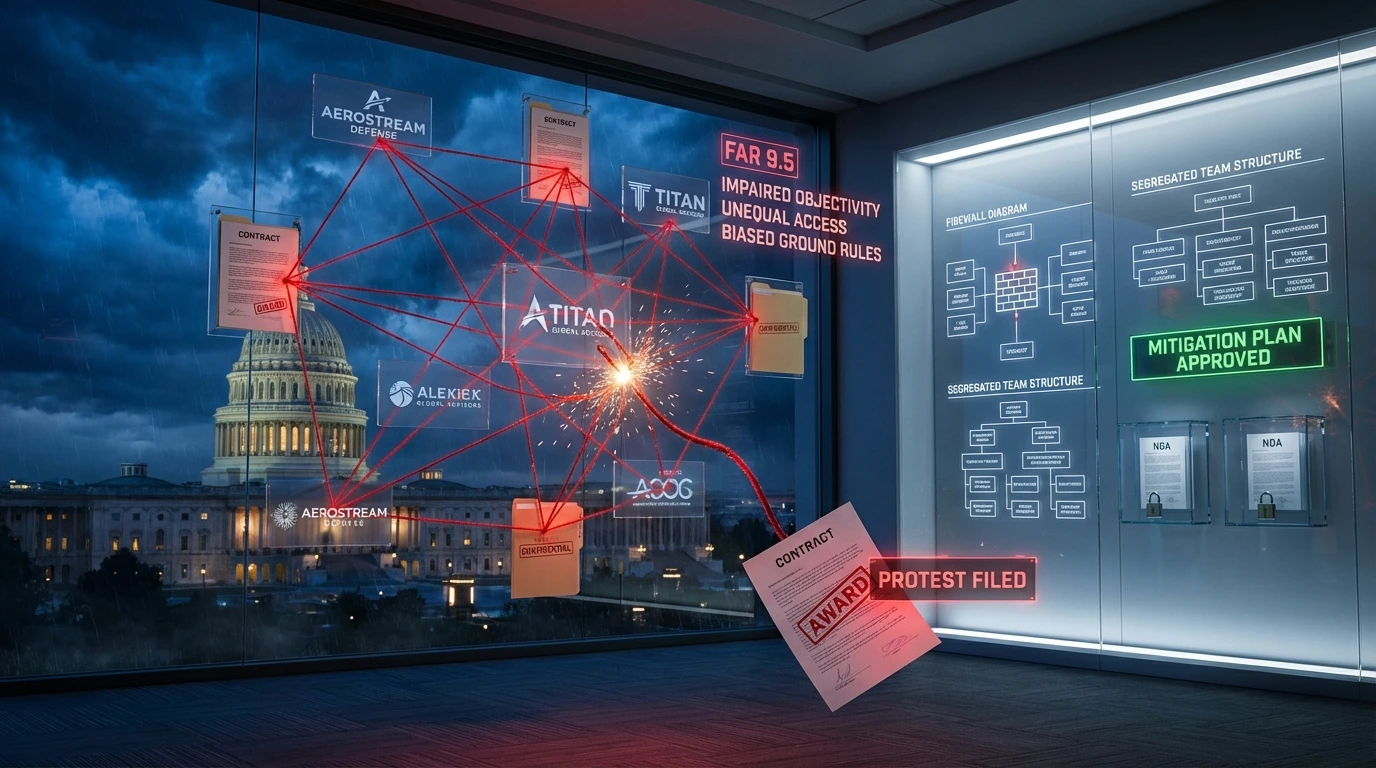
Organizational conflicts of interest (OCI) can quietly derail otherwise strong proposals, trigger bid protests, and even bar future work. For small and mid-size businesses intent on learning how to win government contracts, understanding OCI—and demonstrating credible mitigation—has become table stakes.
Under FAR Subpart 9.5, contracting officers must identify, evaluate, and avoid, neutralize, or mitigate significant potential conflicts as early as possible. FAR 9.5 provides rules, examples, and responsibilities for agencies and contractors alike.
FAR 9.5: The Three Classic OCI Types
FAR 9.5 highlights three "classic" OCI categories that frequently arise in services acquisitions and advisory roles:
Unequal Access to Information
When a contractor gains nonpublic information (e.g., competitors' proprietary data or source selection materials) and therefore enjoys an unfair competitive advantage.
Biased Ground Rules
When a contractor helps draft requirements, specifications, or evaluation criteria that could skew the competition toward its solution.
Impaired Objectivity
When a contractor's judgment on behalf of the government could be affected by its other interests or relationships (for example, evaluating its own or an affiliate's work).
FAR 9.502 provides guidance on applicability and flags higher-risk work such as management support, consultant/professional services, technical evaluations, and systems engineering/technical direction—work that often triggers future work restrictions.
Why OCI Risk Is Rising—and Why It Matters for Capture
Industry trendlines suggest OCI risk is elevated as the federal market relies more on advisory/services contractors and as consolidation concentrates capabilities across fewer firms. Defense Acquisition Magazine notes DoD has spent more on services than supplies for over two decades, and frames consolidation as a "perfect storm" for OCIs—pressuring contractors to formalize firewalls, separate teams, NDAs, and informed-consent measures.
For companies focused on how to win government contracts, that means building OCI thinking into early capture and teaming decisions.
FY 2024 GAO Bid Protest Statistics
1,803
Filings (down ~11% from FY 2023)
16%
Sustain Rate
52%
Effectiveness Rate
The most prevalent sustain grounds were unreasonable technical evaluations, flawed selection decisions, and unreasonable cost/price evaluations—issues that often intersect with OCI risk identification and mitigation. (Source)
Recent GAO Decisions: OCI Lessons You Can Use
Castro & Company (B-423689)
GAO sustained a protest where the agency inadequately evaluated and documented an impaired objectivity OCI. The decision emphasized that contracting officers must perform and document meaningful, fact-based investigations—firewalls aimed at unequal access will not cure impaired objectivity.
Lesson: Provide "hard facts" and practicable mitigations, and ensure the record demonstrates how your measures address the precise OCI type alleged. (Source)
emissary LLC (B-422388.3 et al.)
GAO sustained in part when the agency failed to consider how an OCI mitigation plan materially altered the awardee's technical approach. If mitigation changes labor mix, access, or decision rights, the agency must evaluate the revised technical approach accordingly.
Lesson: Anticipate this scrutiny and align mitigation with a coherent, evaluable approach in the proposal. (Source)
GAO affords deference to reasonable agency OCI investigations—but only where the record shows careful analysis and practicable mitigation. Your mitigation plan must be specific, operationally realistic, and documented in a way that supports both award eligibility and protest defense.
The FAR OCI Overhaul: What's Changing
Congress enacted the Preventing Organizational Conflicts of Interest in Federal Acquisition Act (Pub. L. 117-324), directing a modernization of FAR OCI coverage. On January 15, 2025, DoD, GSA, and NASA proposed a FAR rule to implement the statute—expanding definitions and examples, adding new solicitation provisions and clauses, and relocating OCI coverage from Part 9 to a new Subpart in FAR Part 3.
Comments closed March 17, 2025, and as of February 25, 2026, the Unified Agenda shows the FAR Council considering public input in developing a final rule under RIN 9000-AO54. Contractors should expect more explicit disclosure requirements and standardized mitigation frameworks once the final rule issues.
DFARS Developments to Watch
DoD has separately addressed conflicts in certain consulting services, adding DFARS coverage and clauses for NAICS codes beginning with 5416. The DFARS framework includes certifications and potential mitigation plans where conflicts may arise with covered foreign entities, and it clarifies certain waiver authorities and procedures in Subpart 209.5.
If you support defense organizations, align your compliance playbook with both FAR and DFARS.
Building a Practical, Defensible OCI Mitigation Plan
An effective OCI mitigation plan is not a boilerplate attachment—it's an operational design. Use these elements to demonstrate impartiality, fairness, and integrity:
Conflict Mapping
Identify roles, relationships, affiliates, and prior work that may create unequal access, biased ground rules, or impaired objectivity. Use a visual map and narrative that ties each risk to a specific control.
Segregation of Duties
Establish separate capture, proposal, and performance teams where needed. Document reporting lines and decision rights so evaluators can see objectivity is preserved.
Firewalls and Access Controls
Implement technical and administrative barriers (role-based access, separate networks or repositories, need-to-know lists). Address how you prevent unequal access to nonpublic information.
Nondisclosure Regimes
Require NDAs tailored to the procurement. Include periodic training and auditable acknowledgments for anyone with potential exposure to sensitive data.
Informed Consent and Disclosure
Proactively disclose relationships, prior work, team composition, and subcontractor ties that could present OCI. Reference the specific solicitation provisions or clauses proposed in the FAR overhaul where applicable.
Future Work Restrictions
Where appropriate, propose voluntary limitations (e.g., avoiding downstream design or evaluation roles) and show how you will enforce them contractually across affiliates.
Independent Review
Engage an independent ethics officer or outside counsel to review mitigation, monitor compliance, and issue periodic certifications to the CO.
Contemporaneous Documentation
Maintain a detailed log of mitigation decisions, approvals, and training records. GAO decisions repeatedly stress the importance of "show, don't tell" documentation.
Capture Management: Bake OCI into Win Strategy
OCI is not just a compliance box; it's a strategic consideration integrated into capture. To strengthen your approach to how to win government contracts, apply OCI thinking from day one:
Teaming Discipline
Vet partners and subs for potential conflicts early. Where a partner has advisory contracts with the customer, evaluate whether their role might bias ground rules or impair objectivity on the target opportunity.
Solution Shaping with Guardrails
If you offer pre-RFP insights, maintain clear boundaries. Avoid any role that could be seen as drafting requirements tailored to your solution.
Qualification Screening
Address DFARS unique OCI scenarios for defense work; ensure certifications and mitigation plans are ready for NAICS 5416 solicitations as applicable.
Proposal Narrative
Don't assume the agency will infer mitigation. Explain how firewalls operate, who is ring-fenced, and what monitoring you'll perform.