Multiple Award Contracts: How They Work & How to Win
A complete guide to multiple award contracts (MACs): the three vehicle types, two-level competition structure, fair opportunity and its exceptions, small business pools, GAO protest thresholds, ordering period mechanics, and five strategies for winning more orders.

Tiatun T.
Federal Sales Consultant · Apr 22, 2026
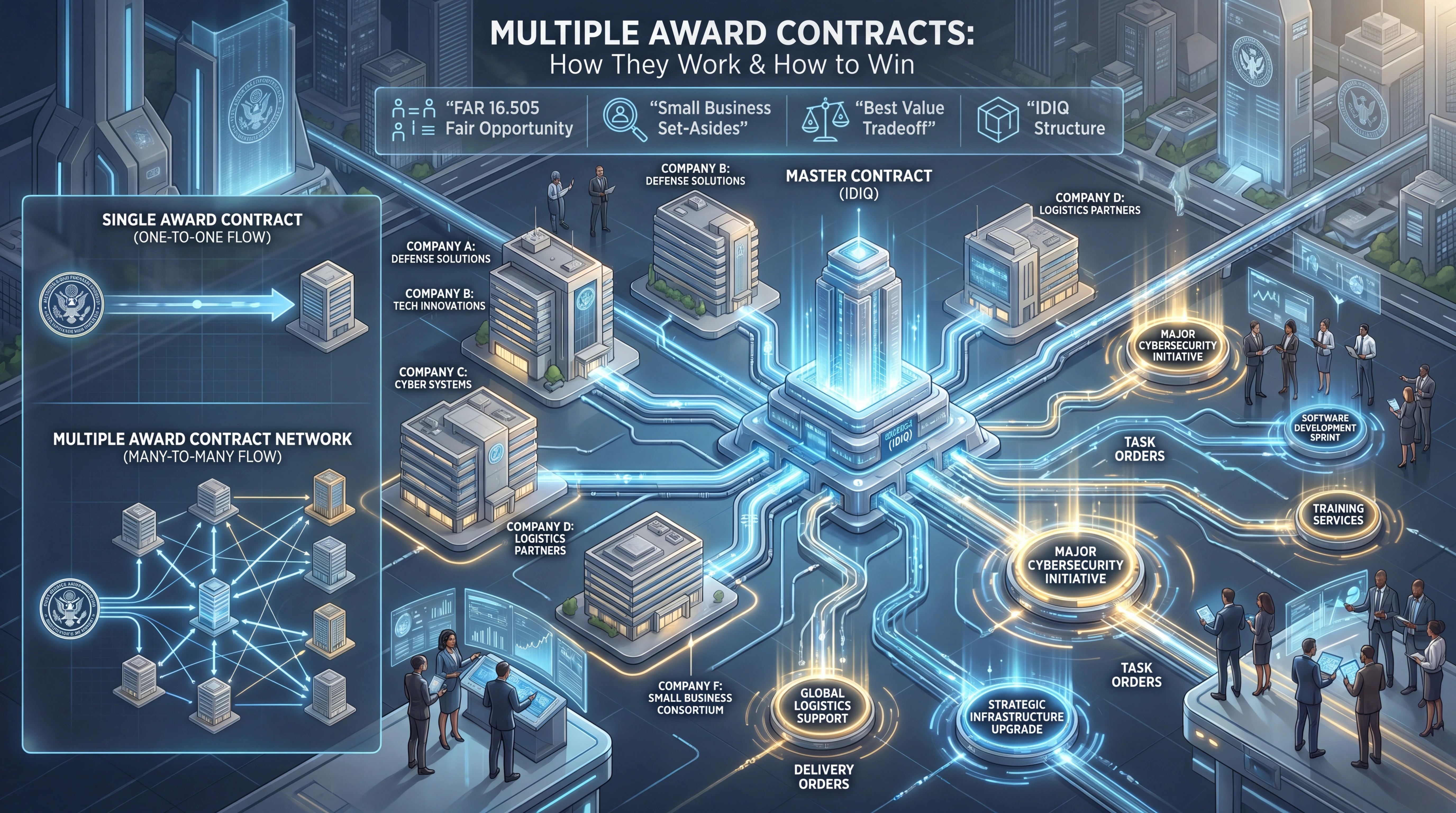
This article explains multiple award contracts (MACs) — one of the most common and powerful buying tools the federal government uses to purchase everything from IT services to logistics support. By the time you finish reading, you will understand what a MAC is, how it differs from a single-award contract, how the government issues work under one, what “fair opportunity” means for your company, where small businesses fit in, and how protest rules change at the task-order level.
What Is a Multiple Award Contract?
Think of it this way: the government issues one competition, selects several winners, and then parcels out specific work over time through individual task orders (for services) or delivery orders (for products).
A multiple award contract is an Indefinite-Delivery/Indefinite-Quantity (IDIQ) contract awarded to more than one contractor under a single solicitation for the same or similar supplies or services. The Federal Acquisition Regulation (FAR) — the rulebook for federal purchasing — explicitly prefers MACs over single-award contracts when the requirement is large enough or ongoing enough to support competition at the order level, per FAR 16.504(c) [1].
The MAC family includes three main vehicle types, and you will encounter all of them as you learn how to win government contracts:
| Vehicle Type | Who Manages It | Who Can Order From It |
|---|---|---|
| Agency-specific IDIQ | A single agency (e.g., Army, DHS) | Typically only that agency |
| Government-wide Acquisition Contract (GWAC) | Designated agencies (e.g., NASA SEWP, NIH CIO-SP3) | Any federal agency |
| GSA Multiple Award Schedule (MAS) | General Services Administration (GSA) | Any federal agency (and some state/local) |
All three share the same DNA: a master “shell” contract that locks in terms and conditions, approved labor categories, ceiling rates, an ordering period, and contract minimums and maximums. The actual buying — scope, price, timeline — happens order by order. If you are wondering whether your company qualifies for a GSA Schedule, GovBidLab’s free GSA Eligibility Calculator can give you a quick preliminary answer.
The Master Contract vs. the Task Order: Two Levels of Competition
Understanding MACs means understanding that competition happens twice, in fundamentally different ways.
Level 1: Winning a Spot on the Contract
The first competition is the master-level award. The agency publishes a solicitation on SAM.gov describing what it intends to buy over the life of the contract. Companies submit proposals, and the government evaluates them under normal competitive procedures governed by the Competition in Contracting Act (CICA). Winners receive a place “on the vehicle,” meaning they are eligible to compete for future orders.
Every IDIQ, including a MAC, must state a guaranteed minimum and a contract maximum (the ceiling). Under FAR 16.504(a)(1), the government is legally obligated to buy at least the minimum from each awardee [1]. In practice, agencies often satisfy this guarantee through a small initial order — sometimes as low as a few hundred dollars — so do not count on the minimum as meaningful revenue.
Pricing strategy watch-out: Your pricing strategy at the master level should set ceiling rates that are competitive enough to win an award yet leave room for order-level discounting. Most best-value tradeoffs occur at the task-order stage, not during the initial competition. Locking in rates too low at the master level erodes margin on every order that follows.
Level 2: Competing for Individual Orders
Once on a MAC, you compete again — order by order — under a different, streamlined set of rules. This is where FAR 16.505 takes over [1]. Orders under a MAC are not subject to CICA’s full-and-open requirements. Instead, the contracting officer (CO) must give each MAC holder a “fair opportunity to be considered” for any order exceeding the micro-purchase threshold (currently $10,000) [2]. Fair opportunity is lighter and faster than full competition: the CO tailors the process to the complexity of the order.
Orders are not publicly advertised: Orders under MACs generally do not require public synopsis on SAM.gov under FAR 5.202(a)(6) [3]. This means opportunities may circulate only among the MAC holders. If you are not on the contract, you will likely never see the requirement — precisely why getting on the right vehicles is foundational to how to win government contracts in high-volume agencies.
Documentation requirements scale with dollar value. Below the Simplified Acquisition Threshold (SAT) of $250,000, procedures are relatively informal [2]. Above the SAT, expect more structured evaluation, written proposals, and detailed selection memoranda.
Exceptions to Fair Opportunity
FAR 16.505(b)(2) carves out exceptions where the CO may direct an order to a specific awardee without offering it to everyone [1]. These exceptions are narrow and must be justified in writing:
- Sole capability: Only one awardee can perform the work.
- Unusual urgency: The need is so pressing that providing fair opportunity would cause unacceptable delay.
- Logical follow-on: Continuity of a previous order is in the government’s interest and only one awardee can provide it without undue cost.
- Minimum guarantee: The order is needed to satisfy the contract’s minimum obligation to a specific awardee.
- Small business set-aside: The order is reserved for small business MAC holders under FAR 19.502-4 and FAR 16.505(b)(2)(i)(F) [4].
Small Business Rules: Master Level and Order Level
Small business policy weaves through MACs at two layers, and this dual-layer structure creates opportunities that many newcomers miss.
At the Master-Contract Level
Agencies may reserve the entire MAC (or specific pools within it) for small business concerns under FAR 19.503 [4]. You will often see solicitations structured with an “unrestricted pool” and a “small business pool,” each with its own set of awardees and ceiling.
At the Order Level
A CO may set aside individual orders for small businesses among the MAC holders, even on an otherwise unrestricted vehicle. This creates a separate fair opportunity exception — only the small business awardees on the MAC are eligible to compete for that order.
Size status nuance: Under 13 CFR 121.404 [4], size status for orders is ordinarily determined at the time of the initial proposal for the MAC itself and is generally not re-certified for each subsequent order. This means a company that was small when it won its MAC seat can continue competing for small business set-aside orders even after it grows past the size standard — unless a merger, acquisition, or specific regulatory trigger forces re-certification.
If you are building or refreshing your company’s positioning for a MAC pursuit, GovBidLab’s free Capability Statement Generator can help you create a professional capability statement that highlights your relevant experience and socioeconomic status.
Protest Rules: Different Thresholds, Limited Jurisdiction
Protest rights at the task-order level are far more restricted than at the master-contract level. The Government Accountability Office (GAO) has limited jurisdiction over task and delivery orders placed under MACs. The rules differ by agency type:
| Agency Type | GAO May Hear a Protest If… | Legal Authority |
|---|---|---|
| Civilian agencies | Order exceeds $10 million, or the order increases the MAC’s scope, period, or maximum value | 41 U.S.C. 4106(f) [7] |
| DoD, NASA, U.S. Coast Guard | Order exceeds $25 million, or the order increases the MAC’s scope, period, or maximum value | 10 U.S.C. 3406(f) [8] |
Strategic tradeoff: Below these thresholds, a disappointed offeror’s main recourse is the agency-level ombudsman process under FAR 16.505(b)(8), or in some cases the Court of Federal Claims. MACs trade some protest protections for speed and flexibility. Understand that tradeoff before you invest in pursuit.
Ordering Periods, Extensions, and the Clock
The ordering period is the window during which the government may place new orders against the MAC. For services, FAR 17.204(e) generally caps the base period plus options at five years unless a statute or agency policy authorizes longer [5]. GWACs and the GSA MAS program often have express statutory authority for longer periods — the current GSA MAS runs for a 20-year base period.
Revenue past the nominal end date: An order placed before the MAC’s ordering period expires may extend beyond that expiration date. The Indefinite Quantity clause (FAR 52.216-22(d)) [6] permits continued performance for a reasonable time after the ordering period closes, as long as the order itself was issued while the contract was still active. For practitioners managing a portfolio of IDIQs, tracking ordering-period expiration dates is essential pipeline hygiene.
Positioning to Win: Practical Advice
Understanding the mechanics is necessary, but not sufficient. Here is what the structure of MACs means for your day-to-day strategy.
-
1
Get on the right vehicles early.
Because orders are generally not advertised publicly, the MAC itself is the gateway. Research which vehicles your target agencies use most heavily. Tools like USAspending.gov and FPDS-NG let you see which contracts an agency spends through [9][10]. Align your pursuit calendar with upcoming MAC recompetes and on-ramps.
-
2
Price the master contract strategically.
Your ceiling rates set a cap, not a floor. You can always bid lower at the order level. Set ceiling rates that keep you competitive in the initial evaluation while preserving margin flexibility for task-order negotiations. Many best-value tradeoffs on MACs occur at the order stage, where past performance and technical approach often outweigh price.
-
3
Invest in order-level capture.
Winning the MAC is step one. The real revenue comes from winning task orders, and that requires the same discipline as any other pursuit: early customer engagement, solution shaping, teaming, and tight proposal execution. Companies that treat task-order responses as afterthoughts consistently underperform on their vehicles.
-
4
Verify your registrations and identifiers.
Before pursuing any MAC, confirm that your Unique Entity Identifier (UEI) is current and that your SAM.gov registration is active. GovBidLab’s free UEI Lookup tool lets you verify your UEI in seconds. An expired registration can disqualify an otherwise winning proposal.
-
5
Assess CMMC readiness for DoD MACs.
If your target MACs involve Department of Defense work, cybersecurity compliance is increasingly a requirement. GovBidLab’s free CMMC Calculator can help you estimate where you stand and what steps remain before pursuing defense vehicle opportunities.
What to Do Next
Start by identifying two or three MACs that align with your company’s core capabilities and your target agency’s buying patterns. Pull obligation data from USAspending.gov to confirm that real money flows through those vehicles — not every MAC gets funded equally. Then assess whether you are eligible for the next recompete or on-ramp, and begin building your master-level pricing and teaming strategy now. Knowing how to win government contracts under MACs begins with choosing the right vehicle and showing up prepared before the solicitation drops.
Glossary of Terms Used in This Article
Best-Value Tradeoff — An evaluation method where the government weighs non-price factors (technical approach, past performance) against price to determine which proposal offers the best overall value — not necessarily the lowest cost.
Ceiling Rate — The maximum rate a contractor may charge under its MAC for a given labor category or service. Actual order-level pricing can be lower but not higher.
CICA (Competition in Contracting Act) — The federal law requiring agencies to use “full and open competition” when awarding contracts, with defined exceptions. CICA governs master-contract competitions but does not apply to individual orders under MACs.
CMMC (Cybersecurity Maturity Model Certification) — A DoD framework that verifies a contractor’s cybersecurity practices before they can handle certain types of sensitive government information.
CO (Contracting Officer) — The government official with legal authority to enter into, administer, and terminate contracts and to make related determinations and findings.
Delivery Order — An order for supplies or products placed against an existing IDIQ or MAC.
DoD (Department of Defense) — The federal department responsible for military and national security operations; subject to specific acquisition rules distinct from civilian agencies.
Fair Opportunity — The requirement under FAR 16.505 that each MAC holder be given a reasonable chance to compete for orders above the micro-purchase threshold, unless an exception applies.
FAR (Federal Acquisition Regulation) — The principal set of rules governing the federal government’s purchasing process. Found at Acquisition.gov.
FPDS-NG (Federal Procurement Data System – Next Generation) — The government’s central database of federal contract award information, now accessible through SAM.gov’s data tools.
GAO (Government Accountability Office) — An independent agency of Congress that, among other roles, adjudicates bid protests challenging the award or proposed award of federal contracts.
GSA (General Services Administration) — The federal agency that manages government-wide procurement vehicles, including the GSA Multiple Award Schedule program.
GSA MAS (GSA Multiple Award Schedule) — A long-term government-wide contract program managed by GSA that allows agencies to buy commercial products and services at pre-negotiated prices.
GWAC (Government-wide Acquisition Contract) — A type of MAC established by one agency but available for ordering by all federal agencies, typically for IT products and services.
IDIQ (Indefinite-Delivery/Indefinite-Quantity) — A contract type that provides for an indefinite quantity of supplies or services during a fixed ordering period, with stated minimums and maximums.
MAC (Multiple Award Contract) — An IDIQ contract awarded to more than one contractor under a single solicitation, creating a pool of vendors who compete for individual orders.
Micro-Purchase Threshold — The dollar amount ($10,000 for most purchases) below which the government can buy without competitive procedures. Orders under MACs below this threshold do not require fair opportunity.
NAICS (North American Industry Classification System) — The standard system used to classify businesses by industry. Each NAICS code has an associated SBA size standard that determines whether a company qualifies as a small business for that industry.
On-Ramp — A periodic opportunity for new contractors to join an existing MAC, usually through a supplemental competition conducted mid-vehicle.
Ordering Period — The window of time during which the government may place new orders against a MAC. Orders placed before expiration may continue to be performed afterward.
SAM.gov (System for Award Management) — The government’s central platform for entity registration, contract opportunity posting, and procurement data.
SAT (Simplified Acquisition Threshold) — The dollar amount ($250,000) below which agencies may use simplified purchasing procedures with reduced documentation.
SBA (Small Business Administration) — The federal agency that establishes size standards, manages small business programs, and advocates for small business participation in government contracting.
Task Order — An order for services placed against an existing IDIQ or MAC, defining the specific scope, deliverables, period, and price for that increment of work.
UEI (Unique Entity Identifier) — A 12-character alphanumeric ID assigned to entities registered in SAM.gov, replacing the former DUNS number. Required for all federal contract awards.
USCG (United States Coast Guard) — A branch of the armed forces under the Department of Homeland Security; shares DoD’s higher protest thresholds for task orders under MACs.
References
[1] FAR Subpart 16.5 — Indefinite-Delivery Contracts (including FAR 16.504 and FAR 16.505). General Services Administration, Acquisition.gov.
[2] FAR 2.101 — Definitions (Micro-Purchase Threshold; Simplified Acquisition Threshold). General Services Administration, Acquisition.gov.
[3] FAR Part 5 — Publicizing Contract Actions (FAR 5.202(a)(6)). General Services Administration, Acquisition.gov.
[4] FAR Part 19 — Small Business Programs (FAR 19.502-4, 19.503); SBA regulations at 13 CFR 121.404. General Services Administration, Acquisition.gov.
[5] FAR 17.204(e) — Contract Period (options). General Services Administration, Acquisition.gov.
[6] FAR 52.216-22 — Indefinite Quantity (contract clause). General Services Administration, Acquisition.gov.
[7] 41 U.S.C. 4106 — Orders Under Task and Delivery Order Contracts (civilian agencies). United States Code.
[8] 10 U.S.C. 3406 — Task and Delivery Order Contracts (DoD, NASA, USCG), recodified effective January 1, 2022. United States Code.
[9] USAspending.gov. U.S. Department of the Treasury.
[10] SAM.gov — Contract Opportunities and Entity Registration. U.S. General Services Administration.