Is Government Contracting Worth It for Small Businesses?
The real costs, real advantages, and real decision points that determine whether pursuing federal contracts makes sense for your small business — with FAR citations and a practical framework.

Tiatun T.
Federal Sales Consultant · Apr 15, 2026
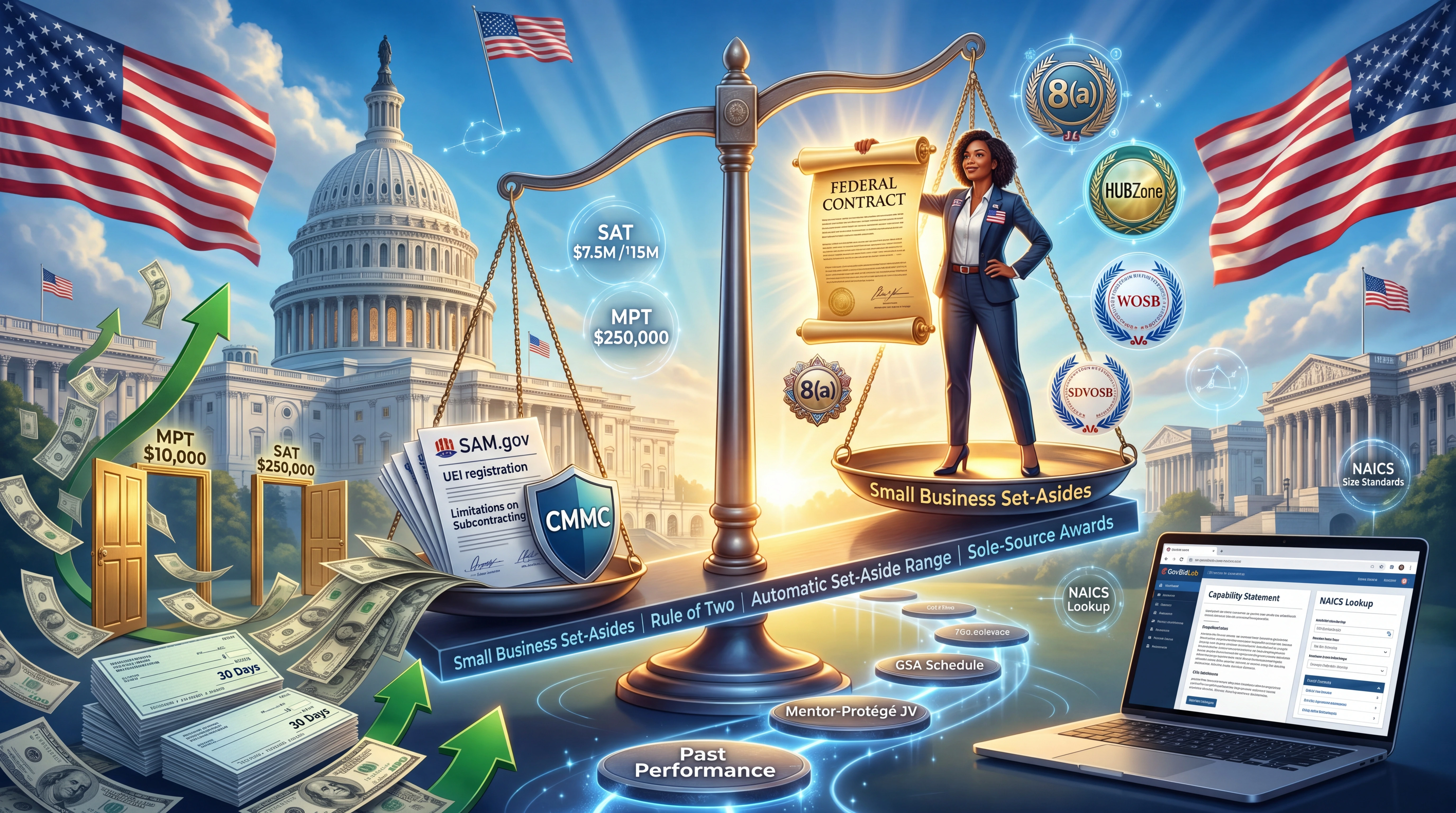
This article walks through the real costs, real advantages, and real decision points that determine whether pursuing federal contracts makes sense for your small business. By the end, you will understand the specific regulatory advantages the government gives small firms, the compliance burdens that come with those advantages, the dollar thresholds that shape every opportunity, and a practical framework for deciding whether — and how — to enter this market.
The Federal Market Is Structurally Tilted Toward Small Businesses
The single most important thing to understand about the federal procurement system is that Congress has deliberately built preferences for small firms into the rules. This is not charity — it is statutory policy, and contracting officers are measured on whether they meet small business goals. That structural tilt is what makes how to win government contracts a different question for small firms than it is for large ones.
Every acquisition above the Micro-Purchase Threshold (MPT) — generally $10,000 — and at or below the Simplified Acquisition Threshold (SAT) — currently $250,000 — is automatically reserved for small businesses unless the contracting officer determines that fewer than two small firms can provide the product or service at a fair market price [1][3]. This is sometimes called the “automatic set-aside” range, and it represents an enormous volume of federal purchasing activity that is structurally off-limits to large businesses.
Above the SAT, the “Rule of Two” still applies: if the contracting officer has a reasonable expectation that at least two responsible small businesses will submit offers at fair market prices, the acquisition must be set aside for small business [3]. In other words, small business set-asides are not limited to small-dollar purchases — they extend upward whenever competition among small firms is likely.
For purchases of commercial products and services, agencies can use Simplified Acquisition Procedures (SAP) — streamlined, faster processes with less paperwork — up to $7.5 million, or up to $15 million for contingency or humanitarian/peacekeeping operations [2]. These simplified buys are prime hunting ground for well-prepared small firms because the evaluation process is less burdensome for both the buyer and the seller.
The table below summarizes the thresholds that define the playing field:
| Threshold | Dollar Value | What It Means for Small Business | Source |
|---|---|---|---|
| Micro-Purchase Threshold (MPT) | $10,000 | Below this, agencies can buy with a government purchase card — no competition required | FAR 2.101 [1] |
| Simplified Acquisition Threshold (SAT) | $250,000 | Buys above MPT and at or below SAT are automatically reserved for small business | FAR 2.101, 19.502-2 [1][3] |
| SAP for Commercial Items | $7.5M ($15M contingency) | Streamlined procedures with less proposal burden — ideal for small firms | FAR 13.500 [2] |
| Sole-Source Ceiling (Services) | $4.5M | 8(a), HUBZone, SDVOSB, WOSB programs may award without competition | FAR 19.8, 19.13–19.15 [4] |
| Sole-Source Ceiling (Manufacturing) | $7M | Same programs, higher ceiling for manufacturing NAICS codes | FAR 19.8, 19.13–19.15 [4] |
| Truthful Cost or Pricing Data (TINA) | $2M | Below this (or with adequate competition), no certified cost data required | FAR 15.403-4 [9] |
Socioeconomic Programs: Your Competitive Edge — If You Qualify
Beyond the automatic set-aside range, four major socioeconomic programs give qualifying small firms an even sharper edge: the 8(a) Business Development Program, the HUBZone program, the Women-Owned Small Business (WOSB) program, and the Service-Disabled Veteran-Owned Small Business (SDVOSB) program [4].
Each of these programs allows agencies to restrict competition to just firms holding that designation — and in many cases, to award contracts on a sole-source basis (meaning without any competition at all) up to $4.5 million for services and $7 million for manufacturing, subject to periodic inflation adjustments under FAR 1.109 [4]. For a small firm, a sole-source award eliminates the most expensive part of government business development: writing competitive proposals.
To qualify, you must meet the SBA size standard for the NAICS code assigned to the opportunity. Size standards vary — they may be based on average annual revenue, number of employees, or other metrics depending on the industry [5]. Choosing the right NAICS code matters enormously, because the same company can be “small” under one code and “other than small” under another. GovBidLab’s free NAICS Code Lookup tool lets you identify and verify the right codes quickly.
Practitioner note: If you are a dealer or reseller rather than a manufacturer, and you are bidding on a small business set-aside for supplies, the Nonmanufacturer Rule applies. You must supply the product of a small business manufacturer — unless the SBA has issued a class waiver for that product category [5]. This trips up more firms than you might expect.
The Compliance Cost: What You Are Actually Signing Up For
Every advantage above comes with compliance obligations. The question is not whether compliance costs exist — they do — but whether they are proportionate to the revenue you expect. Here is what the core compliance stack looks like for a small federal contractor.
Registration and Identification
SAM.gov registration is mandatory before you can receive any federal contract. As part of registration, your firm receives a Unique Entity Identifier (UEI), which replaced the former DUNS number on April 4, 2022 [12]. Registration is free but requires attention to detail — your entity information, NAICS codes, representations and certifications, and banking data must all be accurate. GovBidLab’s free UEI Lookup tool lets you quickly verify your firm’s UEI and registration status.
Limitations on Subcontracting
When you win a set-aside contract, you cannot simply pass most of the work to a large firm and collect a management fee. The Limitations on Subcontracting rule requires that, for services contracts, no more than 50% of the amount paid by the government may go to subcontractors that are not “similarly situated” — meaning subcontractors that do not hold the same small business status as you [6]. The percentages differ for supplies, general construction, and specialty construction.
Practitioner tip: The “similarly situated entity” concept means you can subcontract significant portions of work to another firm that shares your set-aside designation (for example, another 8(a) firm on an 8(a) set-aside) without violating the limitation. This opens teaming and joint-venture strategies that are worth exploring as you learn how to win government contracts in competitive set-aside markets.
Subcontracting Plans — A Burden You Do Not Bear
Here is a compliance requirement you avoid as a small business prime contractor: subcontracting plans. Other-than-small prime contractors must submit detailed subcontracting plans on any contract expected to exceed $750,000 (or $1.5 million for construction) [7]. These plans commit the prime to specific small business subcontracting goals and require ongoing reporting. As a small business prime, you are exempt — a meaningful administrative savings that is easy to overlook.
Payment Risk: Lower Than You Think
One of the underappreciated advantages of federal work is payment reliability. The Prompt Payment Act requires agencies to pay contractors within specified timeframes — typically 30 days for most invoices — and to pay interest penalties when they are late [8]. The FAR also encourages accelerated payments to small business prime contractors and to small business subcontractors [8]. Unlike many commercial clients, the federal government is a legally bound payer.
Cybersecurity: The Growing Cost Center
If you pursue Department of Defense (DoD) work that involves Controlled Unclassified Information (CUI), you must implement the 110 security controls in NIST Special Publication 800-171 [13]. The Cybersecurity Maturity Model Certification (CMMC) framework, currently being finalized through rulemaking, will require third-party assessments for many contracts involving CUI. For small firms eyeing DoD work, this is the fastest-growing compliance cost in the market. Use GovBidLab’s free CMMC Calculator to scope your readiness gap before committing to a pursuit.
Pricing and Accounting: Know What You Can Avoid
The Truthful Cost or Pricing Data statute (TINA) requires contractors to submit certified cost or pricing data — opening your books to government auditors — but only when the contract exceeds $2 million and adequate price competition does not exist [9]. Most small business set-asides involve adequate competition, and many are below $2 million, so you will rarely trigger this requirement if you target the right opportunities.
Cost Accounting Standards (CAS) — a separate set of accounting rules that govern how contractors measure, assign, and allocate costs — generally do not apply to small businesses, and many fixed-price contracts below CAS thresholds are also exempt [10]. If you stick to competitive, fixed-price set-asides in the small-to-mid-value range, your accounting burden stays manageable.
Buy American, Supply Chain, and Other Rules That Catch People Off Guard
If you sell products (as opposed to pure services), the Buy American Act (BAA) will affect you. The BAA requires that end products delivered to the government be manufactured in the United States and that a certain percentage of the cost of their components be domestic. That domestic content threshold is being phased upward: 60% starting in 2022, 65% from 2024 through 2028, and 75% from 2029 onward [11]. If your product does not meet the threshold, a price evaluation penalty applies, making it harder to compete on price.
Practitioners tracking these rules know that trade agreements, waivers, and exceptions (such as the Trade Agreements Act threshold, which applies to acquisitions above approximately $183,000 for most countries) can override or modify BAA requirements. But the baseline rule is clear: if you sell products to the federal government, know your domestic content percentage before you bid.
A Practical Framework for the “Is It Worth It?” Decision
Understanding how to win government contracts starts with understanding whether you should pursue them at all. Here is a five-step decision framework that works for firms at any stage:
-
1
Identify your NAICS codes and confirm you are small.
Use GovBidLab’s NAICS Code Lookup to find the codes that match your work, then check the SBA size standard for each. If you are not small under a given code, set-asides in that category are off limits.
-
2
Estimate your compliance baseline.
SAM registration, UEI maintenance, basic representations and certifications, and understanding of the limitations on subcontracting are non-negotiable. Budget 40–80 hours and modest costs for initial setup. If you plan to pursue DoD/CUI work, add cybersecurity implementation costs — use the CMMC Calculator to scope this.
-
3
Target the right opportunity size.
The sweet spot for most new entrants is the simplified acquisition threshold range — opportunities between $10,000 and $250,000 — where competition is limited to small firms and procedures are streamlined. As you build past performance, you can pursue larger set-asides and even full-and-open competitions.
-
4
Explore whether a GSA Schedule makes sense.
A GSA Schedule (Multiple Award Schedule / MAS) is a long-term, government-wide contract vehicle that lets agencies buy your products or services without running a new competition each time. GovBidLab’s GSA Eligibility Calculator can help you determine whether your firm meets the prerequisites — including two years of financial history and relevant past performance — before you invest in the application.
-
5
Build past performance deliberately.
Teaming arrangements and SBA-approved mentor-protégé joint ventures let you participate in larger contracts alongside experienced firms while earning past performance in your own name. A strong capability statement — summarizing your core competencies, past performance, differentiators, and certifications — is essential for marketing to government buyers and teaming partners alike. GovBidLab’s free Capability Statement Generator can help you build one quickly.
The Honest Answer
Is government contracting worth it? For most small businesses that operate in a service or product area the federal government buys, the answer is conditionally yes. The conditions are: you target opportunities in your core NAICS codes where you are genuinely small; you start at the right dollar level rather than chasing contracts you are not ready to perform; you budget for compliance as a cost of doing business rather than an afterthought; and you avoid contract types — particularly cost-reimbursement contracts with full CAS applicability — that impose accounting overhead disproportionate to your stage of growth.
The federal government is a large, reliable, and legally bound customer. The rules are complex, but they are also public, knowable, and — for small businesses — deliberately favorable. The firms that succeed treat federal contracting compliance not as a barrier but as a moat: once you have invested in understanding the rules, your competitors who have not are at a disadvantage.
What to Do Next
Start with the lowest-friction action: confirm your UEI and SAM registration status, identify your primary NAICS codes and verify your size status, and search SAM.gov for set-aside opportunities in your area of expertise that fall within the simplified acquisition threshold. One well-targeted, well-priced bid on a set-aside you are qualified to perform will teach you more about this market than months of reading. Explore GovBidLab’s full suite of free government contracting tools to accelerate your preparation.
Glossary of Terms Used in This Article
8(a) Business Development Program — An SBA program for small businesses owned by socially and economically disadvantaged individuals, providing access to sole-source and set-aside contracts, training, and mentorship over a nine-year period.
BAA (Buy American Act) — A federal law requiring the government to prefer domestically manufactured end products, subject to minimum domestic content thresholds and price evaluation preferences.
CAS (Cost Accounting Standards) — A set of accounting rules that govern how contractors measure, assign, and allocate costs on government contracts. Small businesses and many fixed-price contracts are exempt.
CMMC (Cybersecurity Maturity Model Certification) — A DoD framework that will require contractors handling certain sensitive information to undergo third-party cybersecurity assessments at specified maturity levels.
CUI (Controlled Unclassified Information) — Government-created or -possessed information that requires safeguarding but is not classified. Common in DoD contracts involving technical data or contract performance details.
DFARS (Defense Federal Acquisition Regulation Supplement) — The set of acquisition regulations that supplement the FAR specifically for Department of Defense procurements.
FAR (Federal Acquisition Regulation) — The primary set of rules governing how federal agencies buy goods and services. Found in Title 48 of the Code of Federal Regulations.
GSA Schedule (Multiple Award Schedule / MAS) — A long-term, government-wide contract administered by the General Services Administration that pre-negotiates pricing and terms so agencies can place orders more quickly.
HUBZone (Historically Underutilized Business Zone) — An SBA program for small businesses located in and employing residents of economically distressed areas, providing access to set-aside and sole-source contracts.
Limitations on Subcontracting — Rules that restrict how much of a set-aside contract’s value a small business prime can pass to subcontractors that do not share its small business designation.
MPT (Micro-Purchase Threshold) — The dollar ceiling (generally $10,000) below which agencies can buy with a purchase card without competitive bidding.
NAICS (North American Industry Classification System) — A standardized coding system used to classify businesses by industry. Each code has an associated SBA size standard that determines whether a firm is “small.”
NIST SP 800-171 — A National Institute of Standards and Technology publication listing 110 security controls that contractors must implement to protect Controlled Unclassified Information in non-federal systems.
Nonmanufacturer Rule — An SBA rule requiring that small business dealers or resellers bidding on set-aside supply contracts provide products manufactured by a small business, unless a waiver applies.
Past Performance — A contractor’s record of prior contract execution — quality, timeliness, cost control — used by agencies as an evaluation factor in future competitions.
Prompt Payment Act — A federal law requiring agencies to pay contractors within specified timeframes and to pay interest penalties when payments are late.
Rule of Two — The requirement that a contracting officer set aside an acquisition for small business if there is a reasonable expectation that at least two responsible small businesses will submit competitive offers at fair market prices.
SAM.gov (System for Award Management) — The official government website where businesses must register to be eligible for federal contract awards. Also hosts contract opportunity postings.
SAP (Simplified Acquisition Procedures) — Streamlined procurement methods used for lower-value and commercial acquisitions, reducing paperwork and cycle time for both agencies and contractors.
SAT (Simplified Acquisition Threshold) — The dollar ceiling ($250,000) at or below which simplified acquisition procedures apply and acquisitions are automatically reserved for small business.
SBA (Small Business Administration) — The federal agency that sets small business size standards, administers socioeconomic certification programs (8(a), HUBZone, WOSB, SDVOSB), and advocates for small business participation in federal contracting.
SDVOSB (Service-Disabled Veteran-Owned Small Business) — An SBA program for small businesses owned and controlled by veterans with service-connected disabilities, providing access to set-aside and sole-source contracts.
Sole-Source Award — A contract awarded to a single firm without competition. Permitted under specific conditions and dollar ceilings for socioeconomic small business programs.
TINA (Truthful Cost or Pricing Data / Truth in Negotiations Act) — A statute requiring contractors to submit certified cost or pricing data for negotiated contracts above $2 million when adequate price competition does not exist.
UEI (Unique Entity Identifier) — A 12-character alphanumeric identifier assigned to entities registering in SAM.gov, replacing the former DUNS number as of April 4, 2022.
WOSB (Women-Owned Small Business) — An SBA program for small businesses that are at least 51% owned and controlled by one or more women, providing access to set-aside and sole-source contracts in designated industries.
References
[1] FAR 2.101 — Definitions (Micro-Purchase Threshold, Simplified Acquisition Threshold). General Services Administration, FAR Council.
[2] FAR 13.003, 13.500 — Simplified Acquisition Procedures; Simplified Procedures for Certain Commercial Products and Services. GSA, FAR Council.
[3] FAR 19.502-2 — Total Small Business Set-Asides. GSA, FAR Council.
[4] FAR 19.8 (8(a)), 19.13 (HUBZone), 19.14 (SDVOSB), 19.15 (WOSB); FAR 1.109 (Inflation Adjustments). GSA, FAR Council; SBA regulations at 13 CFR 124, 126, 127, 128.
[5] 13 CFR 121; FAR 19.102 — SBA Size Standards by NAICS Code; Nonmanufacturer Rule at 13 CFR 121.406. U.S. Small Business Administration.
[6] 13 CFR 125.6; FAR 52.219-14 — Limitations on Subcontracting. SBA; FAR Council.
[7] FAR 19.702 — Subcontracting Plans: Thresholds and Applicability. GSA, FAR Council.
[8] FAR Subpart 32.9; FAR 32.009-1 — Prompt Payment Act; Accelerated Payments to Small Business. GSA, FAR Council; 31 U.S.C. ch. 39.
[9] FAR 15.403-1, 15.403-4 — Truthful Cost or Pricing Data (TINA) Applicability and $2M Threshold. GSA, FAR Council.
[10] 48 CFR 9903.201-1 — Cost Accounting Standards Applicability and Exemptions. CAS Board.
[11] FAR 25.101, 25.105; 87 FR 12780 (March 7, 2022) — Buy American Act Domestic Content Thresholds and Price Preferences. GSA, FAR Council; Federal Register.
[12] FAR 52.204-7; SAM.gov Policy — UEI Requirement, DUNS Transition (Effective April 4, 2022). General Services Administration.
[13] DFARS 252.204-7012; NIST SP 800-171 — Safeguarding Covered Defense Information and Cyber Incident Reporting. Department of Defense. Acquisition.gov.