How to Protest a Government Contract Award: Deadlines & Forums
Step-by-step guide to protesting a government contract award: timelines, GAO vs COFC vs agency, CICA stay, debriefings, winning grounds, and practical tips.

Tiatun T.
Federal Sales Consultant · Feb 26, 2026
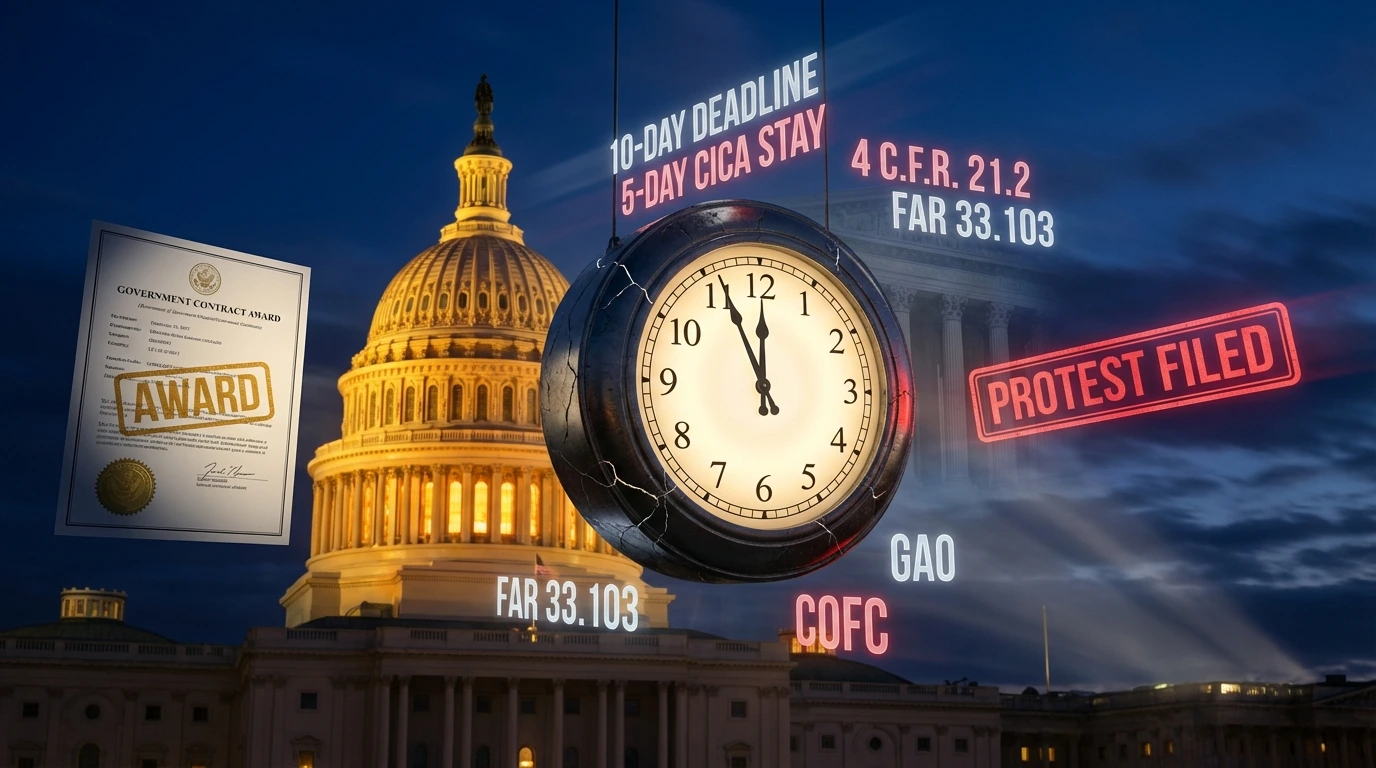
Protesting a federal award is a powerful tool to protect fair competition and improve procurement integrity—especially for small and mid-size businesses. This guide explains the government contract award protest process, how timeliness rules work, and which forum to pick.
We'll cover agency-level protests, GAO bid protest procedures, and Court of Federal Claims bid protest options. We'll also share actionable strategies to strengthen your position, whether you ultimately protest or use the insights to refine your proposals. Applied correctly, this knowledge supports your broader strategy for how to win government contracts.
Why (and When) to Protest
Protests uphold fairness where a procurement may have deviated from the rules. Typical grounds include:
{item}
The decision to protest should weigh probability of success, strategic value, schedule impacts, and cost. While GAO's formal protest sustain rate has been modest (16% in FY 2024), the broader GAO effectiveness rate—sustains plus agency corrective actions—was 52%. In practice, more than half of protesters obtained some form of relief, even without a formal sustain.
Know Your Forums: Agency-Level, GAO, and COFC
Agency-Level Protest (FAR 33.103)
Often fastest and least expensive. Under FAR 33.103, agencies use "best efforts" to resolve protests within 35 days.
Submit directly to the contracting officer or agency protest official. No guaranteed stay like GAO's CICA stay, but agencies can pause award or performance. Great for clear, fixable errors where speed matters.
GAO Bid Protest (4 C.F.R. Part 21)
Most commonly used forum—relatively fast and structured with a statutory 100-day decision deadline.
If filed timely, triggers an automatic CICA stay of award or performance. Includes protective orders, well-defined briefing schedules, and agency report development. Intervenors (typically the awardee) often participate.
Court of Federal Claims (COFC)
Judicial review with a federal judge and formal litigation procedures. No automatic stay—you must seek emergency relief (TRO or preliminary injunction).
Appropriate for complex records, constitutional/statutory interpretation issues, or broader remedial authority. Often chosen after careful strategic assessment.
Timeliness Rules and the CICA Stay: Do Not Miss the Clock
Strict timeliness drives outcomes. Key rules include:
Pre-Award Protests
Challenges to solicitation terms must be filed before the proposal due date.
Post-Award Protests
Generally must be filed within 10 days of when you knew or should have known the basis of protest.
Triggering the CICA Stay at GAO
File within 10 days of award, or within 5 calendar days of a required debriefing.
Enhanced Debriefing (DoD)
The 5-day clock starts when the government delivers written responses to your timely debriefing questions.
Timeline Examples (Award Notified March 1, 2026)
{item.scenario}
{item.deadline}
{item.note}
Use a calendaring system to track bid protest timelines alongside weekends and federal holidays. Missing a deadline typically results in dismissal—even where your arguments have merit.
What GAO's Data Means for You
FY 2024 GAO Bid Protest Statistics
1,803
Total Cases
100%
Met 100-Day Deadline
16%
Sustain Rate
52%
Effectiveness Rate
Down ~11% from FY 2023 (which was elevated by mass filings in CIO-SP4). The effectiveness rate—formal sustains plus agency corrective actions—signals that more than half of protesters obtained relief.
For companies pursuing how to win government contracts, these figures emphasize two truths: (1) many protests lead to corrective action that improves fairness, and (2) success hinges on narrowly tailored, evidence-backed grounds.
Winning Grounds: Build Your Case on the Record
Protests are resolved on the procurement record, not speculation. Focus on legally viable grounds that align with 4 C.F.R. Part 21 and the solicitation. Recurring reasons GAO sustains protests include:
Unreasonable Technical Evaluations
Overlooking strengths or mischaracterizing weaknesses in the evaluation record.
Flawed Best-Value Tradeoff
Conclusory tradeoff decisions that ignore documented advantages or fail to compare total evaluated prices.
Unreasonable Price/Cost Evaluations
Inconsistent realism analysis, failure to follow stated methodology, or accepting below-market rates without risk assessment.
Unequal Treatment or Unstated Criteria
Crediting the awardee for an unstated criterion or applying different standards to similar approaches.
Award-Specific Proof Examples
Unequal Treatment
Your solution received a "moderate risk" for transition, while the awardee's similar approach was called "low risk" without rationale.
Unstated Criteria
The evaluators emphasized ISO certifications never listed in Section M, materially affecting ratings.
Tradeoff Flaws
The Source Selection Authority (SSA) cited a "negligible price premium" to justify the award but failed to compare total evaluated prices or explain technical superiority.
Price Realism
For a labor-intensive requirement, the agency accepted below-market labor rates without analyzing performance risk.
Expect an intervenor—usually the awardee—to participate. Under GAO protective orders, intervenor counsel can review sensitive documents and argue against your claims. Anticipate their counterpoints and ensure your brief is organized, cites the record precisely, and addresses obvious defenses.