How to Finance Your Government Contracting Business
Learn how to finance your government contracting business using FAR progress payments, SBA loans, invoice factoring, and surety bonds to manage cash flow.

Tiatun T.
Federal Sales Consultant · Apr 10, 2026
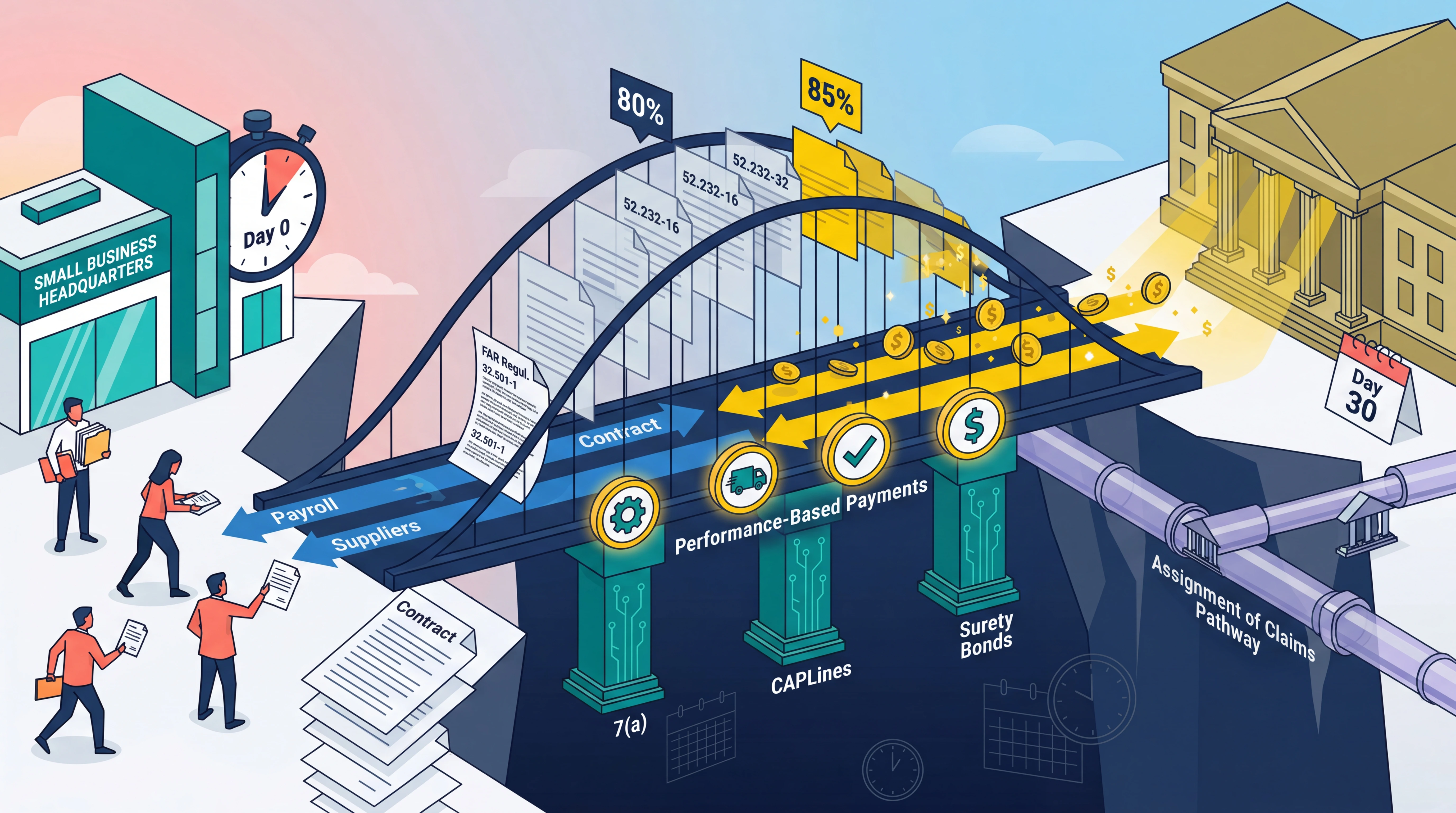
This article explains every major way to finance a government contracting business in the United States — from the payment mechanisms the federal government itself builds into contracts, to commercial lending products designed around federal receivables, to Small Business Administration (SBA) guarantee programs that can unlock capital and bonding capacity you might not qualify for on your own. By the end, you will understand how money actually moves through a federal contract, which financing tools match which contract types, and how to build a cash-flow plan that keeps your company solvent while you wait for the government to pay.
What This Article Covers — and Why Cash Flow Is the Real Game
Here is the uncomfortable truth that every experienced government contractor knows but that rarely appears in “how to win government contracts” guides: winning the award is not the hard part — paying for performance before the government pays you is. A federal agency might take 30 days after accepting your deliverable to release payment. Your employees, suppliers, and landlord will not wait 30 days. The gap between spending money and receiving money is where government contractors fail, and it is where smart financing makes the difference.
Built-In Federal Financing: Progress Payments and Performance-Based Payments
The Federal Acquisition Regulation (FAR) — the massive rulebook governing federal procurement — dedicates an entire part to contract financing: FAR Part 32 [1]. Before you look outside the contract for money, look inside it. The government offers several mechanisms that put cash in your hands before final delivery.
Progress Payments Based on Costs (FAR Subpart 32.5)
If you hold a fixed-price contract for non-commercial supplies or services, you may be eligible for progress payments — periodic reimbursements based on costs you have already incurred. The government’s “customary” rates, established in FAR 32.501-1 and implemented through clause 52.232-16, are 80% of incurred costs for large businesses and 85% for small business concerns [1]. In plain language, if you are a small business and you have spent $100,000 performing the contract, you can submit a progress payment request and receive $85,000 before the final product is delivered and accepted.
A few practitioner-level details matter here. First, progress payments are not automatic — they must be authorized in the contract, and the contracting officer (CO) evaluates whether the contract size, performance period, and financial risk justify them. Second, progress payments create a lien: the government holds title to all work in progress financed by those payments. Third, your accounting system must be adequate to support cost-based billing, which is one reason the Defense Contract Audit Agency (DCAA) or the cognizant audit agency may want to look at your books. If your contract does not include progress payment provisions and you believe the cash-flow gap justifies them, you can ask — the FAR permits the CO to add financing terms at award or even post-award.
Performance-Based Payments (FAR Subpart 32.10)
The government increasingly prefers Performance-Based Payments (PBPs), authorized under FAR Subpart 32.10 and clause 52.232-32 [1]. Instead of reimbursing costs, PBPs tie payments to objective, measurable milestones — for example, completing a software module, delivering a prototype, or passing a test. The advantage for contractors is that PBPs are not capped at the 80/85% cost rates; they can theoretically reimburse up to 90% of the contract price across all events, provided the milestone structure is well designed. The advantage for the government is reduced audit burden, since the agency is verifying deliverables rather than auditing costs.
If you are learning how to win government contracts and your proposal involves clear phases or deliverables, propose a PBP schedule as part of your pricing narrative. It signals financial sophistication and can differentiate your offer.
Advance Payments and Commercial Item Financing
True advance payments — cash provided before any performance — are rare and require high-level approval, strong security (often a lien on assets or an irrevocable letter of credit), and a written determination that no other financing is adequate (FAR Subpart 32.4, clause 52.232-12) [1]. You will encounter advance payments mainly in research contracts, nonprofit arrangements, or national-emergency situations.
For purchases of commercial products or commercial services, financing follows FAR Subpart 32.2 with clauses 52.232-29 through 52.232-31 [1]. Commercial financing can include commercial advance payments and commercial interim payments, but the terms are more flexible and market-oriented than their non-commercial counterparts.
Getting Paid: The Prompt Payment Act and Invoice Platforms
Once you have delivered and the government has accepted your work, the Prompt Payment Act (31 U.S.C. 3901–3907) [3] sets the clock. The standard rule: agencies must pay within 30 days of receiving a “proper invoice” (one that includes all required data — contract number, description of work, quantities, unit prices, and your bank information) and completing acceptance. For construction contracts, the timeline is also 30 days but uses clause 52.232-27 instead of 52.232-25 [1]. If the agency pays late, interest accrues automatically — you do not need to demand it.
In practice, the payment clock starts when acceptance is recorded in the agency’s invoicing system. Civilian agencies often use the Treasury Invoice Processing Platform (IPP) [10], while the Department of Defense (DoD) uses Wide Area Workflow (WAWF), which now lives inside the Procurement Integrated Enterprise Environment (PIEE) [11]. If your invoice is “proper” but the contracting officer’s representative (COR) has not clicked “accept” in WAWF, your 30 days have not started. Build relationships with your COR and program manager to ensure timely acceptance — this is the single highest-leverage cash-flow action most contractors overlook.
All payments go by Electronic Funds Transfer (EFT) to the bank account registered in the System for Award Management (SAM), as required by FAR Subpart 32.11 and clause 52.232-33 [1]. If your SAM registration is expired, incomplete, or lists the wrong bank account, your payment will stall. Use GovBidLab’s UEI Lookup tool to confirm your Unique Entity Identifier (UEI) status and SAM registration are current before you submit your first invoice.
Accelerated Payments for Small Businesses
Federal policy encourages agencies to accelerate payments to small business prime contractors — often paying within 15 days rather than 30. Under FAR 32.009 and clause 52.232-40, prime contractors who receive accelerated payments are expected to accelerate payment to their small business subcontractors as well [1]. If you are a small business subcontractor, ask your prime whether accelerated payment terms apply to your contract — and make sure your subcontract includes flowdown language reflecting this obligation.
Commercial Financing: Assignment of Claims and Invoice Factoring
Sometimes government financing mechanisms are not enough, especially during startup or rapid growth. This is where commercial financing tailored to federal receivables becomes essential.
Assignment of Claims (FAR Subpart 32.8)
The Assignment of Claims Act (31 U.S.C. 3727; 41 U.S.C. 6305) [4] allows you to assign — essentially pledge — your right to receive payment under a federal contract to a bank or financing institution. FAR Subpart 32.8 and clause 52.232-23 implement this [1]. After you execute an assignment instrument and provide the required notices to both the contracting officer and the agency’s finance office, the lender can advance you cash against your invoices and collect payment directly from the government.
This is the legal foundation for invoice factoring on federal contracts. A factor (a specialized lender) purchases your receivables at a discount — typically advancing 80–95% of the invoice value within days — and then collects the full amount from the government when payment is due. For contractors who need working capital for government contracts but lack the credit history for a traditional line of credit, factoring can be a lifeline.
Important nuances for practitioners: partial assignments are generally prohibited — you must assign the full payment stream from a contract, not individual invoices in isolation. Also, unless your contract includes the “no-setoff” provision (Alternate I of clause 52.232-23), the government can still reduce assigned payments for debts you owe the government [1]. Confirm whether your contract includes that alternate before your lender assumes it can collect the full invoiced amount.
Traditional Bank Lines and Working Capital Loans
Banks that understand federal contracting — and there are specialists — will underwrite revolving lines of credit against your contract backlog (the total remaining value of your awarded contracts). The combination of a signed federal contract and the certainty of the Prompt Payment Act makes government receivables attractive collateral. When you are evaluating lenders, look for experience with government contract financing specifically; a local bank that lends primarily against real estate may not understand how to underwrite a contract vehicle.
SBA Programs: Loans, Lines, and Surety Bonds
The SBA operates several programs purpose-built for small government contractors. Your eligibility depends on your size — which is determined by your North American Industry Classification System (NAICS) code and the associated size standard (either annual revenue or number of employees).
| Program | Maximum Amount | Best For | Key Feature |
|---|---|---|---|
| 7(a) Loan | $5,000,000 | General working capital, equipment, contract mobilization | Most flexible SBA loan; can cover a wide range of needs [6] |
| 504/CDC Loan | $5,500,000 (debenture) | Major fixed assets — real estate, heavy equipment | Long-term fixed rate; ideal for facilities supporting contract performance [7] |
| CAPLines (Contract CAPLine) | $5,000,000 | Direct costs of performing assignable contracts | Asset-based revolving line; draws and repayments tied to contract cycle [8] |
The SBA CAPLines financing program deserves special attention. The Contract CAPLine is specifically designed to finance the direct labor, materials, and other costs of performing an individual government contract [8]. It works like a revolving line of credit, but each draw is tied to a specific assignable contract. As you incur costs and submit invoices, you draw on the line; as the government pays, the line is repaid. This structure mirrors the cash-flow cycle of a typical federal contract almost exactly.
For practitioners: the Contract CAPLine requires that the underlying contract be assignable under the Assignment of Claims Act — which circles back to clause 52.232-23 in your contract. Verify the clause is present before applying.
Surety Bond Guarantee Program
If you pursue federal construction contracts — or certain service contracts requiring bonds — you will encounter the Miller Act (40 U.S.C. 3131) [2]. It requires performance and payment bonds on most federal construction contracts exceeding $150,000. For contracts between $35,000 and $150,000, the contracting officer must require some form of alternative payment protection [2]. Bonding is a financing issue because surety companies underwrite your financial strength, experience, and capacity before issuing a bond — and many small contractors cannot qualify.
The SBA’s Surety Bond Guarantee (SBG) Program solves this by guaranteeing 80–90% of the surety’s loss [9]. The program supports bonds on federal contracts up to $6.5 million, and up to $10 million with a contracting officer’s certification of necessity. If you have been told you “can’t get bonded,” the SBG program may change that answer entirely.
Pricing What You Finance — and What the FAR Allows
Here is a subtlety that catches many contractors off guard: FAR 31.205-20 makes interest and most financial costs unallowable as direct charges on cost-reimbursement contracts [5]. You cannot bill the government for the interest on your line of credit or the discount fee your factor charges. However, you can — and should — account for financing costs when building your proposed fixed prices or when computing your indirect rates (overhead, general and administrative). The cost is real; the FAR simply dictates where it lives in your pricing structure.
Bond premiums are expressly allowable under FAR 31.205-4 [5]. Include them as a direct cost in your construction pricing. Failing to do so is leaving money on the table.
For contracts below the Simplified Acquisition Threshold (SAT) of $250,000 (FAR 2.101; FAR 13.201) [1], and especially below the Micro-Purchase Threshold (MPT) of $10,000, payment cycles are typically much shorter. Many micro-purchases are made with the governmentwide purchase card (GPC), which means payment can arrive within days rather than weeks. If you are just learning how to win government contracts, starting with simplified acquisitions and micro-purchases can reduce your financing burden dramatically while you build past performance.
Cost-Reimbursement Withholds
On cost-reimbursement contracts, be aware that the government may withhold a portion of your fee until contract closeout. Under clause 52.216-8 (Fixed Fee), the CO may withhold up to 15% of the fixed fee, not to exceed $100,000 [1]. This withhold protects the government during closeout but can tie up significant cash for months or even years if closeout drags. Factor this into your cash-flow projections from day one.
Cybersecurity and Compliance Costs Are Financing Decisions Too
If you are pursuing DoD contracts, the Cybersecurity Maturity Model Certification (CMMC) program requires investments in cybersecurity infrastructure that can cost tens of thousands of dollars for small businesses. These are real capital expenditures that need to be financed and, where allowable, recovered through your indirect rates. GovBidLab’s free CMMC Calculator can help you estimate these costs before you commit to a financing plan.
What to Do Next
Pull out your most recent federal contract (or the solicitation you are bidding on) and identify three things: which financing clauses are included (look for 52.232-16, 52.232-32, or 52.232-23), what the payment terms say, and whether bonding is required. Then map those answers to the financing options in this article. That single exercise will tell you exactly which tools — progress payments, a CAPLine, invoice factoring, or an SBA bond guarantee — fit your situation. Start with what the contract gives you for free, then layer on commercial and SBA products to close the remaining gap. Explore all of GovBidLab’s free tools to make sure your registrations, codes, and compliance posture support whatever financing path you choose.
Glossary of Terms Used in This Article
Assignment of Claims — A legal mechanism allowing a contractor to transfer (“assign”) its right to receive payment on a federal contract to a bank or lender, enabling that lender to collect directly from the government.
CAPLine (Contract CAPLine) — An SBA revolving line of credit designed to finance the direct costs of performing a specific government contract. Draws and repayments are tied to the contract’s invoicing cycle.
CMMC (Cybersecurity Maturity Model Certification) — A DoD framework requiring contractors handling sensitive information to meet specific cybersecurity standards, verified through assessment.
CO (Contracting Officer) — The government official with authority to enter into, administer, and terminate federal contracts. Only the CO can bind the government.
COR (Contracting Officer’s Representative) — A government employee designated by the CO to monitor contract performance and verify deliverables. The COR typically handles day-to-day oversight and acceptance.
DCAA (Defense Contract Audit Agency) — The DoD agency responsible for auditing contractors’ accounting systems, incurred costs, and pricing proposals.
DoD (Department of Defense) — The largest purchasing agency in the U.S. government.
EFT (Electronic Funds Transfer) — The electronic method by which the government sends payments directly to a contractor’s bank account, as registered in SAM.
FAR (Federal Acquisition Regulation) — The primary set of rules governing how the federal government buys goods and services. Organized into parts, subparts, and clauses.
GPC (Governmentwide Purchase Card) — A government-issued credit card used for small purchases, typically below the micro-purchase threshold. Provides fast payment to vendors.
GSA MAS (General Services Administration Multiple Award Schedule) — A long-term government contract vehicle that allows agencies to buy commercial products and services at pre-negotiated prices.
IPP (Invoice Processing Platform) — The U.S. Treasury’s electronic system used by civilian agencies to receive and process contractor invoices.
Invoice Factoring — A commercial financing arrangement where a lender (“factor”) purchases your outstanding invoices at a discount, giving you immediate cash and collecting from the customer (in this case, the government) later.
Miller Act — A federal law (40 U.S.C. 3131) requiring performance and payment bonds on most federal construction contracts above $150,000.
MPT (Micro-Purchase Threshold) — The dollar limit — generally $10,000 — below which the government can buy goods and services with minimal competition, often using a purchase card.
NAICS Code (North American Industry Classification System) — A six-digit number that classifies your business by industry. The SBA assigns a size standard to each NAICS code to determine small business eligibility.
PBP (Performance-Based Payment) — A contract financing method that ties payments to the achievement of specific, measurable milestones rather than costs incurred.
PIEE (Procurement Integrated Enterprise Environment) — The DoD’s suite of web-based tools for procurement and payment, which includes Wide Area Workflow (WAWF).
Progress Payment — A periodic payment made to a contractor based on a percentage of costs incurred during contract performance, before final delivery.
Prompt Payment Act — A federal law (31 U.S.C. 3901–3907) requiring agencies to pay contractors within specified timeframes (typically 30 days) and to pay interest automatically on late payments.
SAM (System for Award Management) — The government’s central registration database. Contractors must have an active SAM registration — including current banking information — to receive contract awards and payments.
SAT (Simplified Acquisition Threshold) — The dollar limit — generally $250,000 — below which the government can use streamlined purchasing procedures.
SBA (Small Business Administration) — A federal agency that supports small businesses through loan guarantees, surety bond guarantees, contracting assistance, and set-aside programs.
SBG (Surety Bond Guarantee) Program — An SBA program that guarantees 80–90% of a surety company’s loss on bonds issued to small businesses, making it easier for small contractors to qualify for required bonds.
UEI (Unique Entity Identifier) — A 12-character alphanumeric code assigned to every entity registered in SAM, replacing the former DUNS number. Required for all federal contracting.
WAWF (Wide Area Workflow) — The DoD’s electronic invoicing and receipt/acceptance system, now part of PIEE. Contractors submit invoices and receiving officials record acceptance here.
References
[1] Federal Acquisition Regulation (FAR), Parts 2, 13, 28, 31, and 32; clauses 52.232-12, -16, -23, -25, -27, -32, -33, -40, and 52.216-8. General Services Administration, Department of Defense, and National Aeronautics and Space Administration. Current through FAC 2024-05.
[2] FAR Part 28 — Bonds and Insurance (28.102-1), implementing the Miller Act (40 U.S.C. 3131). acquisition.gov.
[3] Prompt Payment Act, 31 U.S.C. §§ 3901–3907; OMB Prompt Payment regulations, 5 CFR Part 1315. uscode.house.gov.
[4] Assignment of Claims Act, 31 U.S.C. § 3727; 41 U.S.C. § 6305. uscode.house.gov.
[5] FAR Part 31 — Contract Cost Principles, including 31.205-4 (Bonding costs) and 31.205-20 (Interest and other financial costs). acquisition.gov.
[6] SBA 7(a) Loan Program. U.S. Small Business Administration. sba.gov.
[7] SBA 504 Loan Program. U.S. Small Business Administration. sba.gov.
[8] SBA CAPLines Program. U.S. Small Business Administration. sba.gov.
[9] SBA Surety Bond Guarantee Program. U.S. Small Business Administration. sba.gov.
[10] Invoice Processing Platform (IPP) — Vendor Information. U.S. Department of the Treasury, Bureau of the Fiscal Service. ipp.gov.
[11] Procurement Integrated Enterprise Environment (PIEE) / Wide Area Workflow. U.S. Department of Defense. piee.eb.mil.