How Congressional Spending Priorities Shape Your Federal Contracts Pipeline
Congressional spending decisions — annual appropriations, the NDAA, and Continuing Resolutions — directly control what agencies can buy, when they can buy it, and which contractors win. This article explains the exact mechanisms that translate a Capitol Hill vote into a SAM.gov solicitation, with a concrete BD playbook aligned to the federal budget cycle.

Tiatun T.
Federal Sales Consultant · May 7, 2026
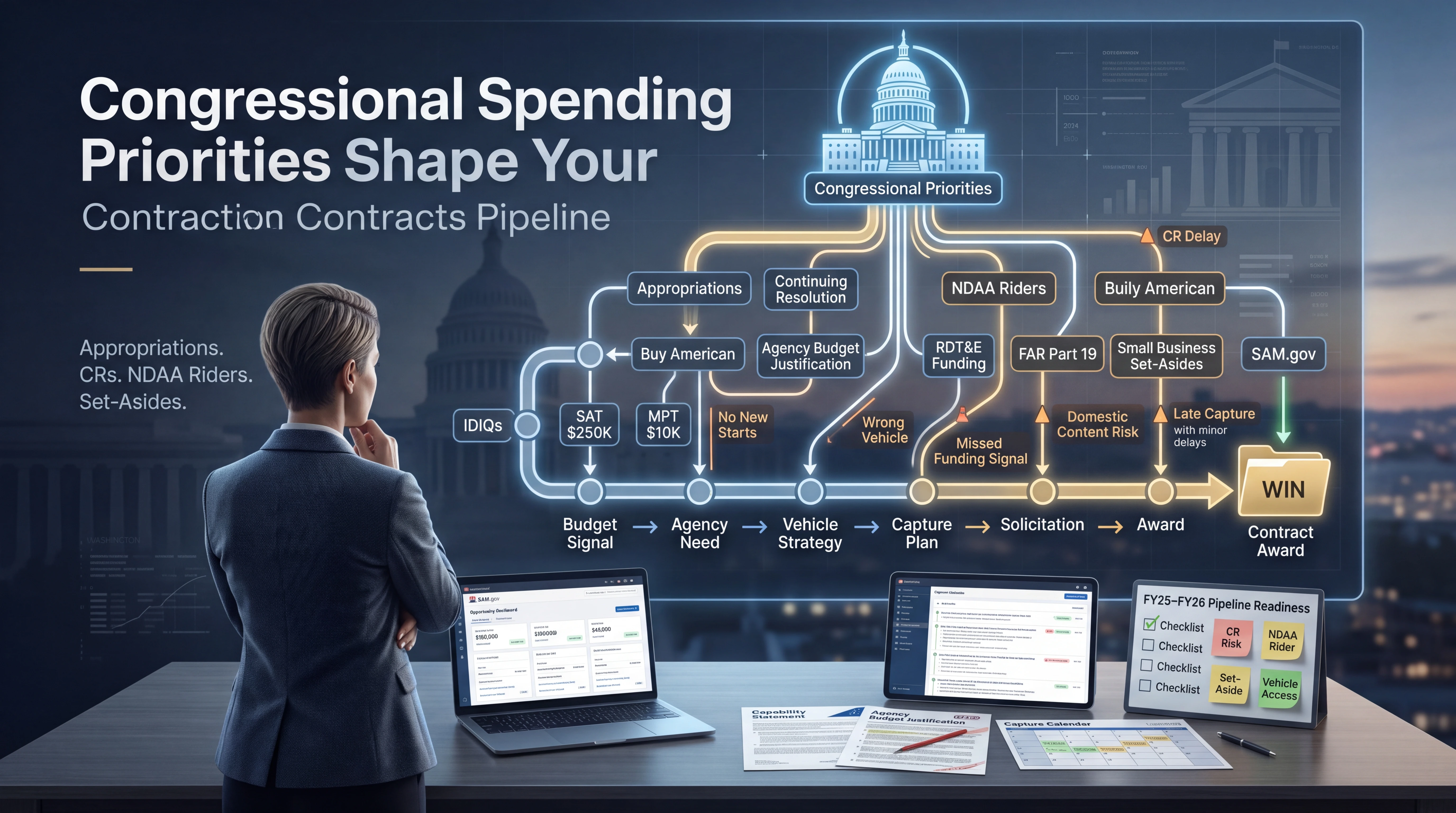
What This Article Covers — and Why It Matters to Your Pipeline
This article explains how congressional spending decisions — annual appropriations bills, the National Defense Authorization Act (NDAA), and Continuing Resolutions (CRs) — directly control what agencies can buy, when they can buy it, and which contractors are best positioned to win. By the end, you'll understand the specific mechanisms that translate a vote on Capitol Hill into a solicitation on SAM.gov, and you'll have a concrete playbook for aligning your business development (BD) strategy to the congressional funding cycle. Whether you're trying to figure out how to win government contracts for the first time or you're a seasoned BD director recalibrating your FY26 pipeline, the funding trail always starts in Congress.
Two Mechanisms That Matter: Availability of Funds and Policy Riders
When Congress passes a spending bill, two things land on your desk as a contractor — even if you never read the bill itself. The first is availability of funds. An agency cannot obligate (legally commit to spend) a single dollar on your contract unless Congress has appropriated the money and the Office of Management and Budget (OMB) has apportioned it. This isn't a technicality — it's enforced by the Anti-Deficiency Act (31 U.S.C. §§ 1341, 1517), which makes it a criminal offense for a government official to spend money Congress hasn't provided [5]. In practical terms, this means your perfectly scored proposal can sit un-awarded if the agency's account is empty or frozen. Understanding which appropriations account funds your target program — and whether that account has been signed into law — is the single most important piece of intelligence a BD team can gather.
The second mechanism is policy riders: provisions Congress attaches to appropriations or authorization bills that tell agencies how to spend, not just how much. Riders are where Congress imposes domestic sourcing rules (Federal Acquisition Regulation (FAR) Part 25), small business utilization targets (FAR Part 19), contract-type restrictions (such as limits on cost-reimbursement contracts for certain research and development work), cybersecurity mandates, and supply-chain prohibitions targeting specific foreign sources. These riders eventually become FAR clauses, Defense Federal Acquisition Regulation Supplement (DFARS) clauses, or evaluation criteria in the solicitations you respond to. If you've ever wondered why a Request for Proposals (RFP) suddenly requires a Cybersecurity Maturity Model Certification (CMMC) assessment or a domestic content certification that wasn't there last year, the answer is almost always a rider that Congress passed six to eighteen months earlier.
For practitioners, here's the nuance that's easy to miss: riders don't always appear in the bill's main text. Many are embedded in committee report language or explanatory statements, which are not legally binding in the same way as statute but which agencies treat as near-mandatory direction. Tracking committee reports — not just bill text — gives you a lead-time advantage on emerging requirements.
Continuing Resolutions: How Funding Limbo Changes the Game
A Continuing Resolution is a stopgap spending bill that keeps the government open when Congress hasn't passed full-year appropriations by the start of the fiscal year (October 1). Under a CR, agencies generally operate at prior-year funding rates and face a critical constraint: no new starts. That means no new programs, no new contract awards for efforts that didn't exist in the prior fiscal year, and — in practice — extreme caution from Contracting Officers (COs) who don't want to run afoul of apportionment rules under OMB Circular A-11 [5].
What does this mean for your pipeline? During CR periods, expect to see:
- Bridge contracts and extensions on existing work, because agencies can continue what they were already doing but can't launch new procurements.
- Heavier ordering against existing Indefinite-Delivery/Indefinite-Quantity (IDIQ) contracts and Blanket Purchase Agreements (BPAs), because task orders on existing vehicles are generally not "new starts." If you're on an IDIQ, a CR is your moment. If you're not, you're largely frozen out until full-year appropriations arrive.
- Shorter periods of performance and smaller funding increments, because COs are rationing uncertain budgets.
- Risk-averse evaluation approaches — more Lowest Price Technically Acceptable (LPTA) awards, fewer complex best-value tradeoffs — because the priority is keeping operations running, not innovation.
The key insight for FY25 and beyond: the U.S. has operated under CRs for at least part of the fiscal year in most recent years. Treating CRs as the exception is a planning failure — treat them as a recurring condition and build your capture calendar accordingly.
If you're evaluating whether to pursue a General Services Administration (GSA) Multiple Award Schedule (MAS) to position for CR-period ordering, GovBidLab's free GSA Eligibility Calculator can help you assess whether your revenue and experience profile qualifies.
The Buy American Escalator and BABA: Domestic Content Is Getting Harder
Congress has made domestic sourcing a sustained priority across multiple administrations, and the compliance bar is rising on a published schedule. Here's what you need to know:
| Rule | What It Covers | Current Threshold | Next Change | Source |
|---|---|---|---|---|
| Buy American Act (BAA) | Direct federal procurement of manufactured end products and construction materials | 65% domestic content (effective January 1, 2024) | 75% on January 1, 2029; fallback mechanism through December 31, 2030 | FAR 25.101, 25.201; FAR Case 2021-008 [2] |
| Build America, Buy America Act (BABA) | Iron, steel, manufactured products, and construction materials on federally funded infrastructure (grants/loans to state and local recipients) | 100% domestic for iron/steel; manufactured products rules vary by agency implementation | Tighter material classifications and waiver justifications ongoing | 2 CFR Part 184; revised 2 CFR Part 200 [6] |
The BAA and BABA are separate regimes, but contractors performing infrastructure work often face both simultaneously. The BAA applies when you're selling directly to the federal government. The BABA applies when you're performing under a contract funded by a federal grant or loan to a state or local entity — even though you may never interact with a federal CO. The practical impact is that you need a bill of materials that traces domestic content at the component level, supplier certifications proving country of origin, and a documented workflow for requesting waivers when compliant products aren't available at reasonable cost.
The practitioner edge here: the 65% threshold that took effect January 1, 2024 uses a cost-based calculation — the cost of domestic components must exceed 65% of the cost of all components. That sounds straightforward, but "component" is defined at FAR 25.003, and the line between a component and a sub-component (which doesn't count separately) trips up experienced contractors. If you haven't re-mapped your supply chain to the updated definitions since the 2024 threshold change, you may be certifying compliance based on an outdated analysis.
Small Business Goals, Set-Asides, and the Year-End Velocity Spike
Small business contracting isn't a feel-good initiative — it's a statutory mandate with teeth. Under 15 U.S.C. § 644(g) and FAR Subpart 19.2, the federal government must award at least 23% of prime contract dollars to small businesses, with sub-goals of 5% to Small Disadvantaged Businesses (SDB), 5% to Women-Owned Small Businesses (WOSB), 3% to HUBZone firms, and 3% to Service-Disabled Veteran-Owned Small Businesses (SDVOSB) [4]. These aren't aspirational — agency heads are scored on them, and COs feel real pressure to use set-asides, especially in Q3 and Q4 of the fiscal year (April through September).
This creates a predictable opportunity window. As September 30 approaches — the end of the federal fiscal year — agencies scramble to obligate remaining funds before they expire. This year-end spending surge disproportionately benefits small businesses because set-aside purchases under the Simplified Acquisition Threshold (SAT) of $250,000 (FAR 2.101) [1] are fast, low-risk ways for agencies to both spend down balances and boost small business numbers. Below the SAT, agencies use Simplified Acquisition Procedures (FAR Part 13), which means shorter solicitation timelines, less paperwork, and faster awards. Below the Micro-Purchase Threshold (MPT) of $10,000 (FAR 2.101) [1], COs can buy with a government purchase card without competitive bidding at all.
If you're a small business, verify your size standard and NAICS (North American Industry Classification System) code eligibility now — not in August. GovBidLab's free NAICS Code Lookup tool lets you confirm your size status against current SBA thresholds for any code you're considering.
For large businesses, the small business emphasis affects you too: your subcontracting plans (required on contracts over $750,000, or $1.5 million for construction) must demonstrate meaningful small business participation. Agencies are increasingly auditing these plans post-award, and SBA's Commercial Market Representatives are more active than they were five years ago. If your plan says 25% small business subcontracting but your actuals are running at 8%, expect scrutiny at option time.
NDAA Policy Riders Shaping FY25–FY26 Solicitations
The NDAA isn't just a defense spending bill — it's the vehicle Congress uses to inject contracting policy changes that often ripple across the entire federal government. Here are three rider categories that will shape solicitations you see in FY25 and FY26:
- Cybersecurity flow-downs. The Department of Defense (DoD) has been tightening cybersecurity requirements through DFARS clauses 252.204-7012, -7019, and -7020 [7], which mandate safeguarding of Controlled Unclassified Information (CUI) and require self-assessments (and eventually third-party assessments) under the CMMC framework. These requirements flow down to subcontractors handling CUI, which means even small firms performing as subs on DoD contracts need to understand their CMMC level requirement. Congress has signaled through multiple NDAAs that this trajectory will continue and likely expand to civilian agencies. If you haven't assessed your CMMC readiness, GovBidLab's free CMMC Calculator gives you a quick baseline estimate of where you stand.
- Supply chain security prohibitions. Recent NDAAs and appropriations riders prohibit the use of products and services from specific foreign entities (most notably certain Chinese telecommunications and surveillance companies under Section 889 of the FY2019 NDAA). These prohibitions are showing up as evaluation factors and representations in solicitations. As a contractor, you need to be able to certify your supply chain doesn't include prohibited sources — and if you're a subcontractor, expect your prime to demand the same certification from you.
- Research, Development, Test, and Evaluation (RDT&E) funding for AI and critical technologies. Congress has steadily increased RDT&E appropriations for artificial intelligence, quantum computing, and hypersonics. For contractors, this means more solicitations using Other Transaction Authorities (OTAs), more Broad Agency Announcements (BAAs), and more emphasis on technical differentiation rather than lowest price. If your firm does R&D work, tracking specific program element (PE) numbers in the RDT&E budget justification documents gives you six to twelve months of lead time on upcoming solicitations. These documents are public, published with each budget request, and vastly underutilized by BD teams outside the top-tier defense firms.
Understanding how to read these signals is a core part of learning how to win government contracts in a landscape where requirements are increasingly shaped by congressional policy, not just agency need.
Thresholds That Determine How Agencies Buy From You
Congressional spending decisions don't just affect how much money is available — they set the regulatory thresholds that determine the acquisition method an agency uses. Here are the thresholds every contractor should have memorized:
| Threshold | Dollar Value | What It Triggers | Source |
|---|---|---|---|
| Micro-Purchase Threshold (MPT) | $10,000 | Purchase card buys; no competition required | FAR 2.101; FAR 13.201 [1] |
| Simplified Acquisition Threshold (SAT) | $250,000 | Simplified procedures (FAR Part 13); automatic small business set-aside below SAT | FAR 2.101; FAR Part 13 [1] |
| Truthful Cost or Pricing Data (TINA) Threshold | $2,000,000 | Certified cost or pricing data required above this amount (with exceptions) | FAR 15.403-4; 10 U.S.C. § 3702 [3] |
For newcomers: these thresholds dictate the complexity of the process. Below the MPT, buying is almost casual. Below the SAT, it's streamlined. Above the TINA threshold, you may need to open your accounting books to the government. For practitioners: remember that the TINA threshold applies to subcontracts too (FAR 15.403-4), and that exceptions exist for adequate price competition, commercial products/services, and prices set by law or regulation. If you're a subcontractor on a cost-type prime contract and your sub value exceeds $2 million, expect the prime's CO to require certified cost or pricing data from you unless you can demonstrate an exception applies.
These thresholds were set by the NDAA for Fiscal Year 2018 and have remained static since, meaning inflation has effectively expanded the range of contracts eligible for simplified treatment — a quiet win for both buyers and small sellers.
How to Align Your BD Strategy to the Congressional Calendar
Understanding how to win government contracts requires syncing your business development rhythm to the federal budget cycle. Here's the practical framework:
- February–April (President's Budget and Congressional Hearings): The President's budget request drops in early February. It's a wish list, not law, but it tells you where the administration wants to increase, cut, or restructure spending. Read the agency budget justification documents — particularly the RDT&E and procurement annexes — for specific program names, funding levels, and new starts. This is your earliest signal of which programs will generate solicitations in 12–18 months.
- May–September (Markup, Conference, and Appropriations Uncertainty): Congressional committees mark up appropriations and authorization bills. Watch for riders that add domestic content requirements, cybersecurity mandates, or set-aside provisions. If full-year appropriations aren't enacted by October 1, prepare your pipeline for CR conditions: prioritize opportunities on existing IDIQ vehicles and BPAs, deprioritize new-start programs that may be delayed.
- October–December (CR Period or Early Execution): If a CR is in effect, agencies are in maintenance mode. Use this time to build relationships, attend industry days, and refine your capability statements. GovBidLab's free Capability Statement Generator helps you tailor your capabilities to align with the spending priorities Congress is signaling — a small effort that makes a measurable difference when a CO is scanning for qualified sources.
- January–March (Full-Year Appropriations Arrive, or Don't): If Congress passes an omnibus or full-year bills, agencies suddenly have clarity and new-start authority. Expect a wave of solicitations in Q2–Q3 and a velocity spike in Q4 as agencies rush to obligate. This is when your pre-positioned pipeline — the relationships built during the CR, the IDIQ seats you already hold, the capability statements already on file — converts into wins.
During accelerated year-end buys, teaming arrangements come together fast. Use GovBidLab's free UEI Lookup tool to verify potential teaming partners' Unique Entity Identifiers and SAM.gov registration status before you commit to a joint proposal on a short deadline.
What to Do Next
Pick one target agency and pull its most recent Congressional Budget Justification document (search "[agency name] congressional budget justification FY2025" — they're all public PDFs). Find the program that aligns with your capabilities and note its funding trend: up, down, or flat. That single data point tells you more about your pipeline's future than any forecast briefing. Then map your existing contract vehicles against that agency's likely buying behavior under current appropriations status — are you positioned on the IDIQs and schedules they'll use during a CR, or are you dependent on new-start awards that may be delayed? The answer determines your next move.
Glossary of Terms Used in This Article
| Term / Acronym | Definition |
|---|---|
| Anti-Deficiency Act (ADA) | A federal law (31 U.S.C. §§ 1341, 1517) that prohibits government officials from spending more money than Congress has appropriated or obligating funds in advance of an appropriation. Violations can result in administrative discipline or criminal penalties. |
| BAA (Buy American Act) | A 1933 law requiring the federal government to prefer domestic end products and construction materials in its direct purchases. Not to be confused with BABA or Broad Agency Announcements, which share the same acronym. |
| BABA (Build America, Buy America Act) | A provision in the 2021 Infrastructure Investment and Jobs Act that requires domestic content for iron, steel, manufactured products, and construction materials on federally funded infrastructure projects, including those performed by state and local grant recipients. |
| BD (Business Development) | The function within a contracting company responsible for identifying, qualifying, and pursuing new contract opportunities. |
| BPA (Blanket Purchase Agreement) | A simplified method of filling anticipated repetitive needs for supplies or services by establishing charge accounts with qualified sources. Think of it as a pre-approved vendor list with negotiated terms. |
| CMMC | Cybersecurity Maturity Model Certification. A Department of Defense framework that measures a contractor's cybersecurity practices at multiple levels. Required for handling Controlled Unclassified Information on DoD contracts. |
| CO (Contracting Officer) | The government official with legal authority to enter into, administer, and terminate contracts on behalf of the U.S. government. |
| CR (Continuing Resolution) | A temporary spending bill that funds government agencies at prior-year levels when Congress hasn't passed full-year appropriations by the start of the fiscal year. |
| CUI (Controlled Unclassified Information) | Government-created or government-received information that requires safeguarding but is not classified. Common in defense and homeland security contracts. |
| DFARS | Defense Federal Acquisition Regulation Supplement. The DoD-specific supplement to the FAR containing additional rules and contract clauses for defense acquisitions. |
| DoD (Department of Defense) | The federal department responsible for military and national security operations; the single largest buyer in the federal government. |
| FAR (Federal Acquisition Regulation) | The primary set of rules governing how the federal government buys goods and services. Published jointly by GSA, DoD, and NASA. |
| GSA (General Services Administration) | The federal agency that manages government-wide procurement vehicles, including the Multiple Award Schedule (MAS) program. |
| HUBZone | Historically Underutilized Business Zone — an SBA program giving contracting preferences to small businesses located in economically distressed areas. |
| IDIQ (Indefinite-Delivery/Indefinite-Quantity) | A contract type that provides for an indefinite quantity of supplies or services during a fixed period. Work is issued through individual task or delivery orders. |
| LPTA (Lowest Price Technically Acceptable) | An evaluation approach where the government awards to the lowest-priced proposal that meets minimum technical requirements, with no tradeoff for higher quality. |
| MAS (Multiple Award Schedule) | A GSA-managed long-term government-wide contract program that gives agencies a pre-competed vehicle to buy commercial products and services at pre-negotiated prices. |
| MPT (Micro-Purchase Threshold) | The dollar amount ($10,000 baseline) below which a government buyer can purchase without competitive bidding, typically using a government purchase card. |
| NAICS (North American Industry Classification System) | A coding system that classifies businesses by industry type. Each code has an associated SBA size standard that determines whether a firm qualifies as "small" for that industry. |
| NDAA (National Defense Authorization Act) | An annual law that authorizes defense spending levels and sets defense policy. Often includes contracting policy provisions that affect civilian agencies as well. |
| OMB (Office of Management and Budget) | The executive branch office that oversees the federal budget, apportions funds to agencies, and issues government-wide procurement and financial management guidance. |
| OTA (Other Transaction Authority) | A contracting mechanism outside the FAR used primarily by DoD to fund research, prototyping, and production projects, often with non-traditional defense contractors. |
| RDT&E (Research, Development, Test, and Evaluation) | A category of defense appropriations funding that covers basic research, applied research, technology development, and system testing. |
| RFP (Request for Proposals) | A formal solicitation document asking contractors to submit proposals for a defined requirement, typically evaluated on both technical merit and price. |
| SAT (Simplified Acquisition Threshold) | The dollar amount ($250,000) below which agencies can use streamlined buying procedures under FAR Part 13, including automatic small business set-asides. |
| SBA (Small Business Administration) | The federal agency that sets small business size standards, administers set-aside programs, and advocates for small business participation in federal contracting. |
| SDB (Small Disadvantaged Business) | A small business that is at least 51% owned and controlled by one or more individuals who are socially and economically disadvantaged. Eligible for certain contracting preferences. |
| SDVOSB | Service-Disabled Veteran-Owned Small Business. A small business at least 51% owned and controlled by one or more veterans with a service-connected disability. Eligible for sole-source and set-aside awards. |
| TAA (Trade Agreements Act) | A law that requires products purchased under certain large-dollar government contracts to be manufactured or substantially transformed in the U.S. or a TAA-designated country. Applies to GSA Schedule purchases and purchases above certain thresholds. |
| TINA (Truthful Cost or Pricing Data) | The law (now codified at 10 U.S.C. § 3702) requiring contractors to submit certified cost or pricing data on contracts exceeding $2,000,000, unless an exception applies. |
| UEI (Unique Entity Identifier) | A 12-character alphanumeric code assigned to entities registered in SAM.gov, replacing the former DUNS number. Required for all federal contract and grant recipients. |
| WOSB (Women-Owned Small Business) | A small business at least 51% owned and controlled by one or more women. Eligible for set-aside awards in industries where WOSBs are underrepresented. |
References
- Federal Acquisition Regulation (FAR) Part 13 – Simplified Acquisition Procedures; FAR 2.101 – Definitions (SAT, MPT). General Services Administration, Department of Defense, NASA. acquisition.gov/far/part-13.
- FAR Part 25 – Foreign Acquisition; FAR 25.101 and 25.201 – Buy American Act domestic content thresholds; FAR Case 2021-008 (domestic content phase-up schedule, effective January 1, 2024). General Services Administration, Department of Defense, NASA. acquisition.gov/far/part-25.
- FAR 15.403-4 – Requiring Certified Cost or Pricing Data; Truthful Cost or Pricing Data threshold ($2,000,000, effective July 1, 2018 per NDAA FY2018); 10 U.S.C. § 3702. General Services Administration, Department of Defense, NASA. acquisition.gov/far/15.403-4.
- 15 U.S.C. § 644(g) – Small business prime contracting statutory goals; FAR Subpart 19.2 – Policies on small business set-asides. U.S. Small Business Administration; Federal Acquisition Regulation. acquisition.gov/far/subpart-19.2.
- Anti-Deficiency Act, 31 U.S.C. §§ 1341, 1517; OMB Circular A-11 – Preparation, Submission, and Execution of the Budget (apportionment and CR execution rules). Office of Management and Budget. whitehouse.gov/omb/information-for-agencies/circulars.
- 2 CFR Part 184 and revised 2 CFR Part 200 – Build America, Buy America Act (BABA) implementation guidance for federally funded infrastructure (effective late 2023). Office of Management and Budget. ecfr.gov/current/title-2/subtitle-A/chapter-I/part-184.
- DFARS 252.204-7012, -7019, -7020 – Safeguarding Covered Defense Information, NIST SP 800-171 Assessment Requirements, and CMMC flow-down provisions. Department of Defense. acquisition.gov/dfars.