GSA Schedule Pricing Updates: What Changed and How to Protect Your Rates
GSA's temporary inflation pricing flexibilities are gone — and standard EPA clause enforcement is back. This practitioner guide explains which clauses cap your rate ceiling, how the Price Reductions Clause creates compliance traps, and the exact pre-modification checklist to protect your margins on every GSA Schedule increase request.

Tiatun T.
Federal Sales Consultant · May 18, 2026
What This Article Covers — and Why It Matters Right Now
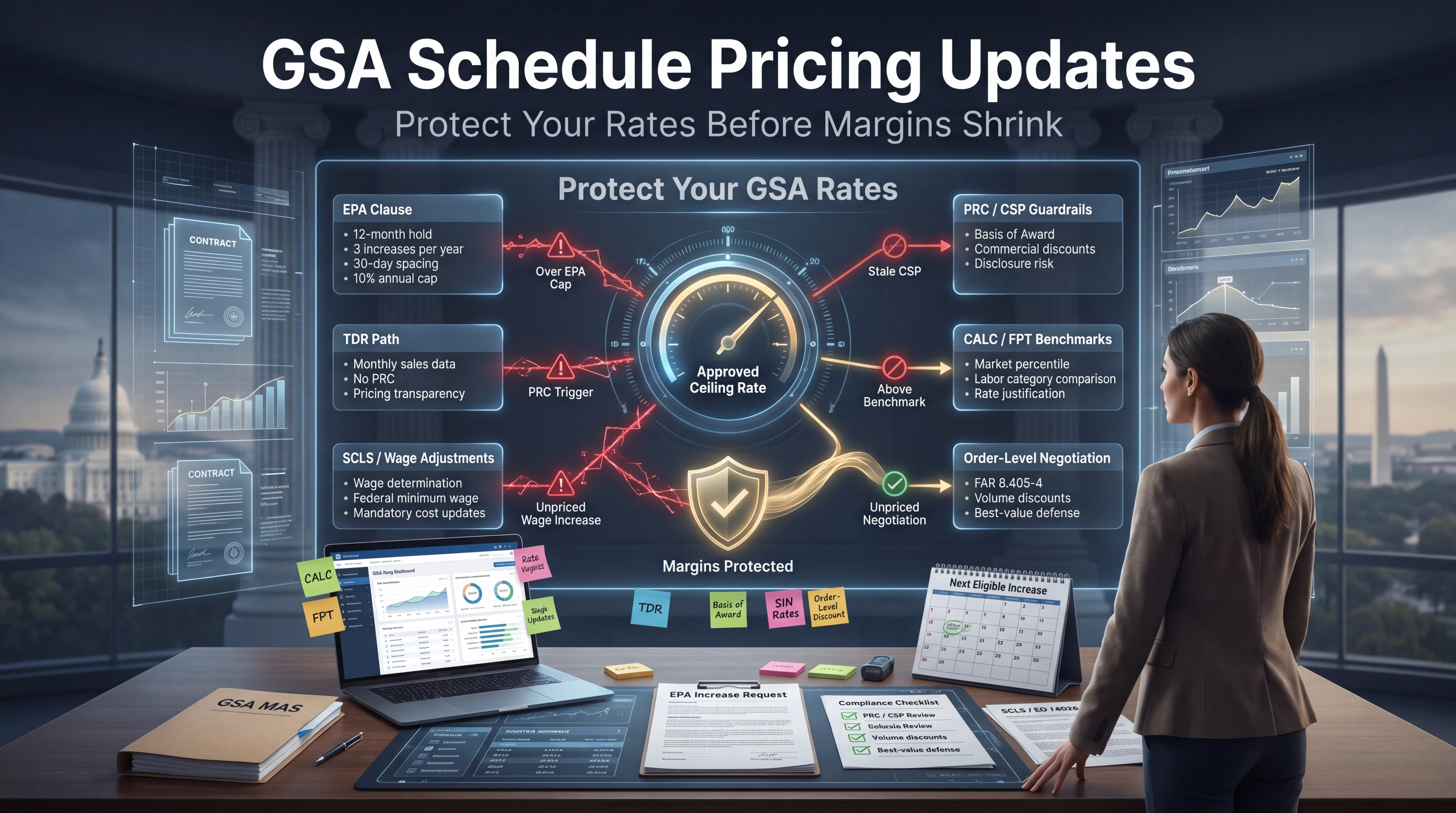
This article explains the specific pricing rule changes that hit GSA Schedule holders between 2022 and 2024 — temporary inflation flexibilities that let contractors raise rates faster than normal, the return to standard Economic Price Adjustment (EPA) clause enforcement, and the benchmarking tools that now shape whether your increase request gets approved or rejected. By the end, you will know exactly which clauses govern your rate ceiling, how to calendar your next permissible increase, and what documentation to prepare before you submit a modification request.
If you are new to the schedule program, start with our foundational guide to how GSA Schedules work before diving in here. If you already hold a schedule and are watching your margins erode, keep reading — the practitioner-level details below may save you a costly misstep.
The EPA Clauses That Control Your Rate Ceiling
Every GSA Schedule contract contains at least one Economic Price Adjustment clause that dictates if, when, and by how much you can raise your awarded rates. Think of it as the speed limit for price increases. Two clauses do the heavy lifting:
GSAR 552.216-70 is the general EPA clause GSA uses across federal supply schedule contracts. I-FSS-969 (Economic Price Adjustment — FSS Multiple Award Schedule) is the MAS-specific variant that most schedule holders encounter. The limits baked into I-FSS-969 historically look like this:
| Limitation | Typical I-FSS-969 Default |
|---|---|
| Increases during first 12 months after award or new SIN addition | Prohibited |
| Maximum number of increases per 12-month period | 3 |
| Minimum spacing between increase requests | 30 days |
| Cumulative cap per 12-month period | Often 10% (varies by contract) |
These are not suggestions — they are contractual ceilings. Your Contracting Officer (CO) will cite the specific variant in your contract, and the exact caps can differ. The first thing you should do after reading this article is pull your contract and confirm which EPA clause variant you carry on each Special Item Number (SIN) — the category code that defines what you are authorized to sell.
Here is the nuance practitioners often miss: your EPA clause may be catalog-based (tied to changes in your published commercial price list) or index-based (tied to an external market index like the Bureau of Labor Statistics Employment Cost Index). If your commercial catalog has not changed but your costs have climbed — say, because you absorbed subcontractor rate increases rather than updating your public price list — a catalog-based EPA gives you no mechanism to request a GSA rate increase. You need a commercial price list change first, and only then can you bring a modification request to your CO.
What GSA Changed During 2022–2024 — and What Snapped Back
Between 2022 and 2023, inflation hit contractors hard. Labor costs spiked, material prices surged, and the standard EPA guardrails left many schedule holders unable to keep their GSA rates aligned with commercial reality. GSA responded by issuing a series of GSA Acquisition Letters that temporarily relaxed the EPA limitations. Under these flexibilities:
- Contracting Officers could approve larger increases exceeding the standard 10% annual cap.
- They could approve increases more frequently than three times per year.
- They could even approve increases during the first 12 months after award — a window that had been firmly locked.
- Documentation requirements were streamlined to speed approvals.
Many contractors who acted quickly during this period successfully brought their GSA ceiling rates back to market levels.
By early 2024, as inflation cooled, GSA signaled a return to standard EPA clause enforcement. The temporary flexibilities were not renewed indefinitely. In practical terms, COs began pointing back to clause caps and the 12-month hold period. If you used the flexibility window to climb your rates from, say, $95/hour to $120/hour across several SINs, that is now your new baseline — but your next increase is governed by the original clause language again.
This matters because many contractors mentally treat the relaxed period as the "new normal." It was not. If your contract's I-FSS-969 clause caps cumulative increases at 10% per year, and you submit a request for a 15% bump in late 2024, your CO will reject it — not because the rate is unreasonable in the market, but because the clause does not permit it. Understanding this distinction between market reasonableness and contractual permissibility is critical to anyone learning how to win government contracts through the schedule program.
The Price Reductions Clause and Commercial Sales Practices: Your Other Guardrails
The EPA clause controls upward movement. The Price Reductions Clause (PRC), GSAR 552.238-81, controls the floor — and it catches contractors off guard more often than any other pricing mechanism. Here is how it works in plain language: when you originally won your schedule, GSA identified a "Basis of Award" customer — a specific commercial customer or customer category whose pricing represents your most-favored pricing. Your GSA rates are benchmarked against what you charge that customer. If you ever offer that customer a better deal than what the government is paying, the PRC requires you to reduce your GSA rates proportionally and notify your CO.
The trap is subtle. Suppose your Basis of Award customer is "Large Commercial Enterprises." You run a year-end promotion offering that segment 20% off your standard rates. You have just triggered a potential PRC obligation — even though the promotion was temporary and had nothing to do with government work. Fail to report it and reduce your GSA rates accordingly, and you have a compliance problem that can escalate into a contract-level finding.
Alongside the PRC sits the Commercial Sales Practices (CSP) disclosure, which you submitted at proposal time. This document told GSA who your commercial customers are, what you charge them, and what discounts you offer. If your commercial pricing structure has evolved since you submitted that CSP — new tiers, new customer segments, volume discounts you didn't originally disclose — your CSP is stale, and any rate increase request built on outdated CSP data invites scrutiny.
Practitioner Edge
Before submitting your next EPA increase, update your CSP disclosures proactively. COs increasingly cross-reference your CSP against your proposed rates during the EPA review. An inconsistency between your current commercial practices and your on-file CSP is the fastest way to delay or kill an increase request — even when the increase itself is within your EPA clause limits.
TDR Participants Play by Different Rules
If your contract is enrolled in the Transactional Data Reporting (TDR) pilot, you operate under a fundamentally different pricing regime. TDR contractors are exempt from the PRC and CSP disclosures. Instead, you report monthly line-item transactional data — every order, every price, every quantity — directly to GSA. GSA uses this data to assess whether your rates are fair and reasonable without requiring you to maintain a Basis of Award relationship.
This is a significant advantage in pricing flexibility, but it comes with its own discipline. Your transactional data is your pricing story. If your reported data shows you consistently selling at 30% below your ceiling rate, a CO reviewing your next EPA increase will question why your ceiling needs to go higher. Conversely, if your data shows consistent sales near the ceiling with strong order volume, it builds the case that the market supports your pricing.
If you are not in TDR and are considering it, weigh the tradeoff carefully. You gain freedom from PRC and CSP compliance burden. You lose the ability to obscure unfavorable commercial discounting from GSA's view, because your actual transaction prices are reported monthly. For contractors with complex commercial discount structures that frequently trigger PRC headaches, TDR can be a net positive. For contractors whose GSA sales are a small fraction of revenue and whose commercial pricing is straightforward, the compliance simplicity of staying outside TDR may outweigh the flexibility gains.
CALC, FPT, and the Benchmarking Wall You Will Hit
Even when your EPA clause permits an increase and your PRC/CSP compliance is clean, GSA has one more tool that increasingly determines whether your proposed rate survives negotiation: benchmarking analytics.
The Contract-Awarded Labor Category (CALC) tool and the Federal Pricing Tool (FPT) are internal and semi-public databases that let COs compare your proposed rates against what other schedule holders have been awarded for similar labor categories or products. If you propose a Senior Systems Engineer at $185/hour and CALC shows the 75th percentile for that category across all MAS contracts is $160/hour, your CO will demand justification for the delta — regardless of what your commercial clients pay you.
This is where many contractors fail. They treat the EPA increase as a mechanical exercise: fill out the modification request, attach the updated price list, submit. But the CO is not just checking clause compliance anymore. They are pulling your proposed rates into FPT and comparing them horizontally against the market.
Actionable Tactic
Before your next EPA mod, run your labor categories through CALC. If your proposed rates exceed the 75th percentile, prepare a written justification memo addressing scope differences, geographic cost factors, clearance requirements, SCLS wage determination impacts, or specialized certifications that explain the premium. Attach it to your mod request. COs appreciate contractors who anticipate the question rather than force them to ask it.
Category managers and ordering COs increasingly use FPT and CALC ranges to benchmark not just your contract rates but your order-level proposals. If three other schedule holders offer a comparable Cybersecurity Analyst at $140/hour and you propose $165, you will be asked to justify the gap or lower your price — your contract ceiling is irrelevant to the ordering officer's best-value determination.
This is where understanding how to win government contracts through the schedule program diverges from simply holding a schedule. Winning task orders requires you to bring recent commercial invoices, competitive market data, and scope-specific justifications to every order-level negotiation. Geography matters — a cleared systems administrator in Northern Virginia commands a different rate than the same role in Huntsville. Teaming arrangements, SCLS applicability, and escalation clauses in multi-year orders all create legitimate reasons for rate variation. Document them.
If you are not sure whether your company qualifies for a GSA Schedule in the first place, GovBidLab's free GSA Eligibility Calculator can help you assess readiness before investing in the application process. And if you need to identify which NAICS codes align with your offerings for SIN selection, the NAICS Code Lookup tool is a fast starting point.
SCLS and Minimum Wage: The Rate Increases That Find You
Some rate changes are not optional. If your schedule includes services covered by the Service Contract Labor Standards (SCLS) — formerly the Service Contract Act — your pricing must reflect applicable Department of Labor (DOL) wage determinations for the geographic area and labor categories involved. When DOL updates a wage determination, your cost basis changes whether your commercial rates move or not. You may need to submit a contract modification to flow the new wage floor into your schedule rates, and failing to do so creates a compliance gap.
Additionally, Executive Order 14026 set the minimum wage for federal contractors at $17.20 per hour effective January 1, 2024, indexed to inflation going forward. If any of your schedule labor categories pay near this threshold — particularly in facilities, administrative support, or help desk services — you must ensure your GSA rates absorb this floor. Failure to do so does not just mean you lose money on those orders; it means you are potentially out of compliance with the wage order, which creates a separate audit and suspension risk.
Practitioner Detail
SCLS wage determination updates and E.O. 14026 adjustments are not counted against your EPA clause caps. They are separate, mandatory cost adjustments handled through distinct modification channels. This means you can submit an SCLS-driven mod and an EPA increase in the same 12-month period without one consuming the other's allowance. If you have been holding off on EPA increases because you thought a recent SCLS mod used up one of your three annual slots, check your contract — they are separate tracks.
Order-Level Pricing: Where the Real Negotiation Happens
Your MAS ceiling rate is just that — a ceiling. Under FAR 8.405-4, ordering Contracting Officers are authorized to seek order-level price reductions at any time, and they are expected to do so for larger quantities, recurring requirements, and multi-year buys. This means that even after you successfully negotiate a rate increase at the contract level, every individual task order is a fresh pricing negotiation.
This is not a flaw in the system — it is the system working as designed. The schedule program's value proposition to agencies is that ceiling rates represent an already-negotiated fair price, but that ordering COs should push for even better deals at the task order level. Your job as a contractor is to know your floor before you enter that conversation, not just your ceiling.
Understand which orders are genuinely volume-sensitive and where discounting makes strategic sense — long-term relationships, bridge contracts, or anchor clients that drive referrals — versus orders where you hold a competitive or clearance-driven advantage and should defend your rate. Undercutting on every order trains the CO to expect discounts as the default, which eventually pressures your ceiling rates at the contract level during the next EPA review.
Your Pre-Modification Checklist
Before you submit your next GSA rate increase request, work through this sequence:
- Pull your contract and identify your EPA clause variant for each SIN. Confirm the annual cap, frequency limit, spacing requirement, and whether you are in a 12-month hold period.
- Check your PRC Basis of Award mapping (non-TDR contractors). Has your commercial pricing to that customer or category changed since your last disclosure? If yes, reconcile before requesting an increase.
- Update your CSP disclosures if your commercial discount structure has evolved. Stale CSPs invite delays.
- Run your proposed rates through CALC. If you exceed the 75th percentile, prepare a written justification addressing scope, geography, clearances, or wage determination impacts.
- Stage SCLS and E.O. 14026 adjustments separately from EPA requests. They do not consume your EPA slots.
- Calendar your increases. Map out permissible windows for the next 24 months so you are never caught off-guard by a clause limitation.
- Consider whether your EPA type still fits. If your commercial catalog is static but your costs are rising with market indices, explore an index-based EPA through a bilateral modification.
What to Do Next
Open your GSA Schedule contract today and identify which EPA clause variant applies to each of your SINs — then calendar the next date you are eligible to submit an increase. If you have not updated your Commercial Sales Practices disclosures in the past 12 months, that update should be your immediate next step before any rate modification. Contractors who treat pricing as a year-round discipline — not a once-a-year scramble — are the ones who consistently protect margins and learn how to win government contracts on a sustained basis. Explore GovBidLab's full suite of free government contracting tools to support your next move.
Glossary of Terms Used in This Article
- Basis of Award
- The specific commercial customer or customer category whose pricing GSA used as the benchmark when negotiating your schedule rates. Your PRC obligations are tied to this customer's pricing.
- CALC (Contract-Awarded Labor Category)
- A GSA tool that aggregates awarded labor category rates across MAS contracts, allowing COs and contractors to benchmark proposed rates against market norms.
- CO (Contracting Officer)
- The government official with legal authority to enter into, administer, and terminate contracts on behalf of the federal government.
- CSP (Commercial Sales Practices)
- A disclosure document submitted to GSA describing your commercial customers, pricing tiers, and discount structures. Required for non-TDR contractors and used to assess pricing fairness.
- DOL (Department of Labor)
- The federal agency responsible for issuing wage determinations and enforcing labor standards, including SCLS wage rates and E.O. 14026 minimums.
- E.O. 14026 (Executive Order 14026)
- A presidential order setting a minimum wage for workers on federal contracts, indexed to $17.20/hour as of January 1, 2024.
- EPA (Economic Price Adjustment)
- A contract clause that defines the rules for requesting upward or downward price changes during the life of a contract, including frequency limits, caps, and documentation requirements.
- FAR (Federal Acquisition Regulation)
- The primary set of rules governing how federal agencies acquire goods and services. FAR Subpart 8.4 specifically governs ordering from GSA Schedules.
- FPT (Federal Pricing Tool)
- A GSA analytics tool used by Contracting Officers to compare proposed prices against awarded rates across the MAS program.
- GSAR (General Services Administration Acquisition Regulation)
- GSA's supplement to the FAR, containing clauses and rules specific to GSA contracts, including schedule-specific pricing clauses.
- I-FSS-969
- The MAS-specific EPA clause that sets limitations on the frequency, size, and timing of price increases for schedule contractors.
- IFF (Industrial Funding Fee)
- A fee of 0.75% on all MAS sales that contractors remit quarterly to GSA to fund the schedule program's operations.
- MAS (Multiple Award Schedule)
- GSA's consolidated contract vehicle — formerly separate schedules — that allows federal buyers to purchase commercial products and services at pre-negotiated rates.
- PRC (Price Reductions Clause)
- GSAR 552.238-81. Requires non-TDR contractors to reduce their GSA rates if they offer deeper discounts to their Basis of Award commercial customers.
- SCLS (Service Contract Labor Standards)
- Federal law (formerly the Service Contract Act) requiring contractors on service contracts to pay workers no less than the prevailing wage rates set by DOL wage determinations for the applicable locality.
- SIN (Special Item Number)
- A category code on a GSA Schedule contract that defines the specific products or services the contractor is authorized to sell through the schedule.
- TDR (Transactional Data Reporting)
- A GSA pilot program under which contractors report monthly line-item sales data instead of complying with PRC and CSP requirements. GSA uses this data to assess pricing reasonableness.
References
- FAR Subpart 8.4 — Federal Supply Schedules. General Services Administration / Defense Acquisition Regulations Council. https://www.acquisition.gov/far/subpart-8.4 (current as of 2024).
- FAR 15.404-1 — Proposal Analysis Techniques. https://www.acquisition.gov/far/15.404-1 (current as of 2024).
- FAR 16.203 — Fixed-Price Contracts with Economic Price Adjustment. https://www.acquisition.gov/far/16.203 (current as of 2024).
- GSAR 552.216-70 — Economic Price Adjustment. General Services Administration. https://www.acquisition.gov/gsam/552.216-70 (current as of 2024).
- I-FSS-969 — Economic Price Adjustment — FSS Multiple Award Schedule. GSA MAS Solicitation Clause (current as of 2024).
- GSAR 552.238-81 — Price Reductions. General Services Administration. https://www.acquisition.gov/gsam/552.238-81 (current as of 2024).
- MAS Solicitation No. 47QSMD20R0001 — Multiple Award Schedule. General Services Administration. https://www.gsa.gov/buy-through-us/purchasing-programs/multiple-award-schedule (current as of 2024).
- GSA Federal Pricing Tool (FPT) and CALC Resources. GSA Federal Acquisition Service. https://buy.gsa.gov/pricing (current as of 2024).
- U.S. Department of Labor, Wage and Hour Division — Executive Order 14026 Minimum Wage for Federal Contractors; SCLS Wage Determinations. https://www.dol.gov/agencies/whd/government-contracts (2024).