Government Contractor Accounting: CAS Requirements Explained
Learn Cost Accounting Standards (CAS) requirements for government contractors—coverage thresholds, exemptions, compliance steps, and how CAS works with FAR Part 31.

Tiatun T.
Federal Sales Consultant · Apr 1, 2026
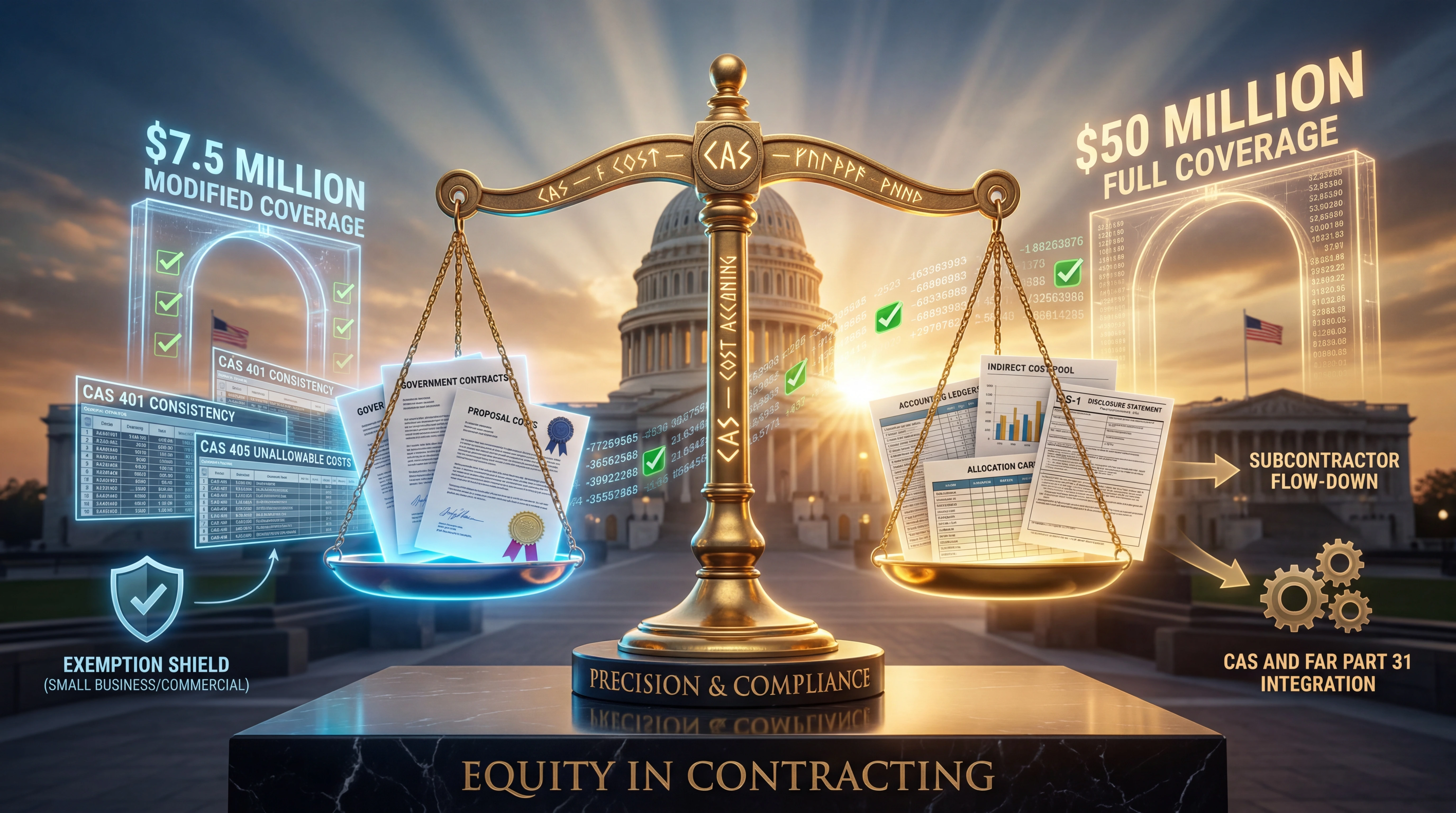
This article explains the Cost Accounting Standards (CAS)—the federal rules that govern how government contractors measure, assign, and allocate costs on U.S. government contracts. By the time you finish reading, you will understand which contractors CAS applies to, which contracts are exempt, how the coverage tiers work, what each tier requires, and what practical steps you need to take to build or maintain a compliant accounting system.
What This Article Covers—and Why It Matters
Whether you are a small business owner considering your first cost-reimbursement proposal or a seasoned business development director evaluating the overhead of chasing a $60 million award, this guide gives you the framework you need.
Understanding CAS is essential if you want to learn how to win government contracts that involve cost-type pricing, large negotiated awards, or subcontracting to prime contractors who hold such awards. Getting the accounting wrong does not just risk an audit finding—it can trigger mandatory price adjustments, interest charges, payment withholds, and, in serious cases, contract disputes that stall your entire operation [1][2].
CAS and FAR Part 31: Two Rule Sets, One Accounting System
Before diving into thresholds and standards, it helps to understand the relationship between two sets of rules that newcomers often confuse. The Cost Accounting Standards (CAS), found at 48 CFR Chapter 99, tell you how to handle costs—how to categorize them, how to allocate them consistently, and how to report them. The Federal Acquisition Regulation (FAR) Part 31 cost principles tell you what costs are allowable (meaning the government will reimburse or accept them in pricing) and what costs are unallowable (meaning the government will not pay for them, such as entertainment, lobbying, or certain interest expenses) [3]. Both sets of rules apply at the same time. A cost can be allowable under FAR Part 31 but still be allocated incorrectly under CAS—or vice versa. Your accounting system must satisfy both.
Think of it this way:
FAR Part 31 is the guest list that decides who gets into the building. CAS is the seating chart that decides where each guest sits. You need both to run the event properly.
FAR Part 30 serves as the administrative bridge, containing the procedures the government uses to administer CAS—how changes in accounting practice are reported, how cost impacts are calculated, and how price adjustments are made [2]. The contract clauses that actually bind you appear at FAR 52.230-2 (full coverage), FAR 52.230-3 (modified coverage), FAR 52.230-4 (foreign concerns), FAR 52.230-5 (educational institutions), and FAR 52.230-6 (administration of cost accounting standards) [6].
Who Is Exempt? Understanding CAS Applicability
CAS does not apply to every federal contract. Several important exemptions exist at 48 CFR 9903.201-1(b), and understanding them early can save you significant compliance expense [4].
Small businesses are fully exempt from CAS, regardless of contract type or dollar value [4]. If the Small Business Administration (SBA) considers your company a small business under the applicable North American Industry Classification System (NAICS) size standard for the contract you are pursuing, CAS does not apply. If you are unsure about your size status, GovBidLab’s free NAICS Code Lookup tool can help you verify the size standard associated with your industry code.
Other notable exemptions include sealed-bid contracts (where price competition, not cost analysis, determines the winner), contracts for commercial items (products or services sold in the commercial marketplace), and contracts at or below the Truthful Cost or Pricing Data threshold—currently $2,000,000, as aligned by the Cost Accounting Standards Board (CASB) in its April 16, 2019 final rule (84 FR 15931) [9]. If your negotiated contract falls under $2 million and is otherwise exempt, CAS will not apply.
For practitioners, it is worth noting that the CAS exemption analysis happens at the contract level, but coverage determination (modified versus full) happens at the business unit (segment) level. A single company can have one division under full coverage and another division that is entirely exempt, depending on the contracts each division holds.
Modified vs. Full CAS Coverage: The Thresholds That Matter
When a contract is not exempt, the next question is which tier of coverage applies. There are two: modified coverage and full coverage. The differences are substantial, and crossing the threshold from modified to full triggers significant accounting system and disclosure requirements.
| Coverage Tier | Trigger | Standards That Apply | Disclosure Statement Required? |
|---|---|---|---|
| Modified CAS Coverage | Single non-exempt negotiated award of $7.5M or more but less than $50M, and the business unit is not otherwise subject to full coverage [4] | Four standards: CAS 401, 402, 405, 406 [4] | No (unless the business unit independently triggers full coverage) |
| Full CAS Coverage | A single CAS-covered award of $50M or more, OR the business unit received $50M+ in net CAS-covered awards during the preceding cost accounting period [4] | All 19 applicable CAS (CAS 401–420, excluding 419) [4] | Yes—a CASB Disclosure Statement (DS-1) must be submitted before award [5] |
A few subtleties that practitioners should keep in mind. First, the $50 million trigger is cumulative for the “net CAS-covered awards” test—it is not limited to a single contract. A business unit that received, say, eight CAS-covered contracts totaling $52 million in its prior fiscal year would be fully covered even if no single contract exceeded $10 million [4]. Second, once a business unit becomes subject to full coverage, it remains fully covered as long as it continues to receive CAS-covered awards. Dropping below the threshold in a subsequent period does not immediately remove full coverage; the transition rules require careful analysis with your Cognizant Federal Agency Official (CFAO)—typically an official at the Defense Contract Management Agency (DCMA) for Department of Defense (DoD) contractors [2].
For companies learning how to win government contracts in the $7.5 million to $50 million range, modified coverage is often the first real encounter with CAS. The four standards under modified coverage are foundational, and getting them right builds the muscle memory for full coverage later.
The Four Modified-Coverage Standards: What They Actually Require
Let us walk through the four standards that apply under modified coverage, because they also apply under full coverage and represent the bedrock principles of government contract accounting.
CAS 401 — Consistency in Estimating, Accumulating, and Reporting Costs
This standard says that the way you estimate costs in your proposal must match the way you actually accumulate (track) and report those costs after award. You cannot propose labor in one cost category and then charge it to a different category during performance. The shorthand is “no bidding one way and billing another.” This sounds obvious, but it trips up contractors whose estimating teams and accounting teams operate in silos [1].
CAS 402 — Consistency in Allocating Costs Incurred for the Same Purpose
A cost cannot be treated as a direct cost (charged straight to a specific contract) in some circumstances and as an indirect cost (pooled and spread across multiple contracts through an overhead rate) in like circumstances. For example, if you charge travel directly to Contract A when an employee flies to the contract’s job site, you cannot bury the same type of travel in your overhead pool for Contract B under similar conditions [1].
CAS 405 — Accounting for Unallowable Costs
You must identify costs that are expressly unallowable under FAR Part 31 (such as entertainment, alcohol, and certain lobbying costs), segregate them in your accounting records, and exclude them from any billing, claim, or proposal to the government. This requires a robust chart of accounts with dedicated unallowable-cost accounts and staff trained to screen expenses [1][3]. Getting CAS 405 wrong is one of the fastest ways to draw a finding from the Defense Contract Audit Agency (DCAA).
CAS 406 — Cost Accounting Period
This standard requires you to use your fiscal year as your cost accounting period for accumulating indirect costs and establishing allocation rates. It sounds simple, but it prevents contractors from cherry-picking favorable time periods to calculate rates [1].
If you are building or refining your accounting system for government work, articulating your compliance capabilities clearly can make a significant difference when teaming with primes or responding to agency requests. GovBidLab’s free Capability Statement Generator can help you present your accounting and compliance qualifications in a professional format.
Full Coverage: The Broader Landscape of All 19 Standards
When full CAS coverage applies, your business unit must comply with all 19 Cost Accounting Standards in effect (CAS 401 through 420, with CAS 419 reserved) [4]. While a detailed walkthrough of each standard exceeds the scope of this article, several deserve attention because they drive major accounting policy and system design decisions.
CAS 403 governs the allocation of home office expenses to segments—critical for multi-division companies that share corporate overhead. CAS 410 addresses the base used to allocate General and Administrative (G&A) expenses, typically requiring a cost input base, total cost input base, or single-element base applied consistently. CAS 418 addresses the composition of direct and indirect cost pools and the selection of allocation bases, essentially dictating the architecture of your indirect rate structure [1].
CAS 412 and 413 cover pension costs—specifically, how to determine and assign the cost of defined-benefit pension plans and how to adjust for actuarial gains and losses. These standards interact with Employee Retirement Income Security Act (ERISA) funding rules and can create complex timing differences between when a pension cost is funded and when it is allocable to contracts [1].
CAS 414 and 417 deal with the cost of money—an imputed cost (not an actual cash expenditure) representing the return a contractor could have earned on capital invested in facilities and capital assets used on government contracts. While not a cash reimbursement, cost-of-money factors can meaningfully affect pricing [1].
Under full coverage, you must also submit a CASB Disclosure Statement (Form DS-1) before contract award if the contract is $50 million or more, or if your business unit received $50 million or more in net CAS-covered awards during the preceding cost accounting period [5]. The DS-1 is a detailed document describing your cost accounting practices—how you define direct versus indirect costs, how you structure indirect pools, what allocation bases you use, and how you handle specific cost elements like compensation, depreciation, and independent research and development (IR&D). The CFAO reviews the DS-1 for adequacy and compliance. Any subsequent change in cost accounting practice—whether you initiate it voluntarily or the government requires it—must be reported. The CFAO will evaluate the cost impact, and if the change increases costs to the government, price adjustments with interest are required [2][6].
CAS Flows Down: Subcontractor Obligations
CAS is not just a prime contractor concern. Prime contractors are required to determine whether their subcontractors are subject to CAS and, if so, to include the appropriate CAS clause (FAR 52.230-2 for full coverage or FAR 52.230-3 for modified coverage) in the subcontract [4][6]. The same exemptions apply—small business subcontractors are exempt, commercial-item subcontracts are exempt, and the dollar thresholds work the same way. But a large, non-small-business subcontractor receiving a $10 million negotiated, non-exempt subcontract under a CAS-covered prime contract would be subject to at least modified CAS coverage.
For practitioners managing subcontractor relationships, this means your procurement team needs a process for assessing subcontractor CAS applicability during the proposal phase—not after award. Including the wrong clause, or omitting a required clause, can create compliance exposure for the prime.
CAS, DCAA, and DoD Business Systems: How They Intersect
Contractors pursuing cost-reimbursement or time-and-materials contracts with the DoD frequently encounter a separate but related compliance framework: the DoD Business Systems rules at DFARS 252.242-7006. This clause establishes criteria for an adequate accounting system, and DCMA evaluates contractor systems against these criteria. It is important to understand that DFARS business system adequacy is not the same as CAS compliance—they are separate frameworks. However, they are frequently evaluated together, and deficiencies in one often reveal problems in the other [7].
DCAA performs audits of contractor accounting systems, incurred cost submissions, forward pricing rate proposals, and CAS compliance. A DCAA audit of your accounting system will look at whether your system can accumulate costs by contract, segregate direct from indirect costs, identify unallowable costs, and produce reliable data for billing and cost reporting. If you are a DoD contractor pursuing cost-type contracts, having a DCAA-adequate accounting system is a practical prerequisite [8]. For companies also navigating cybersecurity requirements under the Cybersecurity Maturity Model Certification (CMMC) framework, GovBidLab’s free CMMC Calculator can help you assess your readiness for the cybersecurity controls that are increasingly evaluated alongside accounting and business system compliance for DoD contract eligibility.
A Practical Compliance Checklist
Whether you are approaching your first CAS-covered contract or tightening controls on an existing portfolio, the following steps represent the practical path to compliance. This is not a substitute for expert accounting guidance, but it is the roadmap that experienced government contract accountants follow.
- Map your chart of accounts and written policies to the applicable CAS. For modified coverage, focus on CAS 401, 402, 405, and 406. For full coverage, extend the mapping to all 19 standards. Document your direct/indirect cost definitions, indirect pool structures, and allocation bases in a written accounting policy manual.
- Isolate unallowable costs in dedicated general ledger accounts and train your staff on screening procedures. CAS 405 and FAR 31 require that expressly unallowable costs never end up in a billing or proposal. Build the account structure so that unallowable costs are captured at the point of entry, not filtered out after the fact.
- Ensure your timekeeping system and indirect rate calculations match your estimating practices. CAS 401 demands consistency between how you bid and how you bill. If your proposal assumes a specific labor category structure or indirect rate methodology, your accounting system must accumulate costs the same way.
- Prepare early for the CASB Disclosure Statement (DS-1) if you are approaching the $50 million thresholds. The DS-1 is a substantial document that requires a thorough understanding of your own cost accounting practices. Do not wait until a contracting officer requests it the week before award.
- Coordinate with your cognizant agency—DCMA and DCAA for DoD contractors—on business system adequacy. Proactive engagement is far better than reactive remediation after a finding. If you are a non-DoD contractor, your cognizant agency may be a civilian agency’s inspector general or contracting office.
- Build CAS flowdown into your subcontract management process. Assess subcontractor CAS applicability during the proposal phase and include the correct CAS clause in every applicable subcontract.
Following this checklist is one of the most overlooked aspects of learning how to win government contracts in the cost-reimbursement and large negotiated fixed-price arena. Agencies and primes want to work with contractors whose accounting systems are already adequate—not contractors who promise to become adequate after award.
The Cost of Getting It Wrong
CAS noncompliance is not an abstract regulatory risk. When DCMA or DCAA identifies noncompliance—or when a contractor makes an accounting practice change that increases costs to the government—the regulatory framework requires contract price adjustments with interest dating from the period of overpayment [2][6]. For sustained noncompliance, the CFAO can direct payment withholds until the issue is resolved. In severe cases, noncompliance can escalate to formal contract disputes under the Contract Disputes Act, with proceedings before a Board of Contract Appeals or the U.S. Court of Federal Claims.
Beyond the financial exposure, a noncompliant accounting system can disqualify you from future cost-type awards. Contracting officers are required to determine that a contractor’s accounting system is adequate before awarding a cost-reimbursement contract. If your system has unresolved deficiencies, you may not receive the award even if you submitted the best technical proposal.
What to Do Next
Start by determining whether your current or target contracts trigger CAS coverage—check the dollar thresholds, confirm whether exemptions apply (especially the small business exemption), and identify whether you are looking at modified or full coverage. If you are a small business unsure of your status, use GovBidLab’s NAICS Code Lookup tool to confirm the size standard for your industry. Then pull your chart of accounts and compare it against the four modified-coverage standards (CAS 401, 402, 405, 406) as a baseline health check. If gaps exist, engage a government contract accounting specialist before you submit your next proposal—not after you receive an audit notification. Understanding how to win government contracts at scale requires getting the accounting foundation right first.
Glossary of Terms Used in This Article
| Term / Acronym | Definition |
|---|---|
| Allowable Cost | A cost that the government will reimburse or accept in contract pricing because it meets the criteria in FAR Part 31—it is reasonable, allocable to the contract, and complies with applicable standards and contract terms. |
| Business Unit (Segment) | A division, plant, or other organizational element of a company that is treated as a separate entity for cost accounting purposes. CAS coverage is determined at this level. |
| CAS (Cost Accounting Standards) | A set of 19 federal standards at 48 CFR Chapter 99 that prescribe how government contractors must measure, assign, and allocate costs to federal contracts. |
| CASB (Cost Accounting Standards Board) | The federal board, housed within the Office of Federal Procurement Policy, that issues and administers the Cost Accounting Standards. |
| CFAO (Cognizant Federal Agency Official) | The government official, typically at DCMA for DoD contractors, responsible for administering CAS at a contractor’s business unit—reviewing Disclosure Statements, evaluating cost impact of practice changes, and directing price adjustments. |
| CMMC (Cybersecurity Maturity Model Certification) | A DoD framework that measures a contractor’s cybersecurity practices and processes, increasingly required for contractors handling controlled unclassified information. |
| Cost Accounting Period | The time period (usually the contractor’s fiscal year) used to accumulate indirect costs and calculate allocation rates, as required by CAS 406. |
| DCAA (Defense Contract Audit Agency) | The DoD agency that audits contractor accounting systems, incurred costs, forward pricing proposals, and CAS compliance. |
| DCMA (Defense Contract Management Agency) | The DoD agency that administers contracts after award, including oversight of contractor business systems and CAS compliance. |
| DFARS (Defense Federal Acquisition Regulation Supplement) | The DoD-specific supplement to the FAR, containing additional rules and contract clauses for defense contracts. |
| Direct Cost | A cost that can be identified specifically with a particular contract, project, or activity and is charged directly to that contract rather than being pooled with other costs. |
| Disclosure Statement (DS-1) | A detailed form (CASB Form DS-1) that describes a contractor’s cost accounting practices. Required before award for contracts or business units meeting the $50 million full-coverage threshold. |
| ERISA (Employee Retirement Income Security Act) | A federal law that sets minimum standards for pension and health plans in private industry, relevant to CAS 412 and 413 pension cost standards. |
| FAR (Federal Acquisition Regulation) | The primary set of rules governing the federal government’s acquisition of goods and services, covering everything from competition requirements to cost principles. |
| G&A (General and Administrative) | An indirect cost pool that captures expenses related to the overall management and administration of a business, typically allocated across all contracts and activities. |
| Indirect Cost | A cost that benefits multiple contracts or activities and cannot be charged directly to a single contract. Indirect costs are pooled and allocated to contracts through rates (e.g., overhead rates, G&A rates). |
| IR&D (Independent Research and Development) | Research and development effort that a contractor conducts on its own initiative, not sponsored by a specific government contract, but often allocable as an indirect cost. |
| NAICS (North American Industry Classification System) | A standardized coding system used to classify businesses by industry. SBA size standards for small business eligibility are defined by NAICS code. |
| SBA (Small Business Administration) | The federal agency that establishes size standards and programs for small businesses. Small business status exempts a contractor from CAS. |
| Truthful Cost or Pricing Data Threshold | The dollar threshold (currently $2,000,000) above which contractors must certify the accuracy of cost or pricing data submitted in negotiations. Contracts at or below this threshold are generally exempt from CAS. |
| Unallowable Cost | A cost that the government will not reimburse or accept in contract pricing because it fails to meet the allowability criteria in FAR Part 31 (e.g., entertainment, certain lobbying expenses, alcohol). |
References
- 48 CFR Chapter 99 — Cost Accounting Standards Board Regulations. Cost Accounting Standards Board, Office of Federal Procurement Policy.
- FAR Part 30 — Cost Accounting Standards Administration. General Services Administration.
- FAR Part 31 — Contract Cost Principles and Procedures; FAR 31.201-2 Determining Allowability. General Services Administration.
- 48 CFR 9903.201-1 — CAS Applicability and Exemptions; 48 CFR 9903.201-2 — Types of CAS Coverage. Cost Accounting Standards Board.
- 48 CFR 9903.202-1 — General Requirements for CASB Disclosure Statement. Cost Accounting Standards Board.
- FAR 52.230-2, 52.230-3, 52.230-4, 52.230-5, 52.230-6 — Cost Accounting Standards Contract Clauses. General Services Administration.
- DFARS 252.242-7006 — Accounting System Administration. Department of Defense.
- DCAA Contract Audit Manual — Chapter on Cost Accounting Standards. Defense Contract Audit Agency.
- Truthful Cost or Pricing Data Threshold Implementation and CAS Alignment — CASB Final Rule, 84 FR 15931 (April 16, 2019). Office of the Federal Register.