Government Contracting vs Commercial Sales: Pros, Cons & Key Differences
A FAR-grounded comparison of government contracting vs commercial sales — covering thresholds, compliance costs, payment terms, supply-chain rules, and a practical framework for choosing your channel.

Tiatun T.
Federal Sales Consultant · Apr 17, 2026
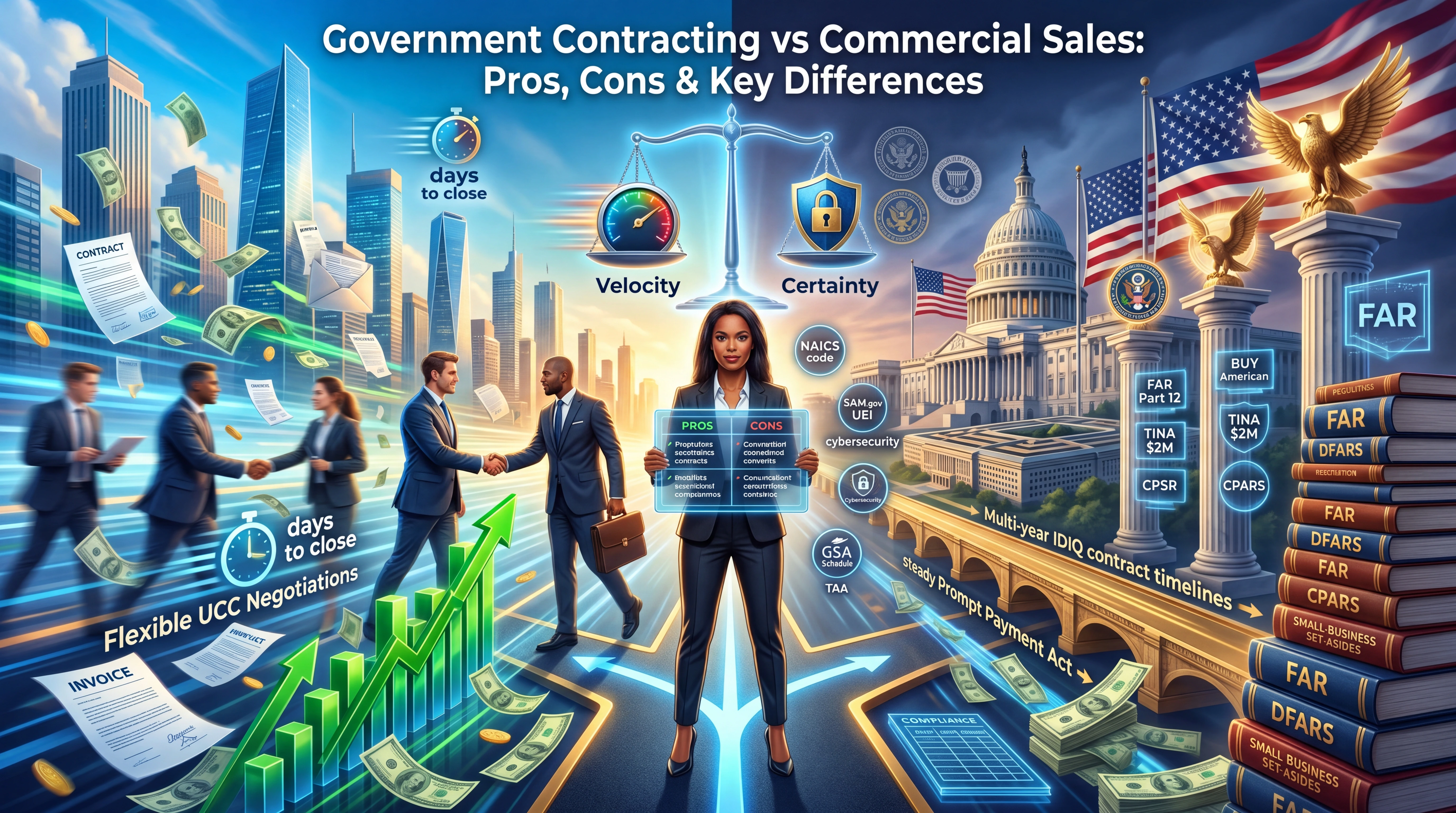
This article breaks down the real differences between selling to the United States federal government and selling in the commercial marketplace. By the end, you will understand the rules, thresholds, advantages, and drawbacks of each channel — and have a clear framework for deciding which one (or both) fits your business. Whether you are exploring how to win government contracts for the first time or you are a seasoned capture manager weighing portfolio balance, every comparison in this article is grounded in the Federal Acquisition Regulation (FAR) and the federal statutes behind it.
The Core Difference: It Is Not What You Sell — It Is How You Sell It
Most companies that cross from commercial sales into government contracting are surprised to find that the product or service they deliver barely changes. What changes dramatically is the process — the way you market, price, propose, win, perform, and get paid. In commercial sales, the governing framework is usually the Uniform Commercial Code (UCC) Article 2 plus whatever terms you negotiate with each customer. In federal sales, it is the FAR — a 53-part set of regulations that covers everything from definitions to mandatory contract clauses, administered jointly by the General Services Administration, the Department of Defense, and NASA.
That regulatory structure is the source of both the biggest advantages and the biggest headaches of government work. Think of the trade-off as velocity versus certainty. Commercial sales move faster: you can negotiate a deal in days, set your own terms, and pivot instantly. Federal sales move slower — capture cycles of six to eighteen months are normal — but once you win, you often land multi-year revenue with statutory payment guarantees and visible pipelines of follow-on work.
How the Government Buys: Thresholds That Shape Every Transaction
Before comparing pros and cons, you need to understand the federal buying lanes, because the rules that apply to your sale depend on the dollar value. The government sorts nearly every purchase into tiers defined by regulatory thresholds:
| Threshold | Dollar Value | What Happens | Source |
|---|---|---|---|
| Micro-Purchase Threshold (MPT) | $10,000 | Government purchase-card buys; no competition required; near-immediate payment | FAR 2.101; FAR 13.201 [1][2] |
| Simplified Acquisition Threshold (SAT) | $250,000 | Agencies may use Simplified Acquisition Procedures (streamlined solicitation and evaluation) up to this amount | FAR 2.101; FAR 13.003 [1][2] |
| Truthful Cost or Pricing Data (TINA) | $2,000,000 | For non-commercial, sole-source, or non-competitive awards at or above this amount, contractors must submit certified cost or pricing data — essentially opening your books to the government | FAR 15.403-1(b); FAR 15.403-4 [3] |
| CAS — modified coverage | Single award ≥ $2,000,000 | Contractor must follow four specified cost-accounting standards | 48 C.F.R. 9903.201-1 [6] |
| CAS — full coverage | Single award ≥ $50M or ≥ $50M net CAS-covered awards in prior period | All 19 CAS standards apply; significant accounting-system infrastructure required | 48 C.F.R. 9903.201-1 [6] |
| Subcontracting plan | > $750,000 (> $1.5M construction) | Large businesses must submit a small-business subcontracting plan | FAR 19.702 [5] |
| Contractor Purchasing System Review (CPSR) | Expected government sales > $25M in next 12 months | Government may audit your purchasing system for compliance | FAR 44.302; FAR 44.303 [7] |
None of these tiers exist in commercial sales. Understanding which thresholds apply to your expected deal size is one of the first steps in learning how to win government contracts.
If you are unsure which NAICS code fits your offering, GovBidLab’s free NAICS Code Lookup tool can help you identify the right code and its associated SBA size standard in seconds.
Pros of Government Contracting
Predictable, large-scale demand
The federal government is the single largest buyer on the planet. Once you earn a spot on a contract vehicle — an IDIQ (a pre-competed framework that lets agencies issue task orders over a multi-year period) or a Blanket Purchase Agreement (BPA) — you gain access to a pipeline of orders without re-competing from scratch every time. Multi-year base-plus-option structures mean revenue visibility that commercial customers rarely match.
Statutory payment terms
Under the Prompt Payment Act, the government generally must pay a proper invoice within 30 days; if it is late, interest accrues automatically [4]. Compare that to commercial receivables, where net-60 or net-90 terms are common and collection risk falls entirely on you. For cash-flow-sensitive small businesses, this alone can tip the calculus toward federal work.
Small-business preferences
The federal government sets annual goals to award a percentage of eligible contract dollars to small businesses, including specific set-asides for SDVOSBs, WOSBs, HUBZone firms, and 8(a) Business Development participants. FAR Part 19 and SBA size standards (13 C.F.R. Part 121) create entire competitions where only qualifying small firms may bid — giving you a structural advantage that does not exist in the commercial market [5].
Transparent pipeline
Federal agencies publish forecasts, pre-solicitation notices, draft RFPs, and RFIs on SAM.gov. You can see what is coming months — sometimes years — before a solicitation drops. Commercial sales intelligence rarely reaches that level of granularity.
Commercial-item streamlining under FAR Part 12
If your product or service is sold commercially, the government can buy it under FAR Part 12 (Acquisition of Commercial Products and Commercial Services), which substantially reduces the regulatory burden [1]. Many of the heaviest compliance requirements — certified cost or pricing data, full CAS coverage — do not apply to commercial-item acquisitions. This pathway is specifically designed to make it easier for commercial companies to enter the federal market.
Cons of Government Contracting
Compliance overhead is real and ongoing
Before you can receive a single dollar from the federal government, you must register in SAM.gov, obtain a Unique Entity Identifier (UEI) (a 12-character alphanumeric code that replaced the DUNS number), and keep that registration current [1]. You can verify your UEI quickly using GovBidLab’s free UEI Lookup tool. Beyond registration, mandatory FAR and DFARS clauses flow down to subcontractors, and cybersecurity requirements under DFARS 252.204-7012 and the NIST SP 800-171 framework apply to any DoD work touching Controlled Unclassified Information.
Long sales cycles and bid costs
A typical federal capture effort — from identifying an opportunity through market research to submitting a compliant proposal — can span 12 to 18 months or more. Proposal development is resource-intensive: compliance matrices, technical volumes, past-performance narratives, price models, and often oral presentations. You may invest tens of thousands of dollars in a single bid with no guarantee of a return. And after award, a disappointed competitor can file a GAO bid protest (under 4 C.F.R. Part 21), triggering an automatic stay of contract performance for 100 days.
Pricing scrutiny and audit exposure
In commercial sales, your pricing is your business. In federal contracting, for non-commercial, sole-source awards at or above the $2,000,000 TINA threshold, you must certify that your cost or pricing data is accurate, current, and complete [3]. If the government later discovers defective data, it can reduce the contract price retroactively. This is called a “defective pricing” claim, and it can surface years after performance ends.
Public transparency
Your performance on government contracts is recorded in CPARS (FAR Subpart 42.15) and visible to every future evaluator [11]. Poor ratings can follow you for years. Additionally, contract terms, pricing, and even some proposal information can be released under FOIA. In the commercial world, your customer relationships and pricing stay private.
Supply-chain constraints
The Buy American Act and FAR Part 25 require domestic content for many supply and construction contracts. The domestic content threshold for manufactured end products increased to 60% in 2022, will rise to 65% from 2024 through 2028, and reaches 75% beginning in 2029 [8]. Above certain dollar thresholds, the Trade Agreements Act (TAA) allows products from designated countries but prohibits products from non-designated countries — including China and India for most items. If you sell products, supply-chain mapping is not optional.
Pros and Cons of Commercial Sales — The Other Side
The speed and flexibility of commercial transactions are genuine advantages. You can negotiate bespoke terms, offer volume discounts without regulatory scrutiny, and close deals in days. There is no SAM registration, no clause flow-downs, no CPARS ratings, and no mandatory domestic-content tests on your supply chain. For companies with strong brand recognition or proprietary technology, the commercial market can deliver higher margins and faster iteration cycles.
But commercial sales carry risks that government contracts mitigate. Customer concentration is dangerous when your largest account can leave for a competitor overnight — there is no protest mechanism keeping them honest. Payment terms are negotiable, which sounds good until a major customer pushes you to net-90 and then pays late with no statutory interest penalty. Credit risk is entirely yours. And while commercial relationships can be rewarding, they lack the pipeline transparency that makes federal opportunities plannable years in advance.
Many firms find the smartest strategy is a hybrid: productize a commercial offering so it qualifies for streamlined FAR Part 12 acquisition, while maintaining a non-commercial capability for research and development or complex services where the government pays for unique requirements. If you are evaluating whether your commercial product or service could qualify for a GSA Schedule, GovBidLab’s GSA Eligibility Calculator can help you assess fit before investing in the application process.
Side-by-Side Comparison: Federal vs. Commercial Sales
| Dimension | Federal Government Sales | Commercial Sales |
|---|---|---|
| Governing framework | FAR, DFARS, agency supplements, statutory mandates | UCC Article 2, negotiated contracts |
| Sales cycle | 6–18+ months typical; formal RFP/proposal process | Days to months; flexible negotiation |
| Payment terms | 30-day statutory payment (Prompt Payment Act); interest on late payments | Negotiable (net-30 to net-90+); no statutory interest guarantee |
| Pricing transparency | Certified cost data above $2M (non-commercial/sole-source); CAS for larger portfolios | Pricing is proprietary; no regulatory audit regime |
| Small-business preferences | Set-asides, sole-source authority, subcontracting goals (FAR Part 19) | None — compete on merit and relationships |
| Contract duration | Multi-year; IDIQ/BPA vehicles spanning 5–15 years | Typically 1–3 year agreements; higher churn |
| Supply-chain rules | Buy American, TAA, DFARS cybersecurity (NIST SP 800-171/CMMC) | Contractual only; no regulatory mandate |
| Performance transparency | CPARS ratings visible to all federal evaluators; FOIA exposure | Private; reputation managed bilaterally |
| Dispute/protest | GAO bid protests (4 C.F.R. Part 21); Court of Federal Claims | Litigation or arbitration per contract terms |
| Entry barriers | SAM/UEI registration, NAICS/size standard alignment, past performance, compliance infrastructure | Low — primarily sales and marketing investment |
Practical Decision Framework: Which Channel Is Right for You?
Rather than choosing one channel and ignoring the other, think about where your business sits on three axes: compliance readiness, cash-flow tolerance, and growth timeline.
If you are a small business with a commercially proven product, the fastest path into federal sales is often through FAR Part 12 commercial-item procedures combined with small-business set-asides. You avoid the heaviest compliance layers (CAS, certified cost data) while gaining access to statutory payment terms and preference programs. Your existing commercial pricing can often demonstrate price reasonableness through market data (FAR 12.209; FAR 15.404-1(b)) [1][3], eliminating the need to open your books.
If you are a mid-size or large firm already doing significant government work, the compliance investments — a CAS-compliant accounting system, CPSR-ready purchasing policies, NIST 800-171 cybersecurity controls — are table stakes. The question becomes portfolio balance: how much non-commercial, cost-reimbursable work versus commercial-item work?
For practitioners managing both channels, the operational challenge is maintaining two pricing and compliance architectures without letting government-specific overhead inflate your commercial cost structure. The firms that do this well typically isolate their government contracts group with dedicated pricing analysts, compliance staff, and contract administrators — treating it as a distinct business unit that shares engineering and delivery resources with the commercial side but maintains its own proposal and compliance infrastructure.
A well-crafted capability statement — the one-page marketing document that federal buyers and prime contractors expect from potential vendors — is essential for either channel but especially for government introductions. GovBidLab’s free Capability Statement Generator can help you build one tailored to federal expectations.
What to Do Next
Start by mapping your current products or services to the federal buying framework: identify your NAICS code and size standard, confirm your SAM.gov registration is active, and determine whether your offering qualifies as a commercial item under FAR Part 12. If it does, you have a streamlined path into how to win government contracts without the heaviest compliance burden. If your offering is non-commercial or highly customized, budget for the compliance infrastructure before you pursue your first opportunity — retro-fitting CAS compliance or cybersecurity controls after award is far more expensive than building them into your business plan from day one. Use GovBidLab’s free tools to check your eligibility, look up your UEI and NAICS codes, and generate your capability statement today.
Glossary of Terms Used in This Article
8(a) Business Development — An SBA program that helps small, disadvantaged businesses compete for federal contracts through mentoring, training, and sole-source/set-aside opportunities.
BPA (Blanket Purchase Agreement) — A simplified acquisition method that establishes pre-negotiated terms with a vendor, allowing agencies to place repeat orders without a new solicitation each time.
Buy American Act — A federal statute requiring the government to prefer domestic end products and construction materials, subject to exceptions and trade agreements.
CAS (Cost Accounting Standards) — A set of 19 federal standards governing how contractors measure, assign, and allocate costs to government contracts. Coverage levels (modified or full) depend on contract and portfolio dollar thresholds.
CMMC (Cybersecurity Maturity Model Certification) — A DoD program that will require contractors to achieve certified levels of cybersecurity maturity, verified by third-party assessors, before winning certain contracts.
CPARS (Contractor Performance Assessment Reporting System) — The government’s system for documenting and sharing contractor past-performance evaluations. Ratings are used in future source selections.
CPSR (Contractor Purchasing System Review) — A government audit of a contractor’s purchasing policies and procedures, typically triggered when government sales exceed $25 million annually.
DFARS (Defense Federal Acquisition Regulation Supplement) — DoD-specific supplement to the FAR, adding rules on cybersecurity, specialty metals, and other defense-unique requirements.
FAR (Federal Acquisition Regulation) — The primary set of rules governing how federal agencies acquire goods and services. Organized into 53 parts covering everything from definitions to contract clauses.
FOIA (Freedom of Information Act) — A federal law giving the public the right to request access to records from any federal agency, including some contract information.
GAO (Government Accountability Office) — An independent agency that, among other functions, adjudicates bid protests — formal challenges to contract award decisions.
GSA (General Services Administration) — The federal agency that manages government property and procurement programs, including GSA Schedules (Multiple Award Schedule contracts).
HUBZone (Historically Underutilized Business Zone) — An SBA program providing contracting preferences to small businesses located in economically distressed areas.
IDIQ (Indefinite-Delivery/Indefinite-Quantity) — A type of contract that provides for an indefinite quantity of supplies or services over a fixed period. Work is ordered through individual task or delivery orders.
MPT (Micro-Purchase Threshold) — Currently $10,000 for most purchases. Below this amount, the government can buy with a purchase card and no competition.
NAICS (North American Industry Classification System) — A six-digit coding system used by the federal government to classify business establishments by industry. Each NAICS code has an associated SBA size standard.
NIST SP 800-171 — A publication by the National Institute of Standards and Technology specifying 110 security controls for protecting Controlled Unclassified Information in non-federal systems.
RFI (Request for Information) — A pre-solicitation notice agencies issue to gather market data and industry feedback before drafting a formal solicitation.
RFP (Request for Proposal) — A formal solicitation document asking vendors to submit detailed technical and price proposals for evaluation and award.
SAM.gov (System for Award Management) — The government’s official registration database for entities doing business with the federal government. Registration is required before receiving any federal contract or grant.
SAT (Simplified Acquisition Threshold) — Currently $250,000. Below this amount, agencies can use streamlined procurement procedures.
SBA (Small Business Administration) — The federal agency that sets small-business size standards, manages preference programs, and advocates for small-business participation in federal contracting.
SDVOSB (Service-Disabled Veteran-Owned Small Business) — A small-business category eligible for federal set-aside and sole-source contracts, based on ownership by one or more service-disabled veterans.
TAA (Trade Agreements Act) — A federal statute that, above certain thresholds, requires purchased products to be manufactured or substantially transformed in the U.S. or a designated country.
TINA (Truthful Cost or Pricing Data) — The common name for the statute requiring contractors to submit certified cost or pricing data for certain non-competitive awards above $2,000,000.
UCC (Uniform Commercial Code) — A set of standardized state laws governing commercial transactions, including the sale of goods (Article 2). The default legal framework for most commercial sales in the U.S.
UEI (Unique Entity Identifier) — A 12-character alphanumeric identifier assigned by SAM.gov, replacing the former DUNS number. Required for all entities registering to do business with the federal government.
WOSB (Women-Owned Small Business) — A small-business category eligible for federal set-aside contracts in industries where women-owned businesses are underrepresented.
References
[1] FAR Part 2 (Definitions) and FAR Part 12 (Acquisition of Commercial Products and Commercial Services). General Services Administration / Defense Acquisition Regulations Council. Acquisition.gov.
[2] FAR Part 13 (Simplified Acquisition Procedures). GSA/DoD/NASA. Acquisition.gov.
[3] FAR 15.403-1 and FAR 15.403-4 (Truthful Cost or Pricing Data thresholds and exceptions). GSA/DoD/NASA. Acquisition.gov.
[4] FAR Subpart 32.9 (Prompt Payment). GSA/DoD/NASA. Acquisition.gov.
[5] FAR Part 19 (Small Business Programs) and FAR 19.702 (Subcontracting Plans). GSA/DoD/NASA; SBA size standards: 13 C.F.R. Part 121. Acquisition.gov.
[6] 48 C.F.R. 9903.201-1 (CAS Applicability). Cost Accounting Standards Board, Office of Management and Budget. eCFR.gov.
[7] FAR Part 44 (Subcontracting Policies and Procedures), including FAR 44.3 (Contractor Purchasing System Review). GSA/DoD/NASA. Acquisition.gov.
[8] FAR Part 25 (Foreign Acquisition), including FAR 25.101 (Buy American — Supplies) and FAR Subpart 25.4 (Trade Agreements). GSA/DoD/NASA; Final rule: 87 Fed. Reg. 12780 (Mar. 7, 2022). Acquisition.gov.