Government Contracting for Small Business: The SAM.gov Beginner Playbook Nobody Told You About
A plain-language beginner playbook for small businesses entering government contracting. Covers SAM.gov registration, NAICS codes, sources sought vs solicitations, insurance basics, and a 7-day action plan.

Tiatun T.
Federal Sales Consultant · Feb 20, 2026
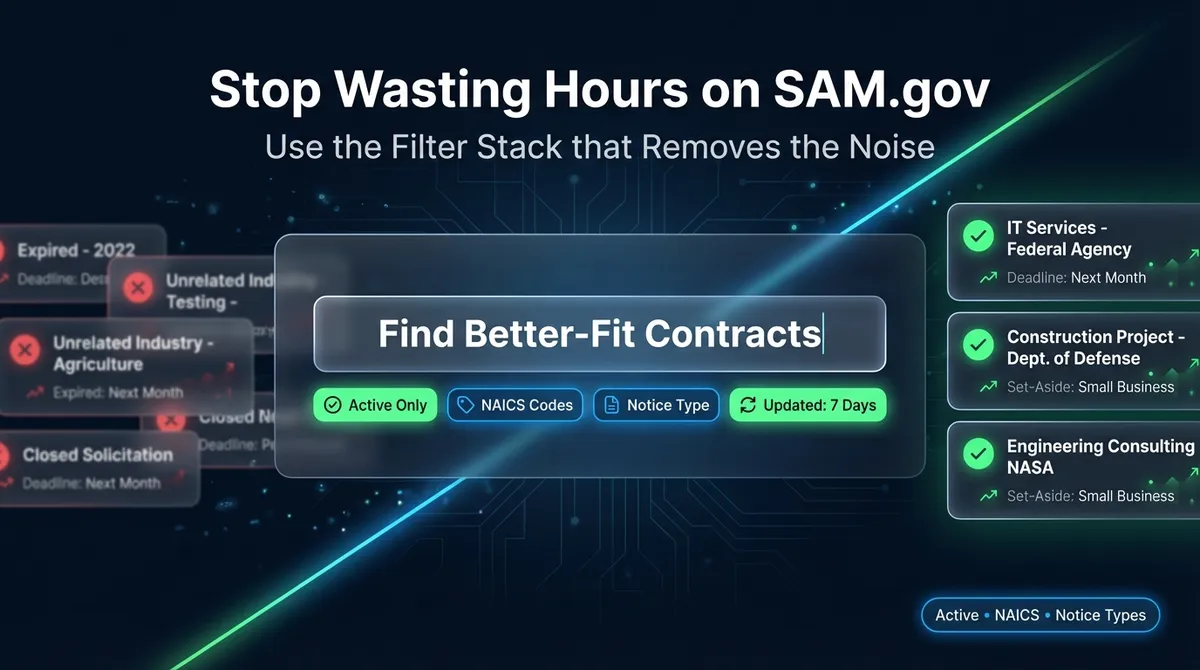
Government contracting for small business is one of the simplest "boring business" paths to steady work that most people skip…because nobody explains it like a normal human.
You ever hear "government contracts" and your brain does that thing where it shuts down like an old laptop with 38 tabs open.
You assume it's for giant companies.
Or you need a cousin who plays golf with a senator.
Or you need a 97-page proposal written in legal code.
Cool story.
Most of that fear comes from one problem.
No one broke it down in plain words.
So let's do that. Like we're sitting at a coffee shop. You've got that burnt-smelling latte. I'm sliding you the simple plan on a napkin. And you walk out knowing exactly what to do next.
The weird truth about government contracting for small business
Here's the part that makes people sit up. The US government has to give 23% of all contracts to small businesses. That's not a motivational quote. That's the rule.
And that means there are opportunities posted all the time. Stuff that sounds almost too normal to be real. Cleaning. Deliveries. Landscaping. Pressure washing.
So if your "side hustle" right now looks like driving around burning gas and patience…this is a different lane. More boring. More paperwork. More stable.
And yes, it can take time. A real timeline can be 6 to 18 months to win a contract, even when you do things right. That's not me trying to scare you. That's me saving you from the "why didn't I win in two weeks" meltdown.
If you can handle delayed gratification, you can handle this.
What is SAM.gov (and why it matters for government contracting for small business)
SAM.gov is the System for Award Management. It's the main government site where businesses register to sell to the US government. And it's where most government contracting opportunities get posted.
Most people don't win because they never get past this stage. They don't register. Or they register wrong. Or they stare at the site like it's written in alien language.
The site feels "official." Lots of menus. Lots of words. And almost no training.
Here's the clean version:
-
{[
"You register your business",
"You get your UEI",
"You search for work",
"You respond the right way"
].map((item, i) => (
- ✓ {item} ))}
That's it.
The quick SAM.gov registration flow
-
{[
Go to Register Entity,
Get a Unique Entity ID (UEI),
Click Get Started,
Use the entity registration checklist to prep your documents
].map((item, i) => (
- ✓ {item} ))}
One big tip. Don't pay someone to register your business on SAM.gov. The system is free. And if you can follow a checklist, you can do it.
Login.gov is part of it
You click Sign In on SAM.gov. It sends you to Login.gov. That's the government sign-in system.
You create an account. You use your email. You set a password. You turn on two-factor authentication. They text you a code when you log in.
Simple. Annoying, but simple.
Do you need a business to bid
Yes. You need a real business.
The government can't pay "random person who seems cool." They pay businesses.
Here's the good news. Your business can start super simple. A one-person sole proprietorship can work. And it can use your SSN at the start.
You can also set up an LLC. Both can work.
And if you're brand new, you're not disqualified. Plenty of first-time contractors start with zero past performance. You just have to start small and do what you say you'll do.
The "start small" service list that actually works
Pick a service you can do well. Not "i could probably figure it out." Not "my cousin did it once." Something you can deliver without drama.
The government buys services all the time. They want reliable. They want boring. They want done.
Here are examples that fit beginners:
-
{[
"Janitorial cleaning",
"Courier / delivery",
"Landscaping",
"Pressure washing",
"Security guard services",
"Laundry and linen services"
].map((item, i) => (
- ✓ {item} ))}
Pick one or two. Two max. People love to pick six and then do none.
If you're stuck, ask one question. What service could i do next week for a regular customer and not embarrass myself. Pick that.
The basics you need: insurance, tools, and being real
Some contracts ask for insurance. Sometimes bonding too, based on the service. This is the government's way of saying, "prove you won't vanish when something goes wrong."
A common insurance target agencies want: $1 million per occurrence, $2 million aggregate.
For low to medium risk work, small businesses often get that for under $1,000 per year. That's what gets said a lot, and it's a helpful ballpark. Your price still depends on your business and your risk.
Talk to an insurance agent. Ask for:
-
{[
"General liability",
"Workers comp if you have employees"
].map((item, i) => (
- ✓ {item} ))}
Then get the basic tools and supplies you need to do the job well. Nothing fancy. Just enough so you can show up and perform.
NAICS, PSC, and "code words" that make searching easier
This part sounds nerdy. It's actually what saves you hours.
Every kind of work has codes. NAICS and PSC codes help you filter listings so you stop scrolling forever.
Instead of searching "cleaning" and getting everything from office cleaning to nuclear waste cleanup…you search by code. And your results get tight.
Examples that get used a lot:
-
{[
561720 = Janitorial services,
492110 = Couriers and express delivery,
561730 = Landscaping services
].map((item, i) => (
- ✓ {item} ))}
Use SAM.gov search. Type your service name or the code. Filter by location. Filter by size. So you don't waste time staring at giant contracts you can't handle yet.
Sources sought vs solicitation (this changes how you win)
This is one of those "small detail, big outcome" things.
There are two notice types you need to recognize fast.
Sources sought
This means: Who can do this.
It's market research. It's the agency checking if capable businesses exist. It's not asking for your price. It's not asking for a full bid.
When you respond, you're raising your hand and saying: "Yep, we can do this. Here's our capability statement."
And that reply can shape what happens next. If enough small businesses respond, the agency can decide to set the work aside for small business.
Easy way to remember it. Sources sought = government is looking around.
Solicitation
This means: Send your bid now.
This is the real request. It can show up as:
-
{["RFQ", "RFP", "IFB"].map((item, i) => (
- ✓ {item} ))}
Your response includes pricing, your plan, and proof you meet requirements.
Easy way to remember it. Solicitation = government is ready to buy.
A simple sources sought reply you can copy
Good news. Your response does not need to be fancy. Short and clear wins.
Here's a plug-and-play format that works:
"Hello, we are [Company Name].
We provide [Service] in the [City/Area].
We have [X years] of experience and have done [short example].
We can handle [size / number of sites / hours per week].
Contact: [Name], [Phone], [Email]."
Why it works. It's clear. It's direct. It tells them you exist.
And that's the first job. Exist on paper.
Solicitations: follow instructions or get tossed
A solicitation is like a teacher handing you a test with rules. Page limits. Forms. File names. Deadline.
Miss one thing and they can throw your bid out without blinking.
Keep it simple:
-
{[
"Read the checklist carefully",
"Include your price",
"Include your timeline",
"Include examples of past work (if you have it)",
"Include proof of insurance",
"Include a short plan for how you'll do the job",
"Hit the deadline"
].map((item, i) => (
- ✓ {item} ))}
That's it. No poetry. No extra pages "just to be safe." Follow the instructions like your rent depends on it.
How a new business wins with zero past performance
Let's talk about the fear. "What if other bidders have more employees and more experience?"
Yeah. They might.
Other companies may have:
-
{[
"Past government work",
"More staff",
"Insurance already lined up",
"Smoother processes"
].map((item, i) => (
- ✓ {item} ))}
So how do you win as a startup. Start where the risk is low. Local. Smaller jobs. Micro contracts. Sources sought replies.
And show up fast. Most people don't respond quickly. Most people don't follow instructions. So if you do those two things, you already stand out.
A realistic path looks like this:
-
{[
"Pick a service you can deliver",
"Register as a business (sole proprietor or LLC)",
"Get your UEI and SAM.gov registration done",
"Get basic insurance",
"Bid on micro contracts or sources sought notices",
"Use those wins as past performance",
"Compete for bigger work later"
].map((item, i) => (
- {i + 1} {item} ))}
This is boring. That's why it works. It's like going to the gym. The plan is simple. People just don't do it long enough.
Track everything or lose your mind
Government contracting has lots of moving parts. Deadlines sneak up. Contacts change. You forget which notice you already answered.
So track it. Simple spreadsheet works.
Use columns like:
-
{[
"Notice ID",
"Opportunity name",
"Agency",
"Due date",
"Contact",
"Status (looked / responded / won)",
"Notes"
].map((item, i) => (
- ✓ {item} ))}
This keeps you sane. And it keeps you consistent.
One-page startup checklist + 7-day action plan
Here's the clean checklist that keeps beginners from spinning in circles.
One-page startup checklist
-
{[
"Pick a business name and register locally",
"Decide sole proprietor or LLC",
"Get your UEI at SAM.gov and finish registration",
"Talk to an insurance agent",
"Get general liability coverage",
"Choose one or two services to offer",
"Search SAM.gov using your NAICS or PSC code",
"Look for sources sought or solicitations",
"Reply to good sources sought using the template",
"Track everything in a sheet or CRM"
].map((item, i) => (
- ✓ {item} ))}
7-day action plan
-
{[
"Register your business name.",
"Apply for your UEI on SAM.gov.",
"Pick your service and list tools plus insurance you'll need.",
"Contact an insurance agent for a quote.",
"Search SAM.gov for sources sought with your NAICS code.",
"Reply to at least one sources sought notice.",
"Create your tracking sheet and log everything you did."
].map((item, i) => (
- {i + 1} Day {i + 1}: {item} ))}
Common mistakes that kill beginners
Mistake 1: Skipping registration
Fix: Do SAM.gov registration first. No registration, no bidding, no payment.
Mistake 2: Submitting late or missing documents
Fix: Read the checklist. Go through your packet twice. If they ask for a form, include the form.
Mistake 3: Chasing big contracts right away
Fix: Start small. Win smaller jobs. Get references. Stack past performance like bricks.
FAQs
How long does it take to win a government contract on SAM.gov?
A realistic timeline can be 6 to 18 months, even when you do things right. That's why starting small and staying consistent matters more than "quick wins."
Can i bid with no past performance?
Yes. Many first-time contractors start with zero past performance, then build it through small local jobs and early wins.
What's the fastest way to find the right opportunities on SAM.gov?
Use NAICS or PSC codes and filter by location and contract size. That cuts out the noise and shows you listings that match what you can actually deliver.
Government contracting rewards the person who stays steady. Register the business. Get on SAM.gov. Search with codes. Respond to sources sought. Follow solicitation instructions like a robot. Track your actions like you're getting paid to be organized.
You don't need special connections. You need follow-through.