Election Year Government Contracting: How to Win When the Budget Stalls
A tactical guide for government contractors navigating election years — covering how CRs and regulatory freezes stall awards, which contract structures protect revenue during delays, the ethics rules that tighten during campaign season, the 65% BAA threshold and EO 14026 wage compliance, GAO protest leverage via CICA stays, and a quarter-by-quarter capture calendar.

Tiatun T.
Federal Sales Consultant · May 11, 2026
What This Article Covers — and Why It Matters Right Now
This article is a tactical guide for government contractors navigating election years — the 12- to 18-month windows when political transitions disrupt federal buying patterns, stall awards, and create both risk and opportunity in your pipeline. By the end, you'll understand exactly how election cycles affect procurement timelines, which contract structures protect your revenue during delays, how to stay compliant with heightened ethics rules, and what pricing adjustments you need to make for shifting domestic-content and wage requirements. Whether you're new to government contracting or a seasoned Business Development (BD) director, the goal is the same: keep winning work when the system slows down.
Election years don't change the Federal Acquisition Regulation (FAR) — the massive rulebook governing how the government buys things. But they change the behavior of the people who use it. Program managers get cautious. Leadership vacancies freeze decisions. Budgets land late. And if you don't adjust your capture strategy accordingly, you'll watch awards slip quarter after quarter while your competitors adapt. Here's how to adapt first.
Why Election Years Slow Down Federal Procurement
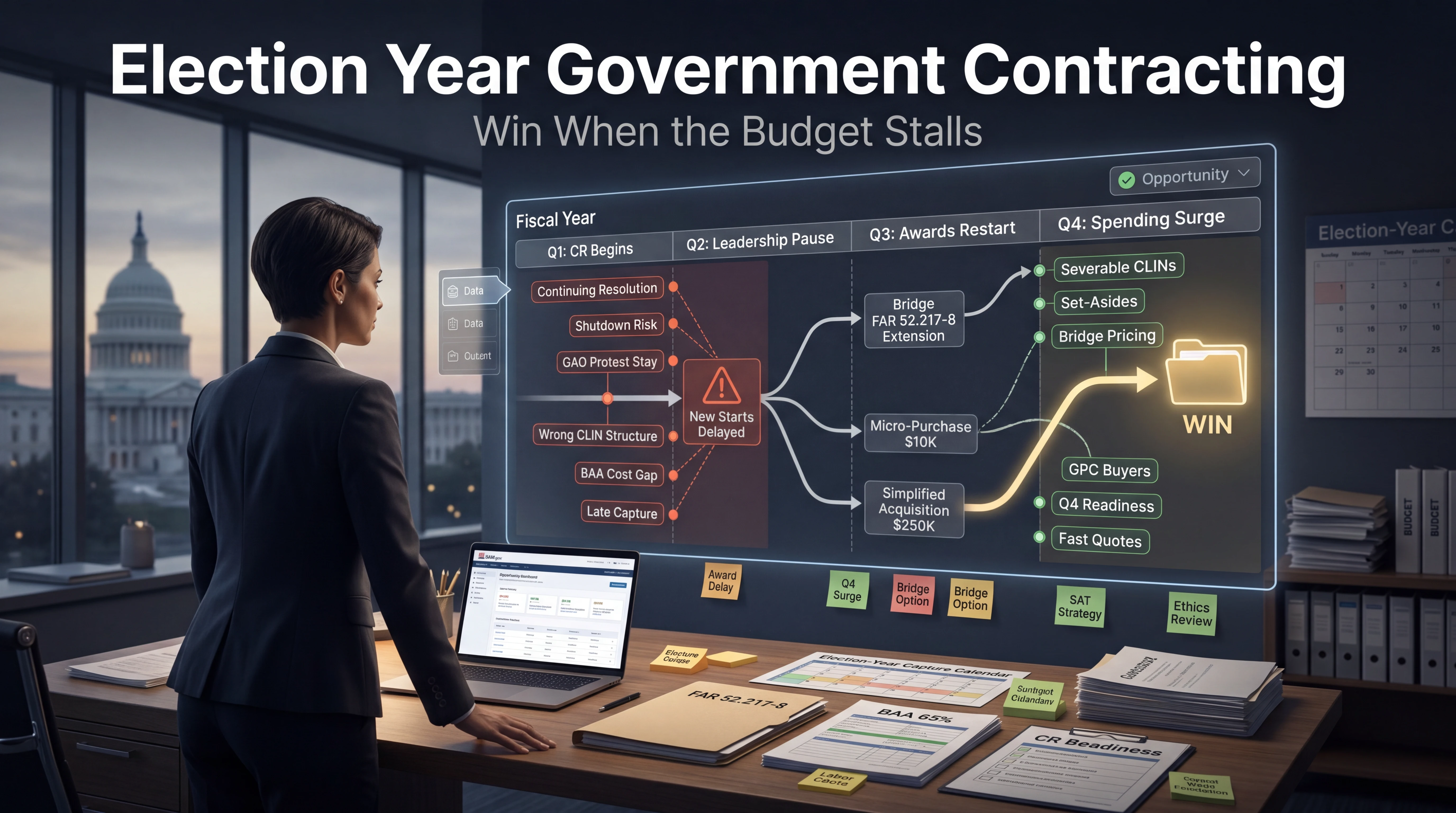
The federal fiscal year runs from October 1 through September 30 — which means every presidential election lands barely a month after the new fiscal year starts. That timing is the root of the problem. Historically, Congress rarely passes all 12 appropriations bills on time, and in election years the odds drop further. Instead, agencies open the fiscal year under a Continuing Resolution (CR) — a temporary funding measure that generally holds spending to prior-year levels and prohibits "new starts" (brand-new programs or contracts that didn't exist in the previous year's budget) [7].
For a newcomer, think of a CR like this: the government gets permission to keep the lights on, but not to buy new furniture. For a practitioner, the nuance matters more — CRs don't just freeze funding levels, they freeze decision-making culture. Contracting Officers (COs) who could legally award a contract during a CR often choose not to because they're waiting for leadership guidance that won't come until an appropriations bill passes or a new administration's political appointees are confirmed. The result is a pileup of delayed awards in the first and second quarters (October–March) that creates a compressed, frantic award surge in the third and fourth quarters.
That Q4 spending surge is not folklore — it's measurable. USAspending.gov data from FY2017 through FY2023 shows that roughly 30–40% of all federal contract obligations occur in Q4 (July–September) [9]. In election years, the front-end drought makes the back-end flood even more intense.
But here's the practitioner edge most contractors miss: the post-inauguration period (January 20 onward) often brings a regulatory freeze. Incoming administrations historically issue a memorandum through the Office of Management and Budget (OMB) pausing pending rules and significant regulatory actions for review. This can stall FAR amendments, new acquisition policy memos, and large discretionary awards for weeks or months — even after appropriations finally pass. If your capture timeline assumes a February award, and the new administration's freeze pushes it to April, your staffing plan, pricing, and teaming arrangements all need elasticity built in.
Contract Structures That Protect Revenue During Delays
When awards slip, incumbents survive and challengers starve — unless both sides structure their proposals to account for delay. The single most important mechanism here is FAR 52.217-8 (Option to Extend Services), which allows the government to extend a contract for up to six months beyond its current period of performance [4]. During election-year transitions, agencies rely heavily on these extensions (often called "bridge contracts") to keep services running while recompetitions stall.
If you're an incumbent, you should be doing two things right now. First, ensure your existing contract includes a 52.217-8 clause and that your pricing for that extension is clearly documented. Second, proactively propose a not-to-exceed (NTE) price for the extension period so the CO doesn't have to negotiate it under pressure — making it easy for them to exercise the option quickly.
If you're a challenger trying to unseat an incumbent, the 52.217-8 extension is your enemy — it buys the incumbent six more months of performance (and relationship-building) while your proposal sits in evaluation. Your counter-move: structure your proposal with clearly priced, severable Contract Line Item Numbers (CLINs). A CLIN is simply an individually priced line item on a contract — think of it as a modular building block. Severable CLINs allow the government to fund and authorize your work in pieces rather than all at once, which is exactly what COs need during a CR when full-year funding isn't available [7]. Under FAR 32.703-1 and 32.703-3, agencies can incrementally fund severable services contracts even during CRs, but only if the contract structure supports it. If your CLINs are bundled into one giant blob, the CO may not be able to start your work until full appropriations pass.
The Speed Lanes: Micro-Purchases and Simplified Acquisitions
When agencies are time-constrained — and election years make everyone time-constrained — two procurement shortcuts become disproportionately valuable. The Micro-Purchase Threshold (MPT) is currently $10,000 (effective August 31, 2020, per FAR 2.101 and FAR Case 2018-004) [1]. Purchases at or below this amount can be made with a Government Purchase Card (GPC) — essentially a government credit card — without any competition requirement. The Simplified Acquisition Threshold (SAT) is $250,000 (same effective date and source) [1]. Purchases under this ceiling can use streamlined procedures under FAR Part 13, which means shorter evaluation timelines, less paperwork, and more flexibility for the CO [2].
| Threshold | Current Amount | Effective Date | What It Means for You |
|---|---|---|---|
| Micro-Purchase (MPT) | $10,000 | Aug 31, 2020 | No competition needed; GPC purchases. Position yourself as a known vendor. |
| Simplified Acquisition (SAT) | $250,000 | Aug 31, 2020 | Streamlined evaluation; faster awards. Ideal for small-business set-asides. |
The strategic play for small businesses: pair the SAT with small-business set-asides under FAR 19.203 and 19.502-2 [1]. Set-aside requirements mean the government must reserve certain procurements exclusively for small businesses, and buys under the SAT that fall within your North American Industry Classification System (NAICS) code are strong candidates. If you're not sure which NAICS codes align with your services, GovBidLab's free NAICS Code Lookup tool can help you identify the right ones in minutes.
Ethics Rules That Tighten During Campaign Season
Election years raise the stakes on compliance — not because the rules change, but because the political environment makes violations more visible and more consequential. The rule most contractors don't fully understand is the federal contractor contribution ban: under 52 U.S.C. §30119 and 11 C.F.R. Part 115, federal contractors are prohibited from making contributions to federal candidates, political parties, or political action committees (PACs) during the period of contract negotiation and performance [6]. This ban was upheld by the D.C. Circuit in Wagner v. FEC (2015), and it applies to the contracting entity itself — not just its officers. If your company holds an active federal contract or is negotiating one, the company cannot contribute. Period.
This catches more companies than you'd expect. A manufacturing firm that donates to a congressional campaign while performing on a Department of Defense (DoD) supply contract is in violation, even if the donation and the contract have nothing to do with each other. The fix is straightforward but requires discipline: implement a corporate policy that flags all political contributions for legal review during any period in which the company holds or is pursuing a federal contract.
Separately, the Procurement Integrity Act (PIA) (41 U.S.C. §§2101–2107; FAR 3.104) prohibits anyone from soliciting or disclosing non-public source-selection information or contractor bid/proposal information [1]. During election-year leadership transitions, outgoing officials sometimes become lax about information boundaries, and incoming officials may not yet understand them. For contractors, the rule is: if someone offers you evaluation criteria, competitor pricing, or selection committee deliberations that haven't been publicly released, you must refuse and document the refusal. The PIA also includes a one-year compensation ban — certain former federal officials cannot accept compensation from a contractor on contracts over $10 million that they personally supervised or made key decisions about.
Pricing Adjustments You Need to Make Now
Two compliance-driven cost changes are already in effect and will affect every proposal you submit through at least 2028. Getting these wrong doesn't just lose you points in evaluation — it can make your contract unprofitable or non-compliant after award.
Buy American Act: The 65% Threshold Is Live
The Buy American Act (BAA) requires that the government prefer domestic end products for supply contracts. Under the March 7, 2022, final rule (87 FR 12780), the domestic content threshold — the percentage of a product's components that must be manufactured in the United States — increased to 65% as of January 1, 2024, up from the previous 55% [3]. It will step up again to 75% in 2029.
If you manufacture or supply hardware to the federal government, this changes your bill of materials math today. Components you've been sourcing internationally may push your product below the 65% threshold, which means either finding domestic suppliers (often at higher cost) or applying for a nonavailability exception — a waiver that's granted only when compliant materials genuinely can't be obtained. Your pricing models for any contract with option years extending past 2028 should also account for the jump to 75%.
The distinction between BAA and the Trade Agreements Act (TAA) matters because TAA waivers can override BAA requirements on certain procurements, and many contractors confuse the two. TAA-designated country products can substitute on many GSA Schedule and above-threshold procurements — but not automatically, and not always.
Federal Contractor Minimum Wage: $17.20 and Climbing
Under Executive Order (EO) 14026, the minimum wage for workers on federal contracts is $17.20 per hour as of January 1, 2024, with annual inflation adjustments every January [8]. This applies to service contracts covered by the Service Contract Labor Standards (SCLS) — formerly the Service Contract Act — and to concessions and contracts covered by the Davis-Bacon Act. If you're pricing a multi-year services contract, your out-year labor rates need to anticipate these annual increases. A flat-rate proposal that doesn't escalate for EO 14026 adjustments will either lose money or require a request for equitable adjustment (REA) down the road — neither of which is a winning strategy.
Before you submit any proposal, verify that your company's registration is current and your Unique Entity Identifier (UEI) is active. GovBidLab's free UEI Lookup tool lets you confirm your registration status in seconds — a small step that prevents avoidable disqualifications.
Protests, Debriefings, and the CICA Stay: Your Leverage When Awards Slip
Election-year delays create a secondary effect that sophisticated contractors exploit: when awards finally happen, they're often rushed, and rushed evaluations create protestable errors. Under the Competition in Contracting Act (CICA), a GAO (Government Accountability Office) protest filed within 5 days after a required debriefing (or within 10 days of award if no debriefing is required) triggers an automatic stay of contract performance [5]. That means the agency must stop work on the new contract until GAO resolves the protest — typically within 100 days.
This isn't advice to file frivolous protests. It's advice to always request and attend your debriefing, because the information you receive there is the foundation for determining whether the evaluation was fair. If the agency's evaluation skipped a stated criterion, misapplied the best-value tradeoff, or treated offerors unequally, those are legitimate grounds for protest — and the CICA stay gives you real leverage.
One nuance practitioners sometimes miss: the Limitations on Subcontracting rule (FAR 52.219-14; 13 C.F.R. §125.6) now measures compliance based on the "amount paid" to the prime contractor, not the legacy cost-of-labor formula that older contracts used [1]. If you're a small-business prime relying heavily on a large-business subcontractor, make sure your subcontracting plan passes the current test, not the old one. Evaluation teams during rushed election-year awards sometimes apply outdated standards, and this is a protestable error — but only if you know the current rule.
Your Election-Year Capture Calendar
Understanding how to win government contracts during an election year requires mapping your capture milestones to the political calendar, not just the procurement calendar. Here's the framework:
- October–December (Q1): Assume a CR. Focus on opportunities under the SAT and existing indefinite-delivery/indefinite-quantity (IDIQ) task orders, which can still be competed during CRs. Pursue GPC micro-purchases by building relationships with end users now. Keep your capability statement updated and tailored — this is the document program managers use to justify reaching out to you for quotes. Use GovBidLab's free Capability Statement Generator to keep yours sharp.
- January–March (Q2): Watch for the regulatory freeze if it's an inauguration year. Don't assume a February award date will hold. Build 90 days of schedule slack into your staffing plans. Price evaluated 52.217-8 options into every proposal. This is also the window to prepare for the Q3/Q4 surge — identify the solicitations that will drop when appropriations finally pass.
- April–June (Q3): Appropriations often pass (or a full-year CR becomes law) during this period. Agencies rush to obligate. Your proposals should already be written, your teams identified, your past performance references confirmed. If you're considering pursuing a GSA Schedule to access a broader set of opportunities, run GovBidLab's free GSA Eligibility Calculator to see if you qualify.
- July–September (Q4): The spending surge. This is where 30–40% of annual obligations land [9]. COs are under pressure to obligate funds before they expire. Simplified acquisitions, small-business set-asides, and existing vehicle task orders move fastest. Be responsive — a 24-hour delay in returning a quote can cost you the award.
What to Do Next
Start by auditing your active contracts and pending proposals for three things: whether your 52.217-8 option pricing is clearly stated and competitive, whether your domestic content percentages meet the 65% BAA threshold, and whether your out-year labor rates account for annual EO 14026 minimum wage adjustments. Then map every opportunity in your pipeline against the CR/appropriations calendar for the current fiscal year. If an award depends on new-year funding that hasn't been appropriated, build your staffing and teaming plans to absorb a 90- to 120-day delay. The contractors who win work in election years aren't the ones hoping the system speeds up — they're the ones who've already priced in the slowdown.
Glossary of Terms Used in This Article
| Term / Acronym | Definition |
|---|---|
| BAA (Buy American Act) | A federal law requiring the government to prefer domestically manufactured products when buying supplies. It sets minimum domestic content thresholds for components. |
| BD (Business Development) | The function within a contracting company responsible for identifying, pursuing, and winning new government contracts. |
| Bridge Contract | A short-term contract extension — often using FAR 52.217-8 — that keeps services running while a follow-on competition is completed. |
| CICA (Competition in Contracting Act) | A federal statute requiring full and open competition for government contracts. It also establishes the automatic stay mechanism when a protest is filed at GAO. |
| CLIN (Contract Line Item Number) | An individually priced item on a government contract. Severable CLINs can be funded and performed independently, which is useful during CRs. |
| CO (Contracting Officer) | The government official with legal authority to enter into, modify, or terminate government contracts. |
| CR (Continuing Resolution) | A temporary funding law that allows the government to keep spending at prior-year levels when Congress hasn't passed regular appropriations bills. |
| DoD (Department of Defense) | The federal department responsible for military and national security operations; the largest single buyer in the federal government. |
| EO (Executive Order) | A directive issued by the President that manages operations of the federal government. EO 14026 sets the minimum wage for federal contractor workers. |
| FAR (Federal Acquisition Regulation) | The primary rulebook governing how the federal government purchases goods and services. It applies to all executive branch agencies. |
| GAO (Government Accountability Office) | An independent legislative branch agency that, among other things, adjudicates bid protests filed by contractors who believe an award decision was improper. |
| GPC (Government Purchase Card) | A charge card used by government employees to make small purchases (at or below the micro-purchase threshold) without a formal contracting process. |
| IDIQ (Indefinite-Delivery/Indefinite-Quantity) | A type of contract that provides for an indefinite quantity of supplies or services during a fixed period. Work is ordered through individual task or delivery orders. |
| MPT (Micro-Purchase Threshold) | The dollar amount ($10,000 standard) below which the government can buy goods or services without competitive bidding. |
| NAICS (North American Industry Classification System) | A standardized coding system used to classify businesses by industry. The government uses NAICS codes to determine applicable small-business size standards and set aside procurements. |
| NTE (Not-to-Exceed) | A pricing ceiling that sets the maximum amount the government will pay for a service or option period. |
| OMB (Office of Management and Budget) | The White House office that oversees federal budget development and agency spending. OMB issues guidance on CRs and regulatory freezes. |
| PAC (Political Action Committee) | An organization that pools campaign contributions from members and donates to political campaigns. Federal contractors are prohibited from contributing to federal PACs. |
| PIA (Procurement Integrity Act) | A federal law prohibiting the disclosure or solicitation of non-public bid, proposal, or source-selection information during a procurement. |
| REA (Request for Equitable Adjustment) | A formal request from a contractor to the government for additional compensation or time when contract conditions change beyond what was originally agreed. |
| SAT (Simplified Acquisition Threshold) | The dollar amount ($250,000 standard) below which the government can use streamlined procurement procedures, reducing paperwork and evaluation time. |
| SCLS (Service Contract Labor Standards) | The statute (formerly called the Service Contract Act) that requires contractors on federal service contracts to pay workers prevailing wages and benefits. |
| TAA (Trade Agreements Act) | A law that implements international trade agreements and can waive Buy American Act requirements for products from designated countries. |
| UEI (Unique Entity Identifier) | The 12-character alphanumeric ID assigned to entities registered in SAM.gov. Required for any company doing business with the federal government. |
References
- Federal Acquisition Regulation (FAR) 2.101 — Definitions (Micro-Purchase Threshold, Simplified Acquisition Threshold); FAR Case 2018-004, effective August 31, 2020. acquisition.gov/far/2.101
- Federal Acquisition Regulation (FAR) Part 13 — Simplified Acquisition Procedures. acquisition.gov/far/part-13
- Federal Register, "Amendments to the FAR: Buy American Act Requirements," 87 FR 12780, March 7, 2022. FAR 25.101, 25.201; staged domestic content thresholds (65% effective 2024, 75% effective 2029). federalregister.gov
- Federal Acquisition Regulation (FAR) 52.217-8 — Option to Extend Services; FAR 52.217-9 — Option to Extend the Term of the Contract. acquisition.gov/far/52.217-8
- 31 U.S.C. §3553(d) — CICA Automatic Stay Provisions; 4 C.F.R. §21.2 — GAO Bid Protest Timeliness Rules. gao.gov/legal/bid-protests
- 52 U.S.C. §30119 — Contributions by Federal Contractors; 11 C.F.R. Part 115 — Federal Election Commission Regulations. fec.gov
- 31 U.S.C. §1341 — Anti-Deficiency Act; OMB Circular A-11 — Preparation, Submission, and Execution of the Budget (CR guidance). whitehouse.gov/omb/circulars
- U.S. Department of Labor, Wage and Hour Division — Executive Order 14026, Federal Contractor Minimum Wage, $17.20/hour effective January 1, 2024; 29 C.F.R. Part 10. dol.gov/agencies/whd/government-contracts/eo14026
- USAspending.gov — Spending Explorer and Agency Profiles, historical obligation trends by quarter, FY2017–FY2023. usaspending.gov/explorer