DOGE and Government Contracting: What Contractors Should Do Now
DOGE isn't rewriting procurement law — but the efficiency philosophy behind it is already reshaping how agencies spend and whom they buy from. Learn which five procurement levers matter, which compliance requirements are tightening, and the concrete five-move playbook to position your business for an efficiency-driven federal market.

Tiatun T.
Federal Sales Consultant · May 12, 2026
What This Article Covers — and Why It Matters to Your Pipeline
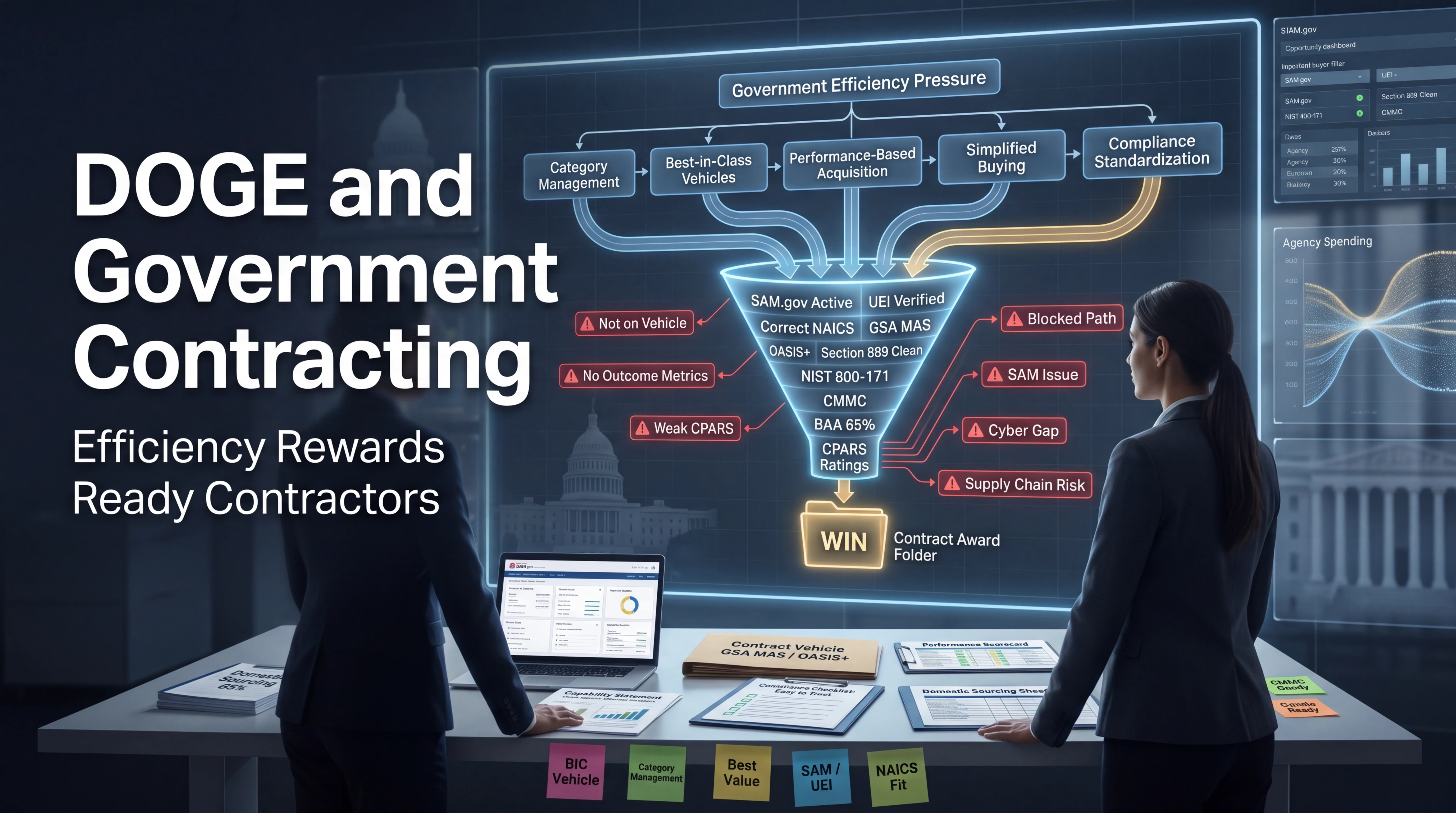
This article explains what the Department of Government Efficiency (DOGE) actually is — and isn't — as of mid-2026, and what it concretely means for contractors trying to win government contracts. You'll finish with a clear picture of which procurement levers an "efficiency" agenda actually pulls, which compliance requirements are tightening (not loosening), and the five specific actions you should take to position your company in a market that increasingly rewards contractors who are easy to buy from, easy to trust, and easy to measure.
Whether you're a first-time bidder wondering if DOGE changes the game or a seasoned business development (BD) director recalibrating your capture strategy, the core message is the same: DOGE isn't rewriting procurement law — but the efficiency philosophy behind it is already reshaping how agencies spend, what they buy, and whom they buy it from. Ignore the branding; act on the substance.
DOGE Is a Concept, Not a Rulemaker — Here's What That Means for You
Let's clear the air immediately. As of May 2026, no law has created a federal Department of Government Efficiency. Establishing a new cabinet-level department requires an authorizing statute passed by Congress, followed by implementation guidance from the Office of Management and Budget (OMB) and the Office of Federal Procurement Policy (OFPP). None of that has happened [1]. The phrase "DOGE" circulates in political discourse and media, but it does not appear in the Federal Acquisition Regulation (FAR) — the actual rulebook that governs how the federal government buys goods and services — nor in any agency supplement like the Defense Federal Acquisition Regulation Supplement (DFARS).
Why does this distinction matter to you as a contractor? Because it tells you where to focus your energy. You don't need to monitor a new department's rulemaking docket. You do need to watch the mechanisms that already drive procurement efficiency: Category Management policy from OMB/OFPP, performance-based acquisition requirements under FAR Subpart 37.6, shared-services mandates, and digital procurement automation initiatives [3]. These aren't theoretical. They're in solicitations right now, shaping evaluation criteria and contract structures on opportunities you're probably already tracking.
Think of it this way: "DOGE" is the brand name on the box. Inside the box, every tool is one you already recognize — Best-in-Class (BIC) contracts, performance work statements, cyber attestations, supply-chain controls. The efficiency agenda is real. The question is whether you've retooled your business to meet it.
The Five Procurement Levers an Efficiency Agenda Actually Pulls
If a future DOGE office — or any OMB-driven efficiency push — gains real authority, it won't reinvent procurement. It will accelerate trends already embedded in the FAR. Here are the five levers that matter most, what each means in plain terms, and the nuance a practitioner should not overlook.
1. Category Management and Best-in-Class Vehicles
Category Management is the federal government's strategy for buying smarter by treating similar purchases as a portfolio rather than thousands of one-off transactions [3]. Agencies are measured on how much of their spending goes through Best-in-Class (BIC) contracts — pre-vetted, governmentwide vehicles like the General Services Administration (GSA) Multiple Award Schedule (MAS) and OASIS+ (a governmentwide, multi-agency indefinite-delivery, indefinite-quantity contract for professional services). If you're not on one of these vehicles, you're increasingly invisible to the buyers with the biggest budgets.
The practitioner edge here: Category Management metrics now influence agency procurement review boards. A contracting officer (CO) who routes a buy through a non-BIC vehicle may face internal pushback. That means even if you have a strong relationship with a program office, you can lose the deal at the procurement-strategy stage if you're not accessible on a preferred vehicle. If you're wondering whether your company qualifies for a GSA Schedule, GovBidLab's free GSA Eligibility Calculator can give you a quick baseline assessment.
2. Performance-Based Acquisition
FAR Subpart 37.6 pushes agencies to define what they need accomplished (outcomes) rather than how to do it (inputs) [1]. Under an efficiency agenda, expect this pressure to intensify. For contractors, this means your proposals need to speak the language of measurable results — service-level agreements, quality metrics, deliverable acceptance criteria — not just staffing plans and labor categories.
If you're new to govcon, performance-based acquisition simply means the government tells you "we need 99.9% network uptime" instead of "we need six system administrators working 40 hours a week." The contractor who can articulate how they'll hit that target — and prove they've done it before — wins. For practitioners: this is where your Contractor Performance Assessment Reporting System (CPARS) ratings become currency. A string of "Exceptional" ratings on performance-based contracts is worth more than a marginally lower price.
3. Simplified and Commercial Buying Pathways
The FAR already provides streamlined pathways for lower-dollar and commercial purchases. FAR Part 13 covers Simplified Acquisition Procedures (SAP) for purchases under the Simplified Acquisition Threshold (SAT) of $250,000 [1]. FAR Part 12 governs the acquisition of commercial products and commercial services, allowing agencies to buy what you already sell commercially without layering on government-unique requirements. The Micro-Purchase Threshold (MPT) sits at $10,000 for most agencies [1], below which a government purchase-card holder can buy directly.
An efficiency push accelerates the use of these pathways. For newer contractors, this is your on-ramp. Winning a handful of simplified-acquisition or commercial buys lets you build CPARS history and demonstrate results quickly — without the multi-year, multi-volume proposal effort of a full-and-open competition.
The practitioner nuance: SAP buys are often set aside for small businesses under FAR Part 19. If your firm is small under the applicable North American Industry Classification System (NAICS) code and size standard (defined by the Small Business Administration (SBA) in 13 CFR Part 121 [4]), these set-asides are a strategic pipeline, not just a side hustle. Use GovBidLab's NAICS Code Lookup tool to confirm your codes and corresponding size standards.
4. Best-Value Tradeoff Over Lowest Price
Here's something that surprises newcomers and reassures practitioners: efficiency does not automatically mean "buy the cheapest option." The Department of Defense (DoD) has actively restricted the use of Lowest-Price Technically Acceptable (LPTA) source selection under DFARS 215.101-2-70 [2]. LPTA — where the government picks the lowest bidder among those who meet minimum technical standards — is now off-limits for many knowledge-based services, IT acquisitions, and complex professional services unless narrow conditions are met.
This pushes evaluations back toward best-value tradeoff, where past performance, technical approach, management plan, and risk mitigation can legitimately outweigh a small price difference. For contractors, this is actionable intelligence: invest in your proposal narratives. A compelling risk-mitigation section or a detailed transition plan can beat a competitor who undercuts you by 5%.
5. Compliance Standardization — More, Not Less
Perhaps the biggest misconception about "efficiency" is that it means fewer rules. It doesn't. It means standardized, strictly enforced rules. Three compliance areas are tightening right now:
| Compliance Area | Key Rule | Current Requirement | What's Changing |
|---|---|---|---|
| Buy American Act (BAA) | FAR Part 25; EO 14005 [5] | 65% domestic content (effective Jan 1, 2024) | Increases to 75% on Jan 1, 2029 |
| Section 889 Supply Chain | FAR 52.204-24/25/26 [1] | Prohibition on providing and using covered telecom/video equipment | Enforcement continues; no relaxation expected |
| Cybersecurity (DoD) | DFARS 252.204-7012; NIST SP 800-171 [2] | Safeguard Controlled Unclassified Information (CUI) | CMMC certification phasing into solicitations |
| Cost/Price Data | FAR 15.403-4 [1] | Certified cost or pricing data required above $2,000,000 | Threshold unchanged since July 2018 |
If you're a DoD contractor or subcontractor, the Cybersecurity Maturity Model Certification (CMMC) program is no longer theoretical. CMMC requirements are expected to appear in DFARS clauses in solicitations, meaning you may need third-party certification before you can even bid. GovBidLab's free CMMC Calculator helps you estimate the level you'll need and the gap between where you are and where you need to be.
Your Five-Move Playbook for an Efficiency-Driven Market
Stop reading about DOGE as a political story. Start treating it as a market signal. Here's what to do — in order of priority.
- Move 1: Lock down your registration and market identity. Your Unique Entity Identifier (UEI) and SAM.gov registration are the front door to every federal opportunity [6]. If they're incomplete, outdated, or inconsistent with your NAICS codes and SBA size standards, you're creating friction for buyers who are being told to reduce friction. Use GovBidLab's UEI Lookup to verify your identifier, and confirm your NAICS codes match the work you're actually pursuing — not just the work you did five years ago.
- Move 2: Build or refresh your capability statement around outcomes. In a performance-based acquisition environment, a capability statement that lists labor categories and past contract numbers is table stakes. Rewrite it to lead with measurable outcomes you've delivered: "reduced help-desk resolution time by 38%," "maintained 99.95% system availability across 14 sites," "delivered $2.1M in cost avoidance through supply-chain redesign." GovBidLab's Capability Statement Generator provides a structured template that emphasizes the outcome language agencies are now trained to look for.
- Move 3: Get on a Best-in-Class vehicle — or get on one faster. If you already hold a GSA MAS or are on OASIS+, audit your offerings. Are your SINs (Special Item Numbers) current? Are your prices competitive against the vehicles that agencies compare you to? If you're not on a BIC vehicle yet, make the application your next quarterly priority. The longer you wait, the more buying activity consolidates onto these contracts without you.
- Move 4: Harden your compliance posture proactively. Don't wait for a contracting officer to ask about your Buy American Act sourcing documentation or your NIST SP 800-171 System Security Plan. Build the evidence package now. For BAA, map every product you sell to its domestic-content percentage and document it. For Section 889, conduct an internal audit of your IT supply chain — including subcontractors. For CMMC, get a gap assessment done before the solicitation drops. Efficiency-oriented agencies will increasingly view compliance maturity as a discriminator, not just a pass/fail gate.
- Move 5: Accumulate CPARS early through small, fast contracts. This is the move that experienced BD directors sometimes overlook because it feels "below" their pipeline targets. Winning two or three simplified-acquisition or commercial buys — and earning strong CPARS ratings on them — gives you documented, verifiable past performance that carries weight in best-value evaluations on larger opportunities. An "Exceptional" rating on a $150,000 IT support contract is more valuable than an "unrated" status on a $50M proposal. Start small, perform well, get rated, and then reference those ratings in your next big capture.
What Practitioners Should Watch That Newcomers Don't Know About Yet
If you're an experienced contracts manager or BD director, here are two under-the-radar dynamics worth tracking.
First, OMB's Spend Under Management (SUM) metrics are quietly reshaping procurement strategy at the agency level [3]. SUM measures how much of an agency's contract spending flows through approved Category Management tiers. Agencies that score poorly face scrutiny. This means procurement shops are under internal pressure to steer work to existing vehicles — even when an open-market buy might yield a better technical solution. If you're competing outside a BIC vehicle, you now need to help the contracting officer justify the decision. Build that justification language into your capture strategy: cite unique requirements, mission urgency, or small-business goals that make an open-market approach defensible under FAR Part 7 acquisition planning requirements.
Second, the interplay between LPTA restrictions and efficiency pressure creates a paradox. Agencies are told to be efficient (read: spend less, buy faster) but are simultaneously prohibited from using LPTA — the evaluation method most obviously aligned with "cheapest and fastest" — for many service categories under DFARS 215.101-2-70 [2]. The practical result is that best-value tradeoff evaluations are becoming the norm in DoD and spreading to civilian agencies. This is good news for contractors who invest in proposal quality, but it also means evaluation timelines are longer and source-selection documentation is thicker. If you're a subcontractor, understand that your prime is being evaluated on the strength of your past performance and technical approach — not just your price to the prime. Push your primes to feature your capabilities prominently in the proposal narrative.
What to Do Next
Pick one move from the playbook above and execute it this week. If your SAM registration is current, audit your capability statement for outcome language. If your capability statement is strong, check whether you're positioned on a Best-in-Class vehicle. If you're already on one, pull your last three CPARS ratings and honestly assess whether they help or hurt you in a best-value evaluation. The efficiency wave is not coming — it's here, with or without the DOGE label. Contractors who learn how to win government contracts in this environment will be those who made themselves easy to buy from, easy to trust, and easy to measure. Start today with GovBidLab's free tools and build from there.
Glossary of Terms Used in This Article
| Term / Acronym | Definition |
|---|---|
| BAA (Buy American Act) | A federal law requiring the government to prefer domestic products when purchasing goods. Contractors must meet domestic-content thresholds to qualify. |
| BD (Business Development) | The function within a contracting company responsible for identifying, pursuing, and winning new government opportunities. |
| BIC (Best-in-Class) | A designation given to governmentwide contract vehicles that OMB considers the most efficient and well-managed. Agencies are encouraged to use BIC vehicles first. |
| CMMC (Cybersecurity Maturity Model Certification) | A DoD program requiring contractors to achieve verified cybersecurity standards before handling sensitive defense information. |
| CO (Contracting Officer) | The government official with legal authority to enter into, administer, and terminate contracts on behalf of the U.S. government. |
| CPARS (Contractor Performance Assessment Reporting System) | The federal system where agencies record evaluations of contractor performance. These ratings follow a contractor from one competition to the next. |
| CUI (Controlled Unclassified Information) | Government information that isn't classified but still requires safeguarding under federal rules. |
| DFARS (Defense Federal Acquisition Regulation Supplement) | DoD-specific procurement rules that supplement the FAR. |
| DOGE (Department of Government Efficiency) | A proposed — but not yet congressionally authorized — concept for a federal office focused on improving government efficiency. |
| FAR (Federal Acquisition Regulation) | The primary set of rules governing how the federal government purchases goods and services. |
| GSA (General Services Administration) | The federal agency that manages government buildings, provides products and services, and administers major contract vehicles like the Multiple Award Schedule. |
| GWAC (Governmentwide Acquisition Contract) | A type of indefinite-delivery contract for IT products and services available to all federal agencies. |
| IDIQ (Indefinite-Delivery, Indefinite-Quantity) | A contract type that provides for an indefinite quantity of supplies or services over a fixed period, with individual task or delivery orders issued as needs arise. |
| LPTA (Lowest-Price Technically Acceptable) | A source-selection method where the government awards to the lowest-priced offeror that meets minimum technical requirements. |
| MAS (Multiple Award Schedule) | GSA's primary contract vehicle allowing agencies to buy commercial products and services at pre-negotiated prices. |
| MPT (Micro-Purchase Threshold) | The dollar limit ($10,000 for most agencies) below which a purchase can be made without competitive bidding. |
| NAICS (North American Industry Classification System) | A coding system that categorizes businesses by industry. The government uses NAICS codes to determine which size standard applies to a contractor for small-business set-asides. |
| NIST SP 800-171 | A cybersecurity standard published by the National Institute of Standards and Technology specifying how contractors must protect CUI. |
| OASIS+ (One Acquisition Solution for Integrated Services Plus) | A governmentwide, multi-agency IDIQ contract vehicle for professional services managed by GSA. |
| OFPP (Office of Federal Procurement Policy) | The office within OMB that sets governmentwide procurement policy. |
| OMB (Office of Management and Budget) | The executive branch office that oversees federal spending, budgeting, and management policy. |
| SAM (System for Award Management) | The official government database where contractors must register to do business with the federal government. Found at SAM.gov. |
| SAP (Simplified Acquisition Procedures) | Streamlined procurement methods used for purchases under the Simplified Acquisition Threshold. |
| SAT (Simplified Acquisition Threshold) | The dollar limit ($250,000 for most purchases) below which agencies can use simplified buying procedures. |
| SBA (Small Business Administration) | The federal agency that sets size standards and administers small-business programs in government contracting. |
| SIN (Special Item Number) | A category code on a GSA Schedule contract that identifies the specific products or services a contractor is approved to sell. |
| SUM (Spend Under Management) | An OMB metric measuring what percentage of an agency's contract spending flows through approved Category Management tiers. |
| UEI (Unique Entity Identifier) | A 12-character alphanumeric code assigned to every entity registered in SAM.gov, replacing the former DUNS number. |
References
- Federal Acquisition Regulation (FAR), Parts 2.101, 7, 12, 13, 15.101-2, 15.403-4, 19, 25, 37.6, and clauses 52.204-24/25/26. General Services Administration, Department of Defense, National Aeronautics and Space Administration. acquisition.gov/far. Current as of May 2026.
- Defense Federal Acquisition Regulation Supplement (DFARS), sections 215.101-2-70 and 252.204-7012. Department of Defense. acquisition.gov/dfars. Current as of May 2026.
- Category Management Policy and Best-in-Class Guidance. Office of Management and Budget, Office of Federal Procurement Policy. whitehouse.gov/omb.
- Small Business Size Standards (13 CFR Part 121; Table of Small Business Size Standards). U.S. Small Business Administration. sba.gov/size-standards.
- Executive Order 14005, "Ensuring the Future Is Made in All of America by All of America's Workers," and implementing FAR Buy American final rule. The White House; FAR Council. federalregister.gov. Domestic-content thresholds effective January 1, 2024 (65%) and January 1, 2029 (75%).
- SAM.gov — System for Award Management (registration portal, UEI assignment, contract opportunities). U.S. General Services Administration. sam.gov.
- USAspending.gov — Federal contract spending data and agency profiles. U.S. Department of the Treasury. usaspending.gov.