BPA Contracts: How Blanket Purchase Agreements Work in Government
A complete guide to BPA contracts: open-market vs. GSA Schedule BPAs, call thresholds, fair opportunity rules, small business set-asides, and the practical steps vendors use to position themselves for BPA wins.

Tiatun T.
Federal Sales Consultant · Apr 20, 2026
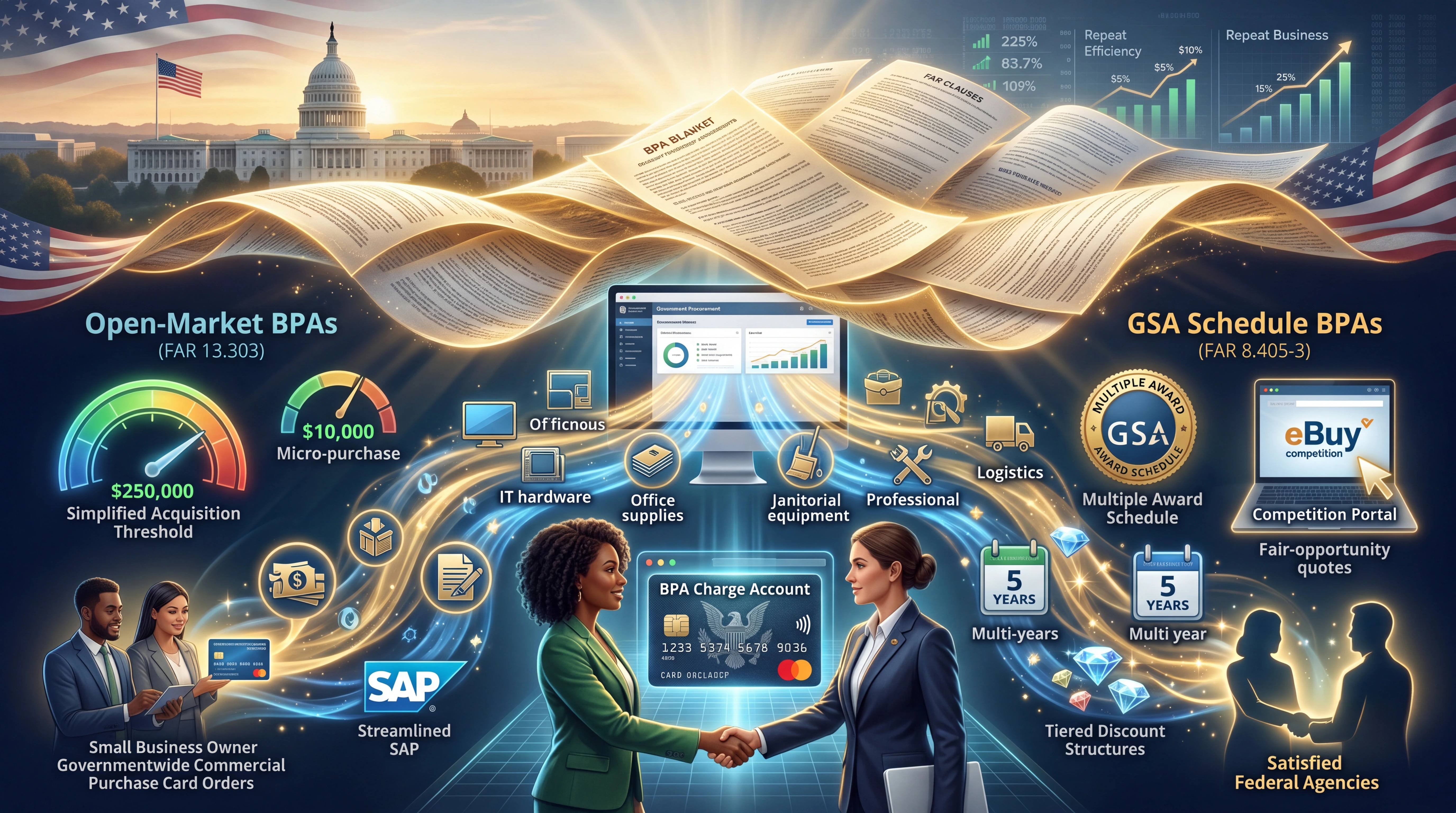
This article explains Blanket Purchase Agreements (BPAs) — one of the most common yet misunderstood tools in federal procurement. By the end, you will understand what a BPA actually is (and what it is not), the two main types the government uses, the dollar thresholds and competition rules that govern each, how small businesses can leverage BPAs, and the practical steps vendors take to position themselves for BPA opportunities. Whether you are exploring how to win government contracts for the first time or refining an existing federal sales strategy, this guide is grounded in the Federal Acquisition Regulation (FAR) and the rules that govern real transactions.
What Is a Blanket Purchase Agreement?
Think of a BPA as a pre-arranged “charge account” between a government agency and one or more vendors. The agency and the vendor agree up front on pricing, delivery terms, discounts, and applicable contract clauses. Once that agreement is in place, the agency can place quick individual orders — officially called calls — whenever a need arises, without repeating the full solicitation process each time.
Here is the critical nuance that trips up newcomers and veterans alike: a BPA is not a contract, and it does not obligate any money. No funds are committed when a BPA is established. The government is only obligated to pay when it places a funded call against the BPA [1][2]. This means winning a BPA is not the same as winning revenue — it is winning a position from which revenue can flow. Experienced contractors understand this distinction viscerally; newer firms sometimes celebrate BPA award only to sit idle waiting for calls that may trickle in slowly.
The purpose behind BPAs is speed and administrative efficiency. Instead of running a fresh competition every time an office needs toner cartridges, IT support hours, or janitorial supplies, the agency competes once to establish terms, then places calls quickly as needs arise within those terms. This benefits both sides: the government reduces paperwork and cycle time, and the vendor gets a streamlined path to repeat business.
The Two Types of BPAs: Open-Market vs. GSA Schedule
Federal BPAs come in two primary flavors, each governed by different sections of the FAR. Understanding which type you are dealing with changes everything about thresholds, competition, and strategy.
| Feature | Open-Market BPA (FAR 13.303) | GSA Schedule BPA (FAR 8.405-3) |
|---|---|---|
| Legal authority | Simplified Acquisition Procedures, FAR Part 13 | Federal Supply Schedule ordering, FAR Subpart 8.4 |
| Prerequisite | None — vendor needs only to be a qualified source | Vendor must hold a GSA Multiple Award Schedule (MAS) contract |
| Typical call dollar limit | Individual calls generally at or below the SAT of $250,000 [5] | No inherent per-call ceiling (governed by underlying Schedule contract scope) |
| Duration | No fixed maximum; reviewed annually [1] | Up to five years, not to exceed remaining Schedule contract term [2] |
| Award structure | Single-vendor or multi-vendor | Single-award or multiple-award |
| Cancellation | Either party, written notice [1] | Per BPA terms and Schedule contract |
Open-Market BPAs Under FAR 13.303
Open-market BPAs are the simpler of the two. They are established under Simplified Acquisition Procedures (SAP) — the streamlined buying rules the government uses for lower-dollar purchases. An agency sets up an open-market BPA by identifying one or more qualified vendors, negotiating pricing and terms, and designating which government personnel are authorized to place calls. Individual calls are typically kept at or below the Simplified Acquisition Threshold (SAT) of $250,000 [1][5]. For very small purchases, the agency may even pay with the Governmentwide Commercial Purchase Card — a government credit card — making the transaction nearly as fast as a consumer purchase.
Important guardrails: Agencies cannot use an open-market BPA to avoid mandatory supply sources — such as AbilityOne — and they cannot use a BPA to circumvent competition requirements [1]. They must also review each BPA at least annually to confirm it still represents best value and to update pricing. If either party wants out, a simple written notice cancels the BPA with no penalty for unfulfilled requirements [1].
The Micro-Purchase Threshold (MPT) for most civilian agencies is $10,000 [5] — below that amount, the government can buy without soliciting competitive quotes at all. BPA calls in the $10,000–$250,000 range are where most of the recurring open-market BPA volume lives.
GSA Schedule BPAs Under FAR 8.405-3
Schedule BPAs add a layer of sophistication. They are established against existing GSA Multiple Award Schedule (MAS) contracts — meaning the vendor must already hold a GSA Schedule contract before it can compete for a Schedule BPA. If you are wondering whether your company qualifies, GovBidLab’s GSA Eligibility Calculator can help you assess readiness in minutes.
Schedule BPAs can be single-award (one vendor) or multiple-award (several vendors). They run for up to five years and may not extend beyond the remaining period of the underlying Schedule contract [2]. Establishing a single-award Schedule BPA requires more justification — and if the estimated total value exceeds the large-dollar threshold linked to FAR 16.504(c)(1)(ii)(D) (inflation-adjusted and commonly cited at $112 million), the head of the agency must personally determine that a single award is in the government’s best interest [2][6].
Once a multiple-award Schedule BPA is in place, the agency must provide fair opportunity among BPA holders when placing orders. For services that require a Statement of Work (SOW), orders above the SAT generally must be posted on GSA eBuy — GSA’s online RFQ portal — for at least seven calendar days, or the agency must solicit from at least three Schedule contractors [3]. This eBuy competition requirement exists to preserve competitive discipline even inside the convenience of a pre-established BPA.
Pricing discipline: For Schedule BPAs, your pricing must be consistent with — or better than — your GSA Schedule pricing. Agencies actively track price reductions under FAR 8.405-4 [8]. Building tiered discount structures (better discounts for higher volumes) is a common and approved strategy.
BPA vs. IDIQ: What Is the Difference?
Practitioners often ask how BPAs compare to Indefinite-Delivery, Indefinite-Quantity (IDIQ) contracts. While both involve pre-competed frameworks with individual task or delivery orders, they are legally distinct.
| Characteristic | BPA | IDIQ Contract |
|---|---|---|
| Legal nature | Agreement — not a binding contract | Binding contract with guaranteed minimum [6] |
| Funding obligation at award | None — funds obligated only when a call is placed | Minimum quantity obligated at award |
| Revenue certainty | Lower — depends on call volume | Higher — minimum guaranteed by contract |
| Protest environment | Limited protest rights | GAO jurisdiction above $10M civilian / $25M DoD |
| Setup complexity | Lower — SAP or Schedule ordering | Higher — full FAR Part 15 or competitive process |
Small Business Opportunities Under BPAs
BPAs can be a powerful entry point for small businesses learning how to win government contracts, but the small business rules differ depending on the BPA type.
Open-Market BPAs
Under FAR Part 13, purchases above the MPT ($10,000) and at or below the SAT ($250,000) are generally automatically reserved for small businesses under the Rule of Two — the acquisition must be set aside for small business if the contracting officer expects at least two responsible small businesses will submit competitive offers at fair market prices [1][5]. This makes open-market BPAs a natural channel for agencies to direct recurring small-dollar spend to small firms.
Schedule BPAs
The ordering activity’s contracting officer may set aside BPAs and individual orders for small business concerns under FAR 8.405-5 [4]. When a Schedule BPA is set aside, the vendor’s small business size status is determined — and periodically reaffirmed — according to SBA rules at 13 CFR 121.404 [7]. This means a firm that grows beyond its size standard during the BPA period may need to rerepresent its size at the next rerepresentation trigger.
If you are a small business preparing to compete for BPAs, GovBidLab’s free Capability Statement Generator helps you build a polished one-pager quickly, and the NAICS Code Lookup tool ensures you are identifying the right industry codes and size standards for the work you pursue.
How to Position Your Company for BPA Wins
Understanding the regulatory framework is necessary but not sufficient. The vendors who consistently win and profit from BPAs share several practical habits that go beyond knowing the FAR.
-
1
Negotiate pricing that leaves room to perform well.
Agencies evaluate BPAs on best value, not just lowest price. Vendors who undercut their own margins to win the BPA often regret it when calls start flowing and they cannot deliver quality at the agreed rate.
-
2
Keep your catalogs and systems current.
Stale pricing, discontinued products, or outdated points of contact are the fastest ways to lose calls to competitors. For Schedule BPA holders, this means keeping your GSA Advantage! listings accurate and responding to GSA’s Industrial Funding Fee (IFF) reporting requirements on time.
-
3
Respond to calls fast.
The entire point of a BPA is speed. When the agency posts a call or sends an RFQ to BPA holders, the vendor who responds quickly — with a compliant, well-organized quote — has a structural advantage. Build internal processes so that authorized staff can turn around quotes within 24 to 48 hours.
-
4
Track your BPA portfolio actively.
Know when each BPA is up for annual review (open-market) or approaching its five-year ceiling (Schedule). Proactively reach out to the contracting officer before review dates with updated pricing, performance summaries, and new capabilities. Agencies appreciate vendors who make their jobs easier.
-
5
Register and verify your entity information.
Every vendor doing business with the federal government needs a valid Unique Entity Identifier (UEI) and an active SAM.gov registration. GovBidLab’s free UEI Lookup tool makes it simple to verify or look up a UEI.
Common Mistakes to Avoid
Treating the BPA award as the finish line
A BPA with no calls against it generates exactly zero revenue. After award, shift immediately into relationship management and call responsiveness. Build rapport with the authorized ordering officials — they are the ones who decide which BPA holder gets each call.
Exceeding the SAT on open-market BPA calls without authority
Individual calls under a FAR 13.303 BPA should generally stay at or below $250,000 [1]. Exceeding this threshold without an applicable authority can create a ratification problem for the contracting officer — and a compliance risk for the vendor.
Ignoring fair opportunity on multiple-award BPAs
When an agency places an order under a multiple-award Schedule BPA, it must give all BPA holders a fair chance to compete unless an exception applies [2]. Vendors who suspect they are being bypassed should document the pattern. Conversely, vendors receiving all the calls on a multiple-award BPA should not assume that will continue unchallenged.
Letting size status lapse
Small businesses on long-term Schedule BPAs must monitor their size status carefully. If your company’s revenue or employee count crosses the applicable SBA size standard, you may need to rerepresent as other-than-small at the next rerepresentation trigger under 13 CFR 121.404 [7]. Plan ahead so this transition does not catch you — or the contracting officer — off guard.
Where BPAs Fit in Your Broader Government Contracting Strategy
BPAs are not the only path into federal sales, but they are one of the most accessible. For newer firms, open-market BPAs offer a relatively low barrier to entry — no GSA Schedule required, smaller dollar values, and simplified procedures. For firms that already hold a GSA Schedule, Schedule BPAs provide a way to lock in recurring revenue streams with specific agencies over multi-year periods. In both cases, strong BPA performance builds the past performance record that unlocks larger opportunities down the road — including IDIQ contracts and full-and-open competitive procurements.
What to Do Next
Start by determining which BPA type aligns with your current positioning. If you do not hold a GSA Schedule, focus on open-market BPA opportunities posted on SAM.gov and agency-specific procurement sites. If you do hold a Schedule, search GSA eBuy for active Schedule BPA solicitations in your Special Item Numbers (SINs). Either way, make sure your SAM.gov registration is current, your capability statement is sharp, and your team is ready to respond to calls within 48 hours. Explore GovBidLab’s full suite of free government contracting tools to check your readiness today.
Glossary of Terms Used in This Article
AbilityOne — A federal program that directs certain government purchases to nonprofit organizations employing people who are blind or have significant disabilities. Agencies must check AbilityOne availability before buying from other sources.
BPA (Blanket Purchase Agreement) — A pre-arranged agreement between a government agency and one or more vendors establishing pricing, terms, and conditions for anticipated, repetitive purchases. It is not a contract and creates no funding obligation until the agency places a call.
Call — An individual funded order placed against an existing BPA. Each call is the point at which the government actually commits money and the vendor earns revenue.
eBuy — GSA’s online portal where agencies post Requests for Quotation (RFQs) and Requests for Proposal (RFPs) to GSA Schedule contractors. Used for Schedule BPA establishment and order-level competition.
FAR (Federal Acquisition Regulation) — The primary set of rules governing how federal agencies purchase goods and services. Published on Acquisition.gov and organized into numbered parts and subparts.
Fair Opportunity — The requirement that agencies give all holders of a multiple-award BPA (or IDIQ) a chance to compete for each order, unless a specific exception applies.
GSA MAS (General Services Administration Multiple Award Schedule) — A long-term, governmentwide contract vehicle administered by GSA that pre-qualifies vendors and establishes pricing for a broad range of products and services. Also called the GSA Schedule or Federal Supply Schedule.
IDIQ (Indefinite-Delivery, Indefinite-Quantity) — A type of contract that provides for an indefinite quantity of supplies or services over a fixed period, with a guaranteed minimum order. Unlike a BPA, an IDIQ is a binding contract.
IFF (Industrial Funding Fee) — A small percentage fee (currently 0.75%) that GSA Schedule contractors pay to GSA on all Schedule sales, used to fund GSA’s acquisition operations.
MPT (Micro-Purchase Threshold) — The dollar amount below which the government can make purchases without soliciting competitive quotes. Currently $10,000 for most civilian acquisitions.
NAICS (North American Industry Classification System) — A coding system that classifies businesses by industry type. Used in government contracting to determine applicable small business size standards.
RFQ (Request for Quotation) — A solicitation document asking vendors to submit pricing and other information for a specific requirement. Common in simplified acquisitions and Schedule ordering.
Rule of Two — The requirement that a contracting officer set aside an acquisition for small businesses when there is a reasonable expectation that at least two responsible small businesses will submit competitive offers at fair market prices.
SAM.gov (System for Award Management) — The government’s official registration database for entities doing business with the federal government. Active registration is required before receiving any federal contract or BPA.
SAP (Simplified Acquisition Procedures) — Streamlined buying procedures in FAR Part 13 used for acquisitions at or below the Simplified Acquisition Threshold, designed to reduce administrative burden.
SAT (Simplified Acquisition Threshold) — The dollar amount at or below which agencies may use simplified acquisition procedures. Currently $250,000 for most acquisitions.
SBA (U.S. Small Business Administration) — The federal agency responsible for defining small business size standards, administering small business programs, and advocating for small business participation in government contracting.
SIN (Special Item Number) — A product or service category on a GSA Schedule contract. SINs define what a Schedule contractor is authorized to sell under their contract.
SOW (Statement of Work) — A document describing the specific tasks, deliverables, and performance standards the vendor must meet under a service contract or order.
UEI (Unique Entity Identifier) — A unique alphanumeric code assigned to every entity registered in SAM.gov, replacing the former DUNS number. Required for all federal contracting.
References
[1] FAR 13.303 — Blanket Purchase Agreements. General Services Administration, Acquisition.gov.
[2] FAR 8.405-3 — Ordering Procedures for Blanket Purchase Agreements (Federal Supply Schedules). General Services Administration, Acquisition.gov.
[3] FAR 8.405-2 — Ordering Procedures for Services Requiring a Statement of Work. General Services Administration, Acquisition.gov.
[4] FAR 8.405-5 — Small Business. General Services Administration, Acquisition.gov.
[5] FAR 2.101 — Definitions (including Micro-Purchase Threshold and Simplified Acquisition Threshold). General Services Administration, Acquisition.gov.
[6] FAR 16.504 — Indefinite-Delivery Contracts. General Services Administration, Acquisition.gov.
[7] 13 CFR 121.404 — When is the size status of a business concern determined? U.S. Small Business Administration.
[8] GSA Multiple Award Schedule Ordering Guide. U.S. General Services Administration.